You know the feeling. Your business does great work in Orlando, but when someone searches for your service, Google shows competitors you know aren't better. Maybe you're a roofer in Winter Garden, a dentist in Lake Nona, or a law firm downtown. Offline, your reputation is solid. Online, you're buried.
That disconnect usually isn't about quality. It's about local relevance, trust signals, and execution. Orlando is crowded, fast-growing, and unusually noisy online because you're competing with established local brands, national chains, tourism-driven businesses, and a constant flow of new companies opening across Central Florida.
The upside is bigger than most owners realize. In 2026, 46% of all Google searches have local intent, and 76% of people who search for a nearby business visit a physical location within 24 hours, according to Digital Applied's local SEO statistics. If you show up at the right moment, local search doesn't just drive traffic. It drives action.
Table of Contents
- Why Your Orlando Business is Invisible on Google
- Mastering Your Google Business Profile for Orlando
- Discovering How Orlando Customers Search
- Building Unshakeable Trust with Citations and Reviews
- Creating Local Content That Google and Customers Love
- Advanced Strategies and Measuring Your ROI
- Your Partner in Orlando Growth
Why Your Orlando Business is Invisible on Google
Most local businesses don't disappear from search because Google is unfair. They disappear because Google doesn't have enough confidence in three things: what they do, where they do it, and whether people trust them.
In Orlando, that problem gets amplified. A search for almost any service can trigger results from downtown, nearby suburbs, franchise operators, and businesses that have spent years strengthening their local presence. If your site is generic, your Google Business Profile is thin, or your business information is inconsistent, you won't look like the strongest answer.
Orlando is one market on paper and many markets in practice
A company can say it serves Orlando and still miss the searches that matter. Someone in Dr. Phillips searches differently than someone in Oviedo. A homeowner in Sanford uses different phrases than a tourist near International Drive. Google picks up on those differences, and so should your strategy.
That means local seo orlando isn't just about putting "Orlando" on your homepage. It means building signals around your actual service areas, your category, your reputation, and your website content.
Google won't reward a vague local presence. It rewards businesses that make their relevance obvious.
A few common reasons solid businesses stay invisible:
- Weak location signals: Your website talks about services, but not the neighborhoods, suburbs, or service areas you cover.
- Neglected business profile: Your Google Business Profile has basic info, but not complete categories, services, photos, or useful Q&A.
- Trust gaps: Old phone numbers, outdated addresses, and inconsistent listings create confusion.
- Thin local content: Your pages sound like they could belong to any company in any city.
Visibility starts with precision
When someone searches for a nearby service, they're often ready to act. That's why local SEO usually outperforms broad organic traffic for service businesses and brick-and-mortar locations. It meets buyers when intent is high.
If your business isn't showing up, start by diagnosing the actual problem, not guessing. A missing category creates a different issue than duplicate listings or weak service-area pages. If you want a practical starting point, this breakdown of why your business isn't showing up on Google helps identify where visibility usually breaks down.
Here's the practical takeaway. You don't need to beat the whole internet. You need to become the clearest local answer for the searches that matter in your service radius.
Mastering Your Google Business Profile for Orlando
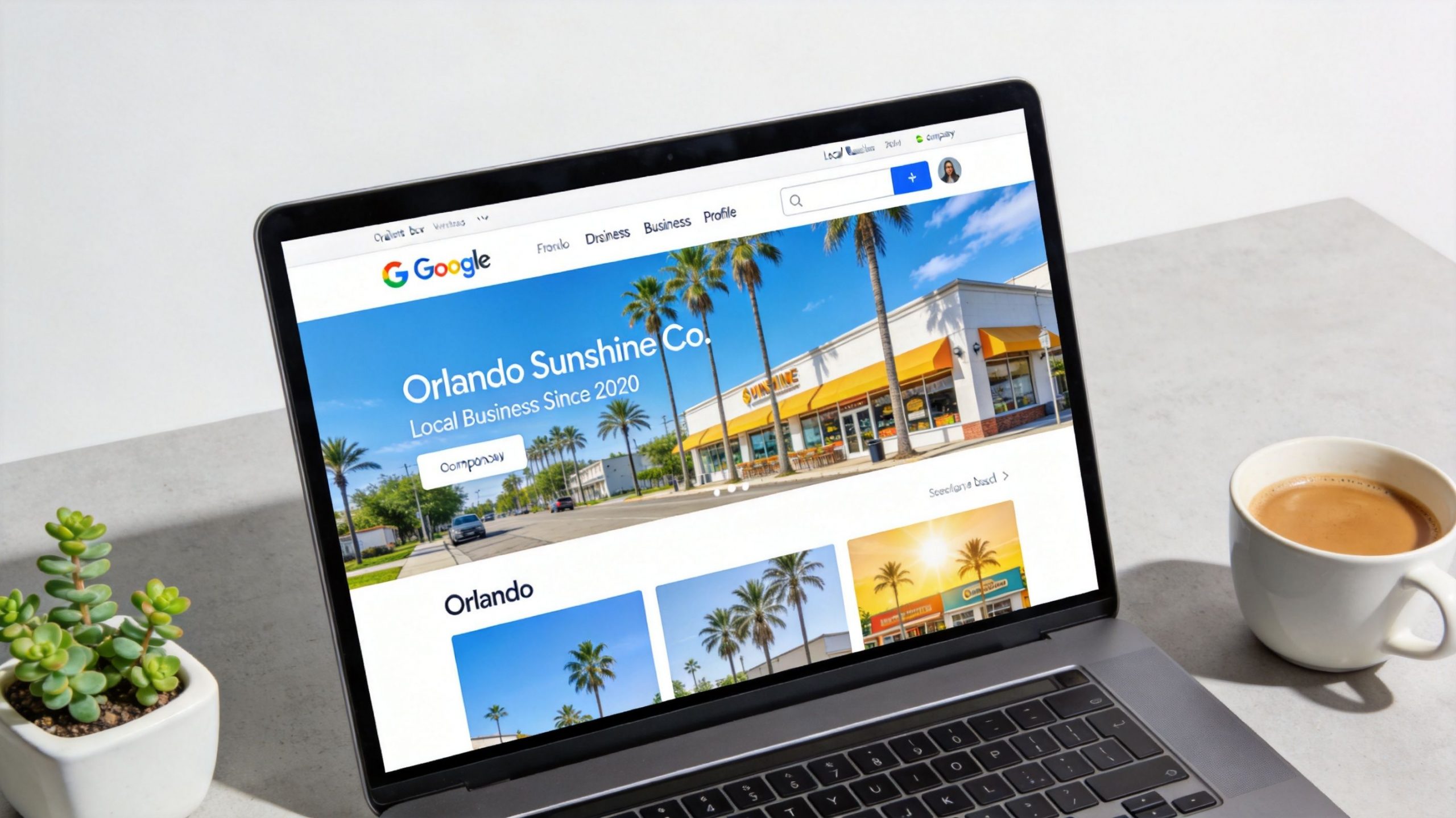
Your Google Business Profile is the front door of your local search presence. For many Orlando businesses, it's the first impression, the first click, and the first lead source.
Start there.
Treat your profile like a sales asset
Owners often treat GBP like a citation. It isn't. It's a live conversion asset that influences whether someone calls, clicks, asks a question, or keeps scrolling.
The first job is completeness. Fill out every legitimate field Google gives you. That includes your primary category, secondary categories, services, service areas, hours, website URL, phone number, business description, and attributes. If you're a service-area business, make that setup match reality. A plumber covering Kissimmee, Hunters Creek, and St. Cloud should define service areas differently than a boutique in Winter Park with a physical storefront.
The second job is accuracy. Don't stuff categories. Don't list services you don't really offer. Don't write a business description that reads like a pile of keywords.
A better approach looks like this:
| Element | Weak version | Strong version |
|---|---|---|
| Primary category | Broad and vague | Closest exact service match |
| Service list | Short and generic | Specific services tied to search intent |
| Description | Keyword-heavy fluff | Clear services plus local context |
| Service area | Too broad | Real neighborhoods and cities served |
What Orlando businesses should fill out differently
A profile built for Central Florida should reflect local behavior. That's especially true in areas where people search by neighborhood, suburb, or landmark.
For example:
- A med spa in Lake Nona should name treatments clearly and reference its location naturally in its description and service setup.
- A family law firm near downtown Orlando should choose legal categories carefully and build out service entries around actual case types.
- A home services company in Seminole County should define service areas with discipline instead of trying to blanket all of Florida.
Practical rule: If a customer can ask about it before calling, answer it inside your profile.
That includes your Q&A section. Seed it with real questions people ask. Parking. Appointment policy. Emergency availability. Insurance accepted. Weekend service. Free estimates if you offer them.
A solid walkthrough of how to optimize Google Business Profile is useful if you want a field-by-field checklist.
The details most owners skip
Photos matter because they reduce uncertainty. Add exterior shots, interior shots, team photos, work examples, and location-specific images that help people recognize your business fast. For a restaurant, that means food and atmosphere. For an HVAC company, that means branded vehicles, technicians, and completed jobs.
Posts can also help keep the profile active when used correctly. Don't post filler. Share actual updates, service highlights, seasonal offers, or common customer questions.
This short video gives a helpful visual overview of what a stronger profile setup looks like in practice:
Most weak profiles don't fail because of one glaring mistake. They fail because of ten unfinished details that add up to a weaker local signal.
Discovering How Orlando Customers Search
Business owners usually describe their services one way. Customers search another way. That gap is where rankings get lost.
If you want local seo orlando to work, stop writing only from your internal vocabulary. Start with the language people use when they need help now.
Broad searches attract browsers
A broad phrase like "restaurants Orlando" or "AC repair Florida" isn't useless, but it's not where many local leads start. High-intent searches are usually more specific and more urgent.
A homeowner with no air conditioning in Lake Mary doesn't search like a marketer. They search like someone sweating in their kitchen. They type things like "emergency AC repair Lake Mary," "air conditioning repair near me," or "HVAC company open now."
The same pattern shows up across industries:
- Legal: "DUI lawyer Orlando" is broad. "Traffic lawyer Orange County FL" is more focused.
- Dental: "Dentist Orlando" is broad. "Lake Nona family dentist accepting new patients" is closer to action.
- Food: "Italian restaurant Orlando" is broad. "Best Italian food near Dr Phillips" signals clearer intent.
Use Google itself as your research tool
You don't need expensive software to get smarter about keyword intent. Google hands you clues every day.
Start typing your main service into Google and watch autocomplete. Look at the map pack results. Check the "People Also Ask" box. Scroll to related searches at the bottom. Those patterns show how real people phrase their needs.
Then compare that language to your website. If your homepage says "residential climate solutions" and your customers search "AC repair in Winter Park," Google's not the one being confusing.
A useful companion resource is this guide to expert keyword research tips for SEO strategy, especially if you want a cleaner process for organizing phrases by intent.
Good keyword research isn't about finding fancy phrases. It's about matching real local demand with the right page.
Think by neighborhood not just by city
Orlando isn't one uniform search market. It behaves more like a cluster of local micro-markets. Winter Garden, Lake Nona, Altamonte Springs, Oviedo, Kissimmee, Maitland, and Sanford all carry different user habits and different competition.
So don't just build around "Orlando" as a single target. Build around how people identify where they are and where they want help. For some businesses, suburb-based service pages make sense. For others, landmark-based phrasing matters more. A shop near UCF may benefit from language different from a business serving Celebration or Baldwin Park.
The rule is simple. If your customers naturally use a place name, your content should reflect it in a useful, non-spammy way.
Building Unshakeable Trust with Citations and Reviews
Google needs proof that your business is real, established, and consistently represented across the web. Customers want the same thing. Citations and reviews handle both jobs.
Many Orlando businesses lose ground. Their site looks fine, but old listings, duplicate profiles, or slow review generation undercut trust.
Bad business data creates ranking friction
If your business name, address, or phone number appears differently across directories, Google has to reconcile conflicting information. That uncertainty weakens local confidence.
According to 57 Clicks' Orlando SEO tips, 73% of businesses have NAP errors that harm rankings. That's not a small cleanup issue. It's a foundational one.
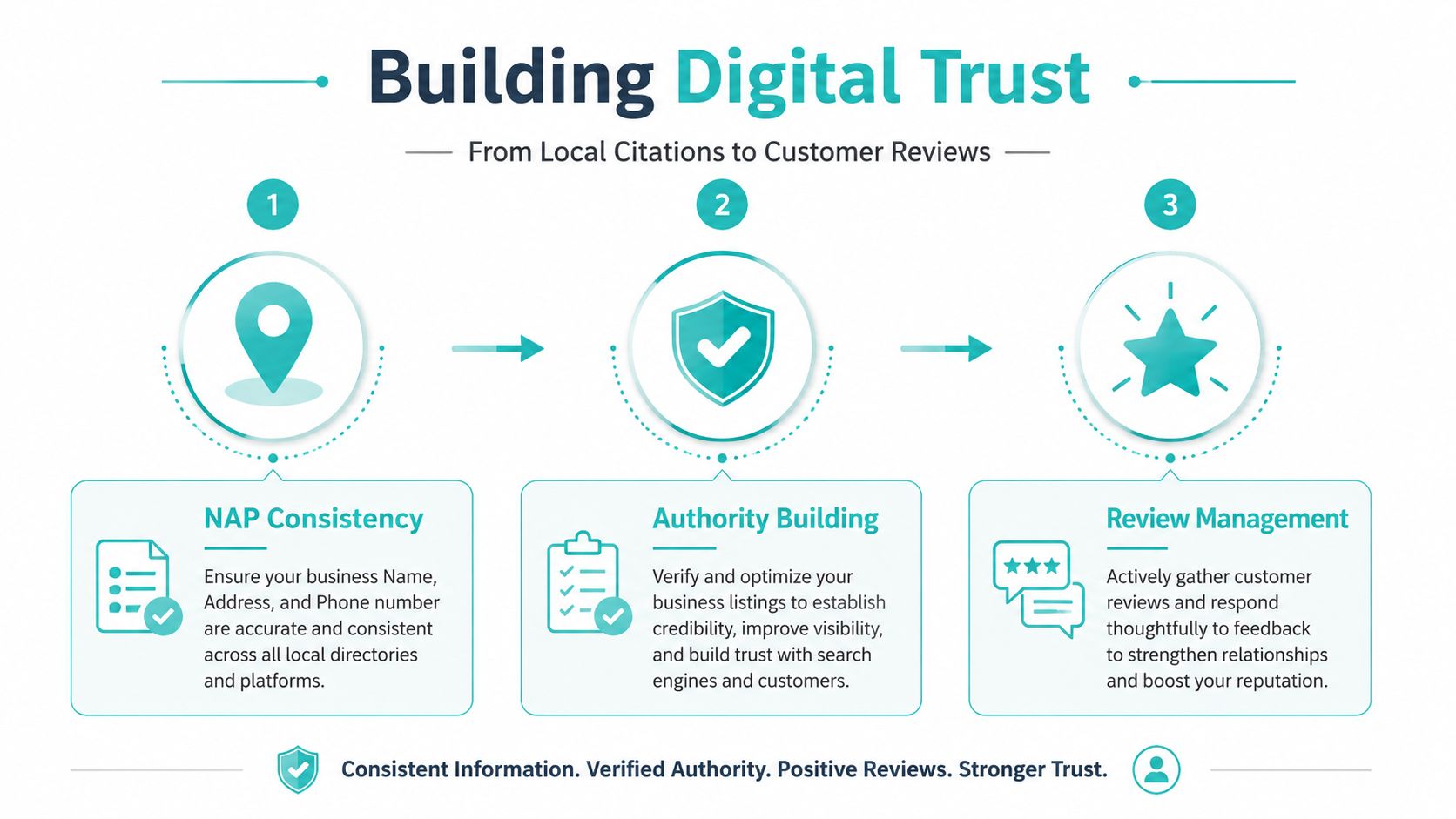
Your NAP should match exactly on your website, Google Business Profile, Apple Maps, Yelp, Facebook, industry directories, and local business listings. If you moved offices, changed tracking numbers, or updated branding, audit everything.
A clean citation process usually looks like this:
- Audit what's already out there. Use tools like BrightLocal or Moz Local to surface inconsistencies and duplicates.
- Pick one canonical version. Lock in one business name, one address format, and one primary phone number.
- Fix major platforms first. Start with Google, Apple Maps, Yelp, Facebook, and top industry directories.
- Add relevant local listings. Orlando-area chambers, neighborhood associations, and local business directories can reinforce geographic relevance.
If you're sorting out the basics, this explanation of what a local citation is gives the right framework.
Review velocity matters more than occasional bursts
Reviews do more than persuade people to trust you. They also tell Google whether your business is active and consistently serving customers.
The same 57 Clicks source notes that a 20% month-over-month growth in positive reviews can yield a 35% uplift in local pack rankings within six months. The important idea isn't just the percentage. It's the pattern. Steady review flow beats random review spikes.
A business with a repeatable review process usually outranks a business that asks only when someone remembers.
That means you need a system, not wishful thinking:
- Ask at the right moment: Right after a successful job, completed appointment, or solved problem.
- Use direct channels: SMS and email requests usually create less friction than vague in-person asks.
- Respond consistently: Thank happy customers, address concerns calmly, and reference the service naturally.
- Show reviews on your site: If you want social proof to support conversion, this guide on customizing Google reviews on WordPress is a practical resource.
A simple trust-building workflow
Don't separate citations and reviews into two unrelated tasks. They work better as one trust system.
A workable monthly routine:
- Week one: Audit business listings and resolve duplicates.
- Week two: Update any outdated service or contact details.
- Week three: Request reviews from recent satisfied customers.
- Week four: Respond to every review and note recurring praise or complaints.
One more practical point. If you're using a marketing partner, ask whether they manage citation cleanup, review workflows, website trust elements, and profile optimization together. Emulous Media Inc handles those local visibility tasks as part of a broader digital strategy that also includes website design, media production, advertising, and AI automation. That's the right direction because local SEO works best when these pieces support each other.
Creating Local Content That Google and Customers Love
Most local business websites fail the same test. Remove the logo, change the city name, and the page could belong to anyone.
That kind of content doesn't win in Orlando. It's too generic for Google and too bland for customers.
Generic pages don't win local searches
A page titled "Roof Repair Services" with a paragraph of broad marketing copy isn't enough. If you serve Altamonte Springs, Winter Park, Oviedo, and College Park, your site should help Google understand that clearly and help customers feel that local familiarity.
That doesn't mean building thin pages that only swap city names. Google sees through that quickly. It means writing pages that reflect the area's needs, language, and context.
A stronger local page includes:
| Content element | What it should do |
|---|---|
| Service headline | Match the actual service people search for |
| Local relevance | Mention the city or neighborhood naturally |
| Real examples | Reference the kinds of property, customers, or issues common in that area |
| Conversion path | Make calling, booking, or requesting help easy |
What strong local pages look like
For home services, the obvious play is location-based service pages. "Roof Repair in Altamonte Springs" is stronger than burying Altamonte in a footer. The same goes for "AC Repair in Lake Mary" or "Drain Cleaning in Winter Garden."
For legal and healthcare businesses, local authority often comes from clarity and specialization. A page about family law in Orlando should answer local concerns in plain language. A page for a pediatric dentist in Lake Nona should address family convenience, appointment expectations, and nearby service context.
Write the page a local customer wants to read, not the page a generic SEO template wants to produce.
You should also support service pages with local proof:
- Neighborhood references: Mention the actual communities you serve when it makes sense.
- Project details: Use real examples of common issues in Central Florida properties and businesses.
- FAQ sections: Answer local questions about timing, service area, scheduling, or regulations in practical terms.
Blog topics that fit Central Florida
Your blog shouldn't exist just to "post content." It should solve local questions that customers already have.
Good Orlando-focused topics tend to come from weather, regulations, seasonality, traffic patterns, neighborhood growth, and lifestyle habits. A few examples:
- Home services: Preparing your home for Florida storm season, signs your AC is struggling in extreme summer heat, what to do after a sudden roof leak.
- Legal: What Orange County drivers should know after a ticket, what to bring to a consultation, how local court logistics affect timelines.
- Healthcare: How to choose a family provider after moving to Central Florida, seasonal allergy questions common in Orlando, when to seek urgent care versus primary care.
- Retail and hospitality: Event-based guides, neighborhood shopping trends, or local buying guides connected to holidays and tourism peaks.
Strong local content does two things at once. It helps you rank for long-tail searches, and it tells a prospect you're part of this market, not just advertising into it.
Advanced Strategies and Measuring Your ROI
Once the basics are in place, the gap between average and dominant local visibility usually comes down to two things: authority building and smarter optimization.
Many businesses often stall. They set up a profile, publish a few pages, get some reviews, then stop. Competitors keep layering on stronger signals.

Local authority is built off your website too
Links still matter in local SEO, but not all links are worth chasing. A mention from a relevant Orlando organization, local publication, chamber site, neighborhood blog, or industry association tends to help more than a random low-quality directory.
The right approach is earned relevance. Sponsor a community event. Contribute useful expertise to a local publication. Partner with nearby businesses. Get listed where real Orlando customers might discover you.
Avoid the usual shortcut trap. Bulk link packages and spammy directory submissions often create more cleanup work than value.
Where AI gives Orlando businesses an edge
A lot of local SEO advice still acts like manual workflows are enough. They aren't if you're competing in a fast-moving market and trying to scale content, profile updates, competitive monitoring, and search behavior analysis.
Emerging data shows that AI-driven local search features can boost local pack visibility by 28% for optimized profiles, yet only 12% of small businesses currently use AI analytics, according to Elit Web's Orlando SEO analysis. The opportunity isn't just novelty. It's speed and adaptation.
AI is useful when it helps with tasks like:
- Spotting query shifts: Seeing how search language changes across Orlando suburbs.
- Improving content briefs: Identifying missing local topics on service pages and blogs.
- Analyzing competitors: Comparing profile completeness, review themes, and page targeting.
- Scaling updates: Refreshing FAQs, service descriptions, and local landing page details more efficiently.
Used badly, AI creates bland, duplicated content. Used well, it helps a strategist make faster and better local decisions.
Track outcomes not vanity metrics
Rankings matter, but they aren't the finish line. What matters is whether local visibility turns into revenue activity.
Track the actions that indicate buying intent:
- Phone calls from Google Business Profile
- Direction requests
- Website form submissions
- Appointment requests
- Qualified leads by service area
If you're not measuring those, you can't tell whether your local SEO is generating business or just movement on a report. This guide to tracking marketing metrics and KPIs is a useful framework for focusing on the numbers that affect decisions.
A mature local strategy doesn't ask, "Did we get more impressions?" It asks, "Did more qualified Orlando-area customers contact us, book, or show up?"
Your Partner in Orlando Growth
Local seo orlando works when the fundamentals are handled with discipline. Your Google Business Profile needs to be complete. Your keyword targeting needs to reflect how people search. Your citations and reviews need to reinforce trust. Your content needs to sound like it belongs in Central Florida.
Most owners can improve pieces of this on their own. Keeping all of it moving consistently is the hard part. That's where an experienced partner becomes valuable, especially when local SEO needs to connect with web design, paid media, conversion tracking, creative, and AI-driven execution.
If your business is ready for a sharper local strategy, Emulous Media Inc can help you turn visibility into calls, leads, and measurable growth. Book a free consultation, call 689-255-6327, or visit the contact page to talk through where your Orlando presence is strong, where it's leaking opportunity, and what to fix first.