Your website looks polished. Your logo is dialed in. You paid for professional photos, wrote service pages, maybe even ran a few ads. But your phone still isn't ringing enough, form submissions are inconsistent, and the businesses showing up on Google don't look half as good as yours.
That's the problem with being online without being discoverable. A website that no one finds is like a storefront built behind a locked gate. It exists, but it doesn't produce.
That's why small business seo services matter. Not because SEO is trendy, and not because agencies like to turn simple ideas into jargon. It matters because search is where buyers go when they need a solution now. If you're not visible there, you're handing demand to competitors in Orlando, Lake Mary, Charlotte, and every market in between.
Table of Contents
- Why Your Business Is Invisible Without SEO
- What Do Small Business SEO Services Actually Include
- Local SEO vs National SEO Which Is Right for You
- Decoding SEO Agency Deliverables and Pricing
- Measuring SEO Success Beyond Rankings
- How to Choose the Right SEO Agency Partner
- Your First Steps to Dominating Search
Why Your Business Is Invisible Without SEO
A buyer in Orlando searches for a service you offer. A competitor shows up in the map pack, another owns the first organic result, and your business is buried far enough down the page that it may as well not exist. That is the actual problem. Small businesses lose revenue because they are hard to find at the exact moment someone is ready to buy.
A website alone does not create demand capture. Search does. If Google cannot connect your pages to the services, locations, and questions your customers are searching for, your business misses high-intent traffic and hands those leads to companies with stronger search visibility.
SEO is a sales channel with a search engine in the middle. Treat it like website decoration and you will get decoration-level results.
Why good businesses still disappear online
The pattern is usually simple. Google struggles to read the site, the content misses buyer intent, or the business lacks enough trust signals to compete.
- The site sends weak technical signals. Important pages are hard to crawl, mobile usability is poor, or the site creates friction before a visitor even reads the offer.
- The content does not match how buyers search. Owners describe the business their way, while customers search by problem, service, and location.
- The business looks less credible than nearby competitors. Thin location pages, inconsistent local signals, and weak topical coverage make stronger competitors look safer to rank.
That is why a polished site can still underperform. Looking professional is not the same as being discoverable.
If agency jargon starts to sound like a different language, use this glossary of essential SEO terminology before you sign anything. You should understand what you are buying, how it ties to leads, and which deliverables affect revenue versus which ones pad a monthly report.
Being online is not the same as competing online
A brochure site says your business exists. Search visibility puts you in front of people with active intent. That gap matters even more in competitive service markets like Orlando and Charlotte, where a few top positions collect the calls, form fills, and quote requests.
Business owners often blame traffic when the actual issue is visibility in the right searches. If you are not appearing for commercial terms tied to your services and service area, start with a practical review of why your business isn't showing up on Google. Find the blockage. Then fix the part that is costing you revenue.
What Do Small Business SEO Services Actually Include
Business owners get burned when agencies sell SEO like a mystery box. You shouldn't buy a mystery box. You should know exactly what's being built and why it matters.
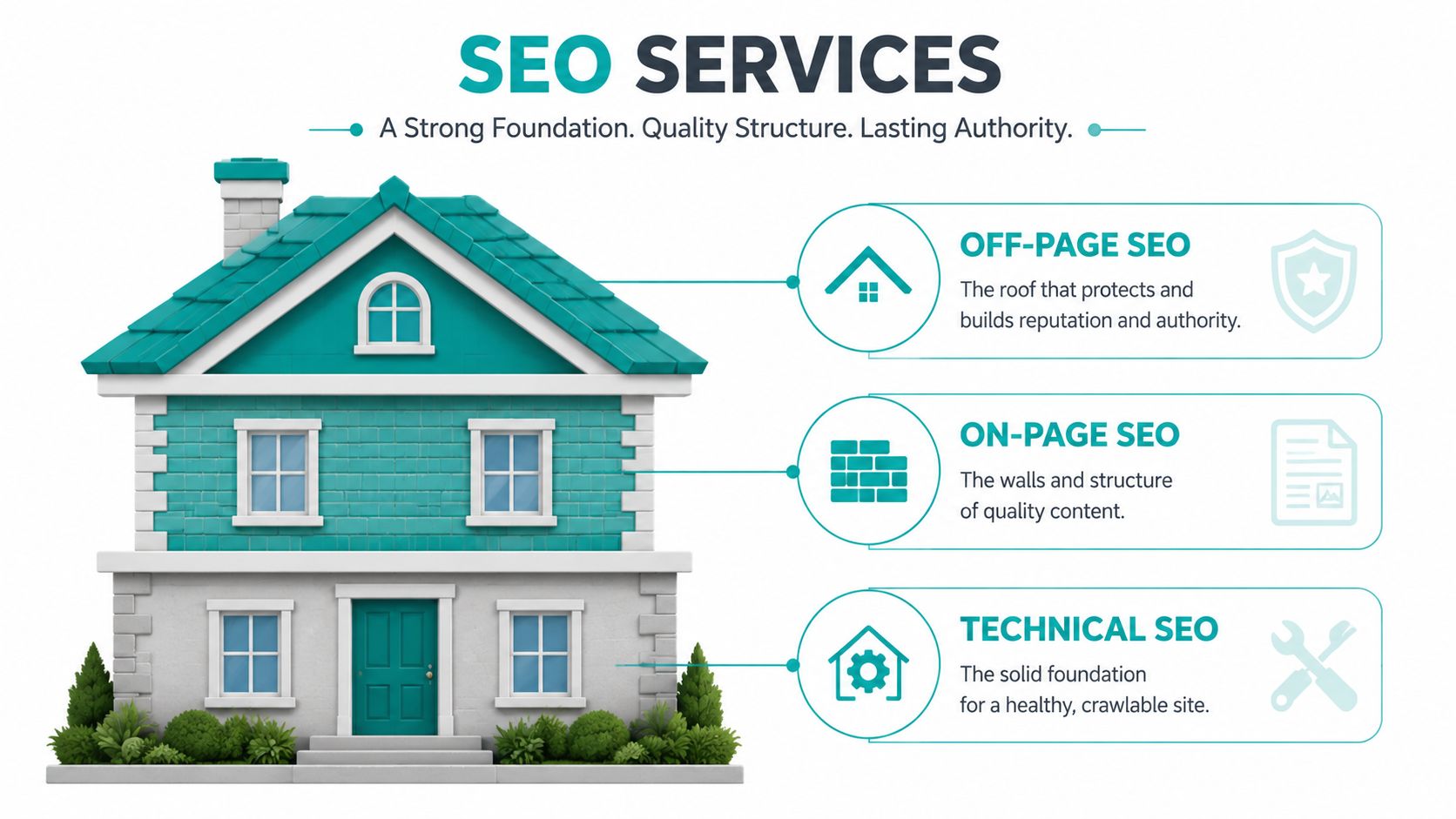
The easiest way to understand small business seo services is to think of your website like a house. If the foundation is cracked, it doesn't matter how nice the furniture looks. If the walls are confusing, visitors won't know where to go. If nobody trusts the neighborhood reputation, fewer people show up in the first place.
Technical SEO is the foundation
This is the part most business owners never see, and it's often the part doing the most damage.
Technical SEO covers crawlability, indexability, site speed, mobile performance, URL structure, XML sitemaps, broken pages, internal linking logic, and structured page hierarchy. If that sounds dry, think of it this way. It's the concrete slab your entire search presence sits on.
According to this breakdown of small business SEO services, achieving Largest Contentful Paint under 2.5 seconds correlates with 24% lower bounce rates and 10-20% higher conversions, while fixing crawl errors can boost indexation rates by up to 30%. That's not academic. It means more of your money-making pages can be found and used.
On-page SEO shapes the rooms people use
Once the foundation is stable, the structure has to make sense.
On-page SEO includes title tags, meta descriptions, page headings, service page copy, image alt text, internal links, and keyword mapping. It's how you tell Google and your customer, “This page is about this specific problem, for this specific audience, in this specific market.”
A strong on-page setup usually includes:
- Service page targeting that matches real buyer searches
- Clear page hierarchy so each page has one job
- Internal linking that moves visitors from general questions to commercial pages
- Local relevance through city, service-area, and trust signals
If your team is active on LinkedIn, optimizing company pages for LinkedIn SEO can support brand visibility beyond your website. It won't replace core SEO, but it can reinforce your credibility footprint.
Content and authority make the house worth visiting
Good content is not blogging for the sake of blogging. It's publishing pages that answer questions, remove objections, and support commercial intent.
Content marketing includes service pages, location pages, FAQs, blog articles, case examples, and supporting assets like video or photography. Off-page SEO includes link earning, brand mentions, citations, review signals, and authority-building across the web. That's your reputation layer.
Practical rule: If an agency only talks about keywords but never talks about site architecture, conversion paths, and authority signals, they're not building a house. They're hanging curtains in an empty frame.
For local businesses, citations also matter because they help search engines confirm your business information across the web. If you're unfamiliar with that piece, here's a straightforward guide to what a local citation is.
Local SEO vs National SEO Which Is Right for You
The wrong SEO strategy wastes money even when the work is done well. A local law firm doesn't need the same search plan as an online jewelry brand. One needs geographic dominance. The other needs broad product visibility across many markets.

Choose local if customers buy within a service area
If you're a plumber in Orlando, a dentist in Lake Mary, or an attorney near Charlotte, local SEO is the smart play. Your buyers are searching for solutions nearby, often with urgent intent. They don't want “a good option somewhere.” They want the right provider in their area.
Local SEO leans heavily on:
| Strategy focus | What it supports |
|---|---|
| Google Business Profile | Map visibility and calls |
| Local landing pages | City and service-area relevance |
| NAP consistency | Business trust across directories |
| Review signals | Buyer confidence and local prominence |
| LocalBusiness schema | Better search understanding |
For businesses in Florida or North Carolina, LocalBusiness schema markup is critical because it can boost click-through rates by 20-30% and influence visibility in Google's local pack and AI-driven search answers.
Choose national if geography is not the constraint
If you run an e-commerce store or a company that can sell across the country, national SEO makes more sense. The playbook changes. You're no longer trying to dominate “near me” searches. You're trying to win product, category, and high-intent informational queries at scale.
A handmade jewelry shop targeting phrases like “gold-plated jewelry for weddings” is a good example. That kind of business benefits from category pages, product schema, topic clusters, and authority content that supports non-local discovery.
Here's the clean distinction:
- Local SEO is about being chosen nearby.
- National SEO is about being discovered broadly.
- Hybrid SEO fits businesses with both local service lines and national offers.
If you're unsure where your business falls, a practical starting point is this guide to national SEO services explained. It helps clarify whether your next growth move should be map pack dominance, broader organic reach, or both.
Decoding SEO Agency Deliverables and Pricing
You get a proposal. It is 12 pages long, full of charts, deliverables, and polished language. Three months later, you still cannot tell what changed on your site, why traffic is flat, or whether the work produced a single qualified lead.
That is the SEO buying problem for small businesses.
A good agency does not sell mystery. It sells a clear plan to increase revenue from search. If a proposal cannot show what work gets done, what pages get priority, and how success ties back to calls, forms, booked jobs, or sales, you are looking at expensive busywork.
What a serious SEO proposal should include
Start with the outcome, then inspect the tasks. You are not buying a pile of monthly actions. You are buying a system that improves visibility for the searches that bring in business.
A strong proposal usually includes a technical SEO audit, a keyword and page strategy, on-page updates, a content roadmap, local SEO work where relevant, and reporting tied to lead generation or sales performance. Larger campaigns may also include schema work, link acquisition, and coordination with your developer or in-house team.
Here is the standard you should use when reviewing agency scopes:
| Weak deliverable | Useful deliverable |
|---|---|
| “Monthly SEO work” | Technical issue list with implementation priority and business impact |
| “Keyword tracking” | Keyword-to-page map based on service lines and buyer intent |
| “Content support” | Editorial plan with page purpose, target query, and conversion goal |
| “Reporting dashboard” | Calls, form submissions, qualified leads, closed revenue, and page performance |
Cheap SEO buys motion. Good SEO buys progress.
One option in this market is Emulous Media Inc, which provides website design, SEO, paid media, media production, and AI automation under one roof. That model can help if your business needs more than rankings. It reduces the common breakdown where one vendor drives traffic, another controls the site, and nobody owns conversion performance.
What you should expect to pay and why
For most small businesses, SEO pricing should reflect the amount of research, implementation, content, and reporting required to produce measurable growth. Local service businesses in Orlando or Charlotte rarely need an enterprise-level campaign. They do need more than a bargain package that spits out a ranking report and calls it strategy.
The pricing split is simple. Lower-cost SEO usually means lighter scope, slower execution, or weaker talent. Higher-value SEO means the agency is spending time on the work that affects revenue: fixing technical barriers, improving money pages, building the right content, and tracking what happens after the click.
Use these four filters before you approve a retainer:
- Research depth. The agency should know which pages and queries can produce leads, not just traffic.
- Technical skill. They should be able to diagnose crawl issues, page quality problems, mobile friction, and weak site structure.
- Content quality. They should write to match search intent and persuade visitors to act.
- Measurement discipline. They should track calls, forms, lead quality, and pipeline impact. A marketing KPI tracking framework makes that standard much easier to enforce.
If an agency promises broad market domination on a tiny budget, assume one of three things is happening. The work is being outsourced at low quality. Core tasks are being skipped. Reporting is padded with numbers that look good and mean little.
Business owners should buy SEO the same way they would buy a sales hire. You would not pay for activity alone. You would pay for a clear plan, accountable execution, and a path to return on investment.
Measuring SEO Success Beyond Rankings
A lot of business owners still ask the wrong first question. They ask, “What keywords will I rank for?” That's understandable, but it's incomplete. Rankings matter only if they lead to calls, form submissions, booked jobs, purchases, and revenue.

Rankings are not revenue
A business can rank for terms that never convert. It can also rank lower for a tighter set of commercial searches and make far more money. That's why generic monthly reports often mislead owners. They highlight visibility movement while hiding whether the leads are real.
A 2025 SEMrush study cited in this analysis of local SEO services found that 68% of small businesses abandon SEO within 6 months due to unclear ROI. The same source notes that 76% of local searches are mobile and often result in a direct call rather than a website click. If your reporting ignores calls and attribution, you're missing the point.
What to track instead
You want a measurement system that follows the entire path from search to sale.
Start with these:
- Qualified organic traffic. Not all visits are equal. Track visits to service and product pages, not just total sessions.
- Phone calls and form fills. Use call tracking and conversion events in GA4.
- Lead-to-customer rate. SEO wins when leads become paying customers.
- Revenue by landing page. Which pages are generating actual business?
A modern stack often includes Google Analytics 4, Google Search Console, call tracking software, CRM tagging, and Looker Studio dashboards. Heatmapping tools can also help you see where organic visitors hesitate, scroll, or drop off.
If your SEO report can't tell you which pages produce leads, it's a status report, not a business tool.
For a practical framework, review this guide to tracking marketing metrics and KPIs. It's the right mindset shift for owners who are done paying for visibility without proof.
How to Choose the Right SEO Agency Partner
A sales call comes in from Google. Your team closes the job. Then you look at your SEO report and get a PDF full of rankings, impressions, and vague notes about "ongoing optimization." That is the problem.
You are not hiring an agency to produce activity. You are hiring one to produce profitable search visibility and explain how that work turns into leads, calls, booked appointments, and revenue. Owners in competitive cities like Orlando and Charlotte get into trouble when they buy a monthly checklist instead of a strategy tied to business goals.

A good agency should make SEO easier to judge, not harder. If they cannot explain what they are doing in plain English, why it matters, and what result they expect, do not sign. SEO is like remodeling a storefront on a busy street. Better layout, stronger signage, and easier entry should bring in more buyers. If all you get is a list of construction tasks, you still do not know whether the job will make you money.
What a strong agency conversation sounds like
The right partner starts with your business model. They ask what a lead is worth, which services drive margin, how long the sales cycle is, and which locations matter most. Then they connect the work to those priorities.
You should hear specifics such as:
- What gets fixed first. They can explain whether your biggest issue is weak service pages, poor local visibility, thin content, technical crawl problems, or low conversion rates.
- How they set priorities. They are not selling the same package to a dentist, a law firm, and a roofing company.
- What you will get each month. You should know whether they are producing location pages, improving internal linking, updating your Google Business Profile, earning links, or cleaning up technical issues.
- How they judge success. The conversation should reach business outcomes, not stop at keyword movement.
Ask them to walk you through a sample roadmap. If the plan sounds like a recycled template, it probably is.
This short video is worth watching if you want a better sense of how to evaluate strategy conversations before signing anything.
Red flags that should end the conversation
Some agency habits signal trouble fast.
- Guaranteed rankings. No agency controls Google, and any firm claiming certainty is selling confidence, not truth.
- Reporting that hides the money trail. If they cannot show how SEO work connects to inquiries and customers, you are buying motion instead of progress.
- Cheap monthly retainers with vague deliverables. Low fees often mean junior labor, thin execution, or risky shortcuts that create cleanup costs later.
- No interest in your website conversion path. Traffic alone does not pay the bills. Your pages need to persuade visitors to call, book, or buy.
- No questions about geography or service mix. Local businesses and multi-market companies need different strategies and different economics.
A good SEO partner sounds disciplined, clear, and accountable.
You should also look beyond SEO in isolation. An agency that understands broader scaling strategies for small business growth will usually make better decisions about budget, timing, and channel fit because they see search as part of growth, not a silo.
If you want a practical baseline before you compare proposals, review this guide on how to increase website traffic organically. It will help you spot whether an agency is offering real strategy or just repackaged tasks.
The best partner gives you clear priorities, honest tradeoffs, and reporting a business owner can use. That is what you are paying for. Not busywork. Not jargon. Results you can trace back to revenue.
Your First Steps to Dominating Search
You don't need to do everything at once. You do need to stop treating SEO like a side project that can wait until “later.” Later usually means after another quarter of missed opportunities.
Step one define the value of a new customer
If you don't know what a new client, patient, customer, or booked job is worth, you can't judge whether SEO is expensive or cheap. A lead channel only makes sense in the context of customer value, sales cycle, and margin.
Write down what one new customer is worth on the front end and, if relevant, over time. That number changes how you evaluate every proposal.
Step two audit what buyers actually see
Search your core services the way a customer would. Check your Google Business Profile, your top service pages, mobile load speed, reviews, page clarity, and whether your site answers the questions buyers ask before they call.
If you want a useful companion read on broader growth planning, scaling strategies for small business growth offers a helpful business lens beyond just search.
Then look at your organic foundation with this resource on how to increase website traffic organically. It's a practical next step if you need to identify where your current visibility breaks down.
Step three get a roadmap before you spend more
Don't buy SEO because someone sent a glossy PDF. Buy it after a real diagnosis. That means understanding your technical issues, your local or national opportunity, your conversion bottlenecks, and your reporting setup.
That clarity is what turns SEO from a recurring cost into a growth asset.
If you want a clear plan instead of another vague proposal, book a free consultation with Emulous Media Inc, call 689-255-6327, or visit the contact page. A smart SEO investment starts with knowing what's broken, what's fixable, and what will drive revenue for your business.