You're probably seeing the same thing most business owners see right now. Every week brings another AI platform that promises more leads, cheaper clicks, better content, and fully automated growth. The demos look polished. The dashboards look smart. Then the tool gets connected to a messy CRM, weak conversion tracking, and a campaign strategy that was already underperforming before AI touched it.
That's where most AI projects stall.
AI driven marketing strategies only work when the business underneath them is organized enough to give AI something useful to act on. If your data is incomplete, your offers are fuzzy, or your tracking breaks between ad click and sale, AI won't fix the problem. It will scale the confusion. For Central Florida service businesses and Charlotte-area e-commerce brands, that usually means wasted ad spend, generic follow-up, and reports that look busy without improving revenue.
The companies getting real results aren't starting with prompts. They're starting with goals, first-party data, clean attribution, and a system for turning insights into decisions. That's the difference between experimenting with AI and building an actual marketing engine.
Table of Contents
- Before the AI Building Your Data Foundation
- Choosing Your AI Marketing Toolkit
- AI Campaign Blueprints for Local and E-commerce Businesses
- Measuring Real ROI from Your AI Marketing
- Common Pitfalls in AI Marketing and How to Dodge Them
- Scaling Your Strategy From Local to National
Before the AI Building Your Data Foundation
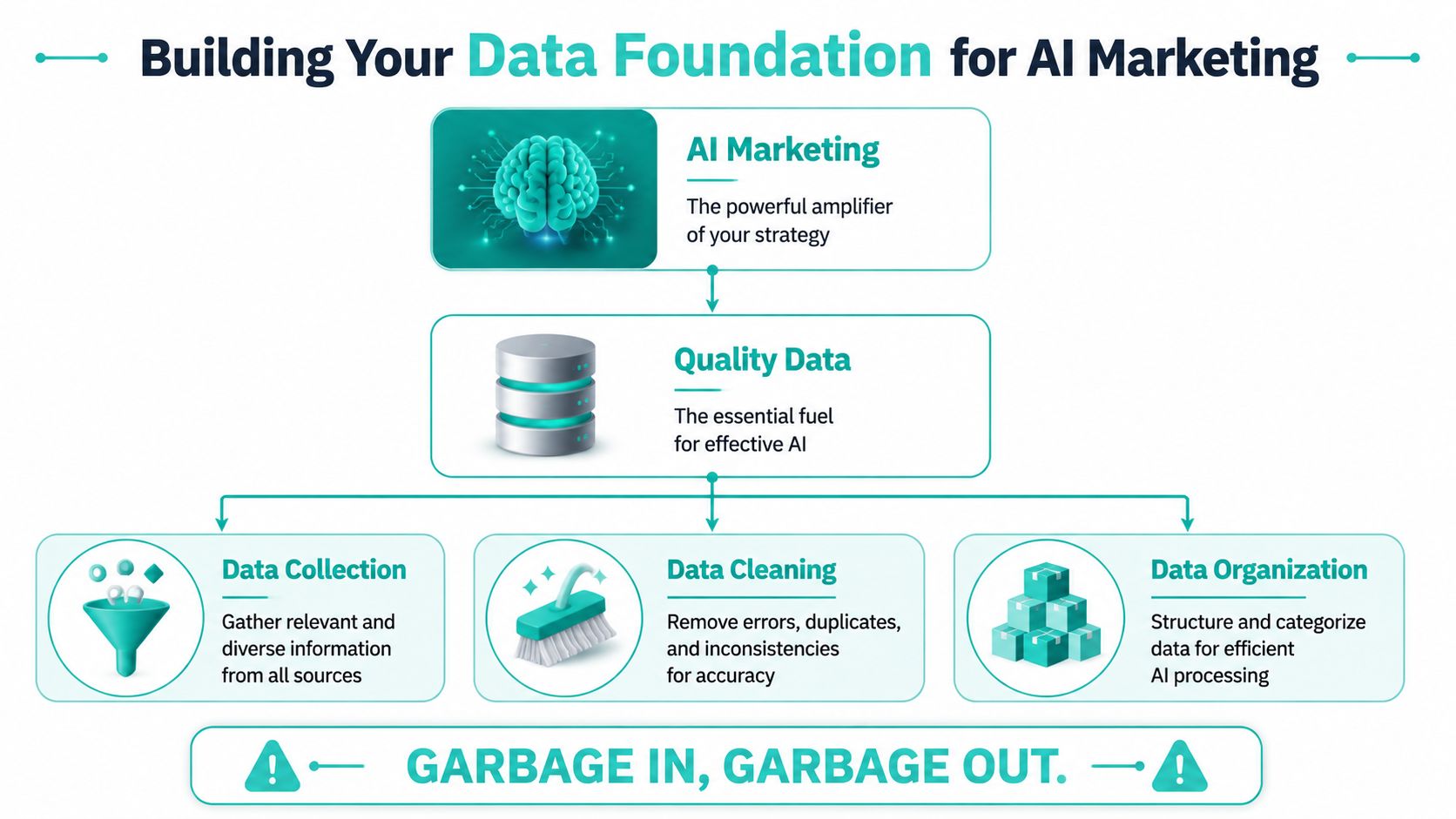
Most businesses try to build AI on top of a shaky marketing setup. That's like building a skyscraper on a swamp. The software may be impressive, but the structure underneath it can't support the weight.
The hard truth is simple. AI is an amplifier, not a magic wand. If your intake process is inconsistent, your sales stages aren't defined, and your website doesn't track meaningful actions, the model will optimize for the wrong thing or fail to optimize at all.
BCG's 2025 research warns that many leaders still approach AI as isolated tool adoption instead of a broader operating model decision. In that same research, CMOs expected AI value to come primarily from marketing effectiveness (57%) and personalization (45%), while noting that leaders who focus only on isolated tools or efficiency gains miss the bigger picture, according to BCG's research on transforming marketing with AI.
Why strategy fails before tools fail
A local business often thinks it has “data” because it has a website, ad account, and CRM. That isn't enough. If lead sources are mislabeled, duplicate contacts sit in the CRM, and booked jobs never flow back into reporting, AI can't distinguish a good lead from a bad one.
An Orlando med spa, law firm, or roofer doesn't need a massive enterprise data warehouse to start. It does need one version of the truth for lead source, customer status, revenue outcome, and conversion events. A Charlotte e-commerce brand needs product-level performance tied to actual customer behavior, not just platform-reported clicks.
Practical rule: Don't buy an AI marketing tool until you can answer three questions clearly. Which actions matter most, where they're tracked, and who owns the data quality.
A strong starting point includes:
- First-party customer data: Clean records from your CRM, booking system, or e-commerce platform. Names, purchase history, lead source, service type, lifecycle stage, and revenue status matter.
- Website event tracking: Form fills, calls, booked appointments, add-to-cart actions, checkout starts, and purchases need to be tracked consistently.
- Historical campaign data: You need enough past performance to compare audiences, offers, creative angles, and landing pages.
- Offer clarity: AI can't rescue a weak value proposition. If your service promise is vague, your outputs will be vague too.
The minimum viable data stack
You don't need complexity first. You need discipline first.
| Foundation element | What it should answer | Common failure |
|---|---|---|
| CRM or store data | Who bought, booked, or became qualified | Leads sit in one bucket with no lifecycle stages |
| Analytics setup | What users did on the site | Traffic is measured, but key actions aren't |
| Ad platform integration | Which campaigns drove outcomes | Platforms optimize for clicks instead of sales |
| Content and offer library | What message fits each audience | One generic message gets used everywhere |
For business owners trying to understand how this turns into action, AI-driven consumer insights are useful only when the source data is trustworthy. That's the part many teams skip.
If your foundation is weak, delay the tool purchase and fix the inputs. That decision usually saves more money than any AI feature ever will.
Choosing Your AI Marketing Toolkit
The market is crowded with AI products, but the decision gets easier when you stop shopping by brand and start buying by business problem. A good stack supports your workflow. A bad stack adds one more dashboard and one more subscription.

SurveyMonkey's marketing data points to where teams are seeing practical value. By 2026, 93% of marketers use AI to generate content 42% faster, AI-driven PPC bid management can cut wasted ad spend by 37% and boost ROI by 50%, and personalized emails can raise open rates by up to 41% in key industries, according to SurveyMonkey's AI marketing statistics.
Start with the problem, not the platform
If you run a service business in Central Florida, your biggest issue might be lead quality, inconsistent follow-up, or wasted spend across broad service-area targeting. If you run a Charlotte e-commerce store, it may be cart abandonment, weak repeat purchase rates, or slow creative testing.
That means your toolkit should be selected in this order:
- Where are you losing money now
- What decision is too slow or too manual
- What data already exists to improve that decision
Good AI tools reduce friction in an existing process. Bad ones create a flashy side process no one maintains.
If you're comparing implementation partners, it also helps to understand how an AI automation agency approaches workflow design and integration. The important question isn't whether a provider uses AI. It's whether they can connect AI to your real operating systems.
The four tool categories that matter
Content generation and optimization
These tools help produce first drafts, ad variations, email copy, product descriptions, and landing page experiments. They're useful when your bottleneck is speed. They're dangerous when you let them publish without editorial control.
An Orlando injury lawyer could use AI to draft practice area page outlines based on search intent, then have a strategist tighten compliance, tone, and differentiation. A Charlotte apparel brand could generate multiple product ad angles for different audience segments, then test which message converts.
Audience segmentation and personalization
This category matters when broad messaging is flattening response. The tool should identify meaningful groups based on behavior, not just age or location.
A local HVAC company might separate emergency repair leads from maintenance-plan shoppers and send completely different follow-up. An e-commerce brand might change homepage offers based on browsing depth, category interest, or prior purchase patterns.
Predictive analytics and lead scoring
AI begins to affect revenue quality, not just marketing output. A useful model ranks leads, estimates likelihood to buy, or flags churn risk.
A roofing company can prioritize inbound requests from areas showing stronger purchase intent after weather-driven demand shifts. A med spa can score leads based on service viewed, repeat sessions, consultation history, and response behavior.
Ad campaign automation and bidding
This category helps when your account already has enough signal to make bid decisions smarter than manual guesswork. It works best when conversion tracking is solid.
A practical stack might include ad automation, CRM syncing, analytics, and large language model workflows. One option businesses evaluate for content systems and workflow support is large language models and LLM applications, especially when they need structured prompt libraries and repeatable output standards.
Don't buy all four categories at once. Most businesses should start with one bottleneck, one clean use case, and one reporting loop. That's how AI becomes operational instead of ornamental.
AI Campaign Blueprints for Local and E-commerce Businesses
The best AI-driven marketing strategies are not broad theories. They are controlled systems tied to one market, one offer, and one conversion path. That is where businesses start seeing the ways AI changes results.

One of the most useful frameworks is straightforward. Define your ideal customer profiles, push those profiles into campaign logic, use AI to detect micro-signals, and adjust based on behavior instead of static demographics. Marketers using this kind of adaptive AI achieved 40% better ROI on multi-channel campaigns, and behavioral cohorts converted 2-3x higher than static demographic targeting, according to this implementation framework for AI-powered marketing.
Local SEO for a Lake Mary legal firm
A local legal practice doesn't need AI to write fifty generic blog posts about the law. It needs AI to find where real search demand and local relevance overlap.
The practical workflow looks like this:
- Content gap analysis: Use AI to compare existing service pages against local intent terms, related questions, and missing supporting topics.
- Entity and topic mapping: Build content clusters around actual legal services, not just broad keywords.
- Review and intake pattern mining: Look for repeated phrasing in calls, chats, and consult forms. Those phrases often become the strongest page headlines and FAQ sections.
A Lake Mary firm could identify that nearby searchers aren't just looking for “attorney.” They're looking for issue-specific help, urgency, location trust, and next-step clarity. That changes page structure, internal linking, and local schema priorities. It also pairs well with geofencing and hyper-local ads when local search and paid visibility need to reinforce each other.
Shopify PPC for a growing e-commerce brand
A Shopify store usually hits a wall when paid traffic scales faster than insight. The account gets more clicks, but product margins, repeat purchase behavior, and audience quality don't keep up.
The AI blueprint here is tighter than most brands expect:
| Stage | AI job | Human job |
|---|---|---|
| Audience input | Cluster past buyers by behavior and product affinity | Decide which clusters deserve budget |
| Bidding | Adjust bids around stronger conversion signals | Protect margin and exclude weak segments |
| Creative testing | Generate variants by angle and offer | Approve voice, positioning, and claims |
| Post-purchase | Trigger retention flows by order behavior | Build brand experience beyond automation |
A Charlotte store selling home decor, apparel, or specialty products can feed first-party buyer data back into paid campaigns so the system optimizes toward customers, not just transactions. That's where the account starts getting smarter instead of spending more.
For businesses building acquisition systems, this overview of AI-powered lead generation strategies is a useful supplement because it focuses on how data inputs shape downstream conversion quality.
This video gives a helpful visual overview of how AI changes live campaign execution.
Email nurturing for a home services company
A Charlotte home services company usually loses deals between inquiry and decision. The problem isn't always lead volume. It's that every lead gets the same follow-up regardless of urgency, budget, or service type.
AI works here when it segments leads based on behavior. Someone who viewed financing details, returned twice, and clicked a repair page should not get the same sequence as someone who downloaded a maintenance checklist. That difference affects booking rate, call center efficiency, and close quality.
The strongest automation feels timely and personal. The weakest automation feels like a machine guessed wrong.
The fix is dynamic nurture logic. Service type, geography, response behavior, page depth, and form content should shape the sequence. Then human staff can step in at the right moment with context instead of cold outreach.
Social engagement and reputation management
Local and e-commerce brands both underestimate how useful AI can be in reading brand sentiment at scale. It's not just about comments. It's about finding signals that tell you when messaging is landing, when service issues are escalating, and when a campaign needs a creative shift.
A restaurant group in Central Florida might use sentiment patterns to flag location-specific service complaints before reviews pile up. An online retailer might notice repeated frustration around shipping communication and adjust both post-purchase messaging and ad expectations.
The campaign blueprint is simple to say and harder to execute well. Feed clean data in. Build audience-specific logic. Let AI surface patterns fast. Keep humans in charge of judgment.
Measuring Real ROI from Your AI Marketing
Most businesses measure AI the wrong way. They look at content volume, click growth, or how many automations were launched. None of that proves financial impact.
A better way to evaluate ai driven marketing strategies is through three lenses: efficiency, effectiveness, and predictive accuracy. If an AI system doesn't improve one of those, it's probably just adding noise.
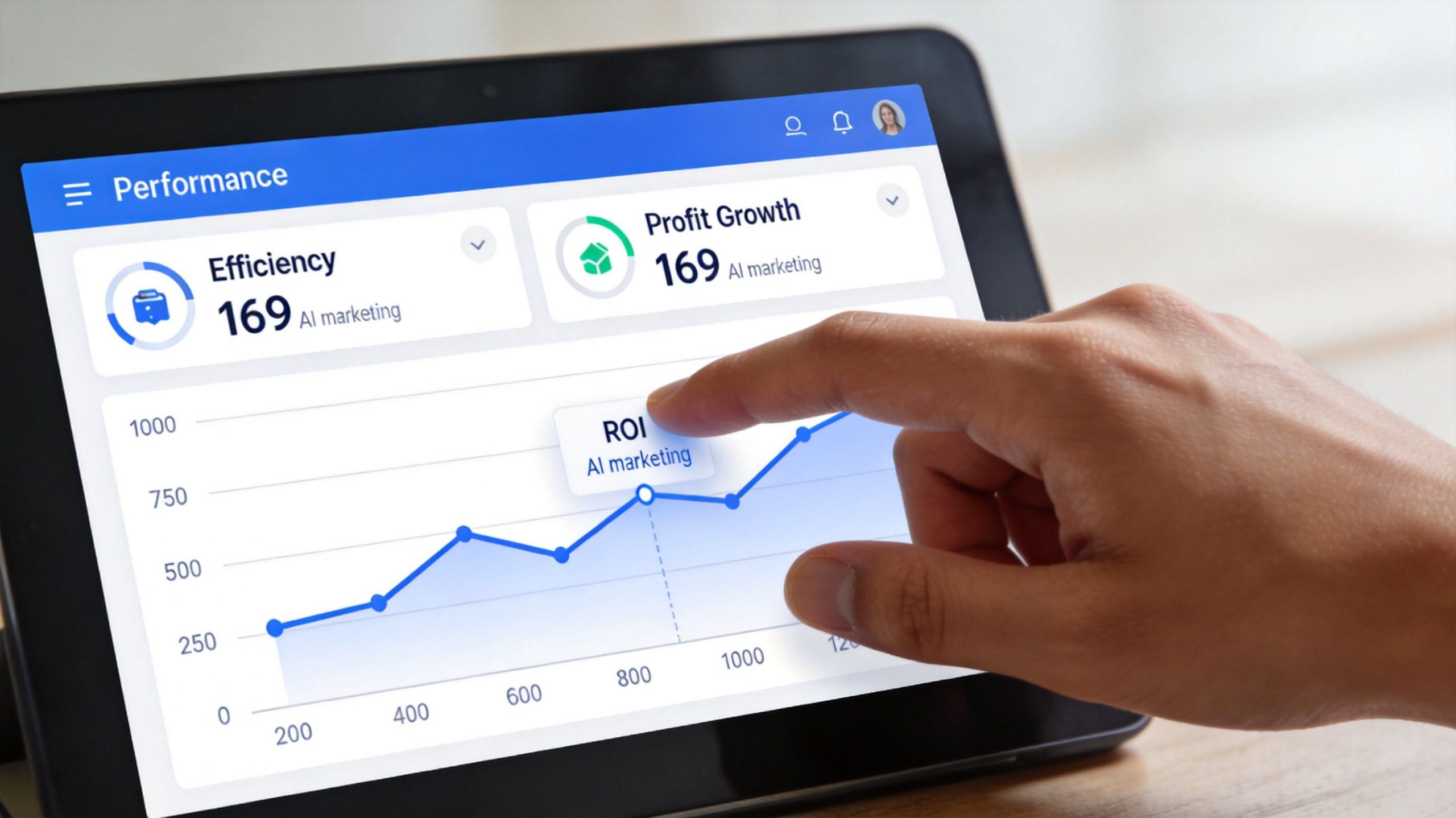
BCG reports that 20% of businesses with deep AI integration boost customer engagement by 25-50%. The same data also notes that AI lead scoring can predict conversions 3x more accurately than manual methods, and optimizing touchpoint timing through AI analysis can lift conversion rates by 30%, according to BCG's blueprint for AI-powered marketing.
Efficiency is the first win
Efficiency is the easiest gain to see, but it's often the least important if it doesn't connect to revenue. Faster content production is useful only if the content supports better conversion paths. Lower manual effort in PPC is useful only if it protects lead quality.
Track items like:
- Production speed: How quickly ads, emails, and landing page variants move from brief to launch
- Workflow reduction: Whether teams spend less time pulling reports or manually segmenting lists
- Spend efficiency: Whether budget waste drops in channels where AI is assisting decision-making
If you manage multiple locations or fragmented reporting, a platform built to optimise local business data can help centralize visibility before you ask AI to optimize anything.
Effectiveness tells you if the market cares
Vanity metrics are filtered out. A campaign can generate more traffic and still be weaker if qualified leads drop. The KPI has to follow the business model.
For a service business, effectiveness usually means stronger booked consultation rates, lower cost per qualified lead, and better close-ready pipeline. For e-commerce, it means higher conversion quality, stronger average order behavior, and better repeat purchase contribution.
What to watch: The winning ad isn't the one with the highest click-through rate. It's the one that lowers your cost per qualified opportunity or increases purchase quality.
Predictive accuracy separates reporting from decision-making
This is the most overlooked category. If your sales forecast, lead scoring, or customer propensity model keeps getting more accurate, your marketing team can shift budget earlier and with more confidence.
That's where attribution matters. Businesses that want a clearer line between channel activity and revenue should pay close attention to marketing attribution modeling, because AI decisions get stronger when attribution gets cleaner.
A useful dashboard doesn't need to be fancy. It needs to answer five questions quickly:
- Which audience is improving
- Which message is fading
- Which channel is wasting budget
- Which leads are most likely to close
- Which actions require human review right now
That's how ROI becomes operational, not just retrospective.
Common Pitfalls in AI Marketing and How to Dodge Them
The fastest way to waste money with AI is to treat it like a replacement for judgment. Businesses do this every day. They let the system write everything, bid everywhere, and make audience decisions nobody on the team can explain.
That approach can work for a short burst. Then the problems show up.
Where businesses go off track
The first mistake is letting AI flatten the brand voice. Service businesses are especially vulnerable here. A dental office, law firm, or home builder can't sound like every other AI-assisted competitor in the market and expect trust to rise.
The second mistake is removing human oversight too early. Businesses leveraging AI across core functions reported an average 32% increase in ROI, and AI-assisted SEO strategies drove a 24% increase in organic traffic, according to these 2025 AI marketing statistics. But those gains aren't automatic. Without human review to catch strategy drift, the performance can erode quickly.
The third mistake is buying black-box software without understanding what the model is optimizing for. If your campaign is chasing cheap leads instead of qualified leads, AI may do exactly what you asked and still hurt the business.
The fourth mistake is ignoring privacy, permissions, and internal governance. If nobody knows what data is being used, where it came from, or how customer records are updated, the system becomes a liability.
What a safer operating model looks like
The fix is not “less AI.” The fix is controlled AI.
Use a hybrid workflow:
- Let AI draft and sort: First-pass copy, segmentation ideas, pattern detection, and bid suggestions are good use cases.
- Keep humans on positioning: Offer strategy, compliance-sensitive language, local nuance, and brand voice still need experienced review.
- Create approval thresholds: Decide what can auto-publish, what needs manual sign-off, and what requires executive visibility.
- Audit outputs regularly: Review lead quality, landing page alignment, search intent fit, and customer feedback.
Don't ask whether AI can do the task. Ask whether your team can verify the task was done well.
That's the discipline that separates sustainable performance from a short-lived spike.
Scaling Your Strategy From Local to National
A local campaign can survive a few manual patches. A regional or national campaign can't. Once you add more locations, more creative variants, more audience segments, and more media spend, weak systems break fast.
What scale actually requires
Scaling starts with the same core pieces discussed above. Clean first-party data. Tight conversion tracking. Clear offer architecture. Human review built into the automation. When those are in place, AI can help a Florida business expand into broader markets without losing control of message quality or spend efficiency.
For e-commerce brands, scale means product feeds, paid media logic, retention workflows, and creative testing all working together. For service businesses, it means local intent, service-area targeting, call handling, CRM stages, and follow-up sequences staying consistent across markets.
That's why the jump from local execution to wider growth usually requires integrated systems, not isolated software. Businesses evaluating that move should look closely at integrated marketing solutions that connect advertising, SEO, websites, media, and automation into one reporting and execution model.
You can build parts of this internally. Many companies do. But the operational reality is that AI multiplies both strengths and weaknesses. If the foundation is right, it accelerates growth. If the foundation is weak, it accelerates waste.
If you want help building a real AI marketing engine instead of piecing together disconnected tools, Emulous Media Inc can map the strategy, data flow, campaign structure, and measurement model around your actual business goals. Ready to build a true performance engine? Book your free, no-obligation strategy session, call 689-255-6327, or visit the contact page to get started.