You might be dealing with this right now. Your business does solid work, your customers are happy, and your team answers the phone. But when someone in Orlando, Lake Mary, Winter Park, or Charlotte searches for the service you provide, a competitor shows up in Google Maps, Apple Maps, and local results while your company barely appears.
That gap usually isn't about who does better work. It's about who has built a cleaner, more trustworthy digital footprint.
One of the most overlooked parts of that footprint is the local citation. It sounds technical, but the idea is simple. Search engines look across the web to confirm that your business is real, located where you say it is, and established enough to recommend. If your details are consistent across the internet, you make it easier for Google to trust you. If they're messy, outdated, or duplicated, you make it harder.
For service businesses, that trust turns into visibility. Visibility turns into calls, quote requests, booked appointments, and revenue. That's why citations aren't busywork. They're infrastructure.
If you've ever wondered why another company keeps showing up before you, this proof of how local SEO works will look familiar. Strong local visibility usually sits on top of strong foundational signals, and citations are one of them.
Table of Contents
- Introduction Why Your Competitors Are More Visible Online
- Unpacking the Core Concept of a Local Citation
- The Real-World Impact of Citations on Your Local SEO
- Critical Citation Mistakes Costing You Customers
- How to Audit and Build Accurate Local Citations
- Your Next Step Toward Local Dominance
Introduction Why Your Competitors Are More Visible Online
Most local business owners assume visibility comes down to website design, ad spend, or reviews alone. Those matter, but they don't solve a basic verification problem. Search engines need repeated confirmation that your business information is accurate across the web before they feel comfortable surfacing you for local intent searches.
Think of citations as digital breadcrumbs. Every accurate mention of your business name, address, and phone number helps search engines connect the dots. Every mismatch creates friction.
A plumbing company with the right service pages and solid reviews can still lose map visibility if old addresses, tracking numbers, or duplicate listings are scattered across directories. A law firm can invest heavily in content and PPC, then leak opportunity because one set of listings says “Suite 200” and another leaves the suite off entirely. A healthcare practice can rank poorly in local search because major listing platforms don't agree on its core details.
Accurate listings don't just help Google. They help real people choose whether to call you, drive to you, or keep scrolling.
This matters even more in competitive local markets. In Central Florida and the Charlotte area, many service searches carry urgency. People don't spend all afternoon comparing ten businesses. They choose from the businesses they can find quickly, trust immediately, and contact without confusion.
Here’s what local citations influence in practical terms:
- Search visibility: They support your ability to appear in local map results and directory searches.
- Customer confidence: Matching business details reduce hesitation when someone wants to call.
- Lead flow quality: Clean listings send people to the right location, the right landing page, and the right phone line.
- Channel performance: SEO, PPC, and website conversion efforts work better when your business data is aligned.
Citations aren't glamorous, and that's exactly why many businesses neglect them. The companies that don't neglect them often become the ones everyone sees first.
Unpacking the Core Concept of a Local Citation
A local citation is an online mention of your business's core contact details, usually your Name, Address, and Phone number, often called NAP. Sometimes the citation also includes your website URL, business hours, categories, photos, or a short description.
The simplest way to understand what is a local citation is to view it as your business being listed in hundreds of digital phone books. If each phone book shows the same business details, search engines gain confidence that the information is reliable. If those phone books disagree, trust drops.
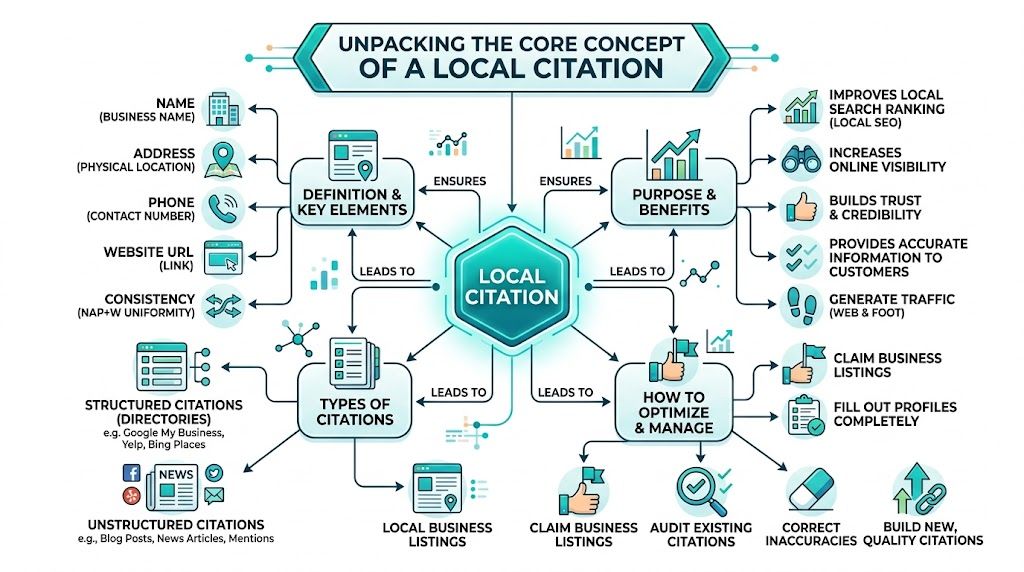
A strong citation strategy supports every other local search effort, which is why it belongs inside a broader search engine optimization strategy instead of being treated like a one-off admin task.
Your NAP is the fingerprint
Your NAP isn't just contact info. It's your business fingerprint.
Search engines compare your business details across directories, maps, social platforms, and mentions on other websites. When that information matches, the business looks legitimate. When it doesn't, the signals become muddy.
According to Moz's guide to local citations, local citations fall into structured listings such as Yelp and Yellow Pages, and unstructured mentions such as blogs and news sites. The same source notes that Google's algorithm treats NAP consistency as a primary relevance factor, and when NAP appears identically across 50+ high-authority directories, it can boost verification trust by up to 30-50% in local pack rankings.
That tells you something important. Search engines aren't just looking for mentions. They're looking for matching mentions.
Structured and unstructured citations
Not all citations look the same, and that matters.
| Citation type | What it looks like | Common examples | Why it matters |
|---|---|---|---|
| Structured | A formal business listing with defined fields | Google Business Profile, Yelp, Yellow Pages | Easy for search engines to parse and compare |
| Unstructured | A mention inside regular content | Blog posts, local news stories, community pages | Adds context and reinforces legitimacy |
Structured citations are the foundation. They give platforms clean, consistent business data in a format machines can read easily.
Unstructured citations add breadth. If a local news site mentions your company, or a neighborhood blog lists your business in a roundup, that mention can still reinforce your local presence even if it isn't in a directory format.
Practical rule: Start with the listings you control directly. Don't chase press mentions while your core directories still show old information.
What works is consistency, completeness, and priority. What doesn't work is submitting to random low-value directories while your major listings remain unclaimed or inaccurate.
The Real-World Impact of Citations on Your Local SEO
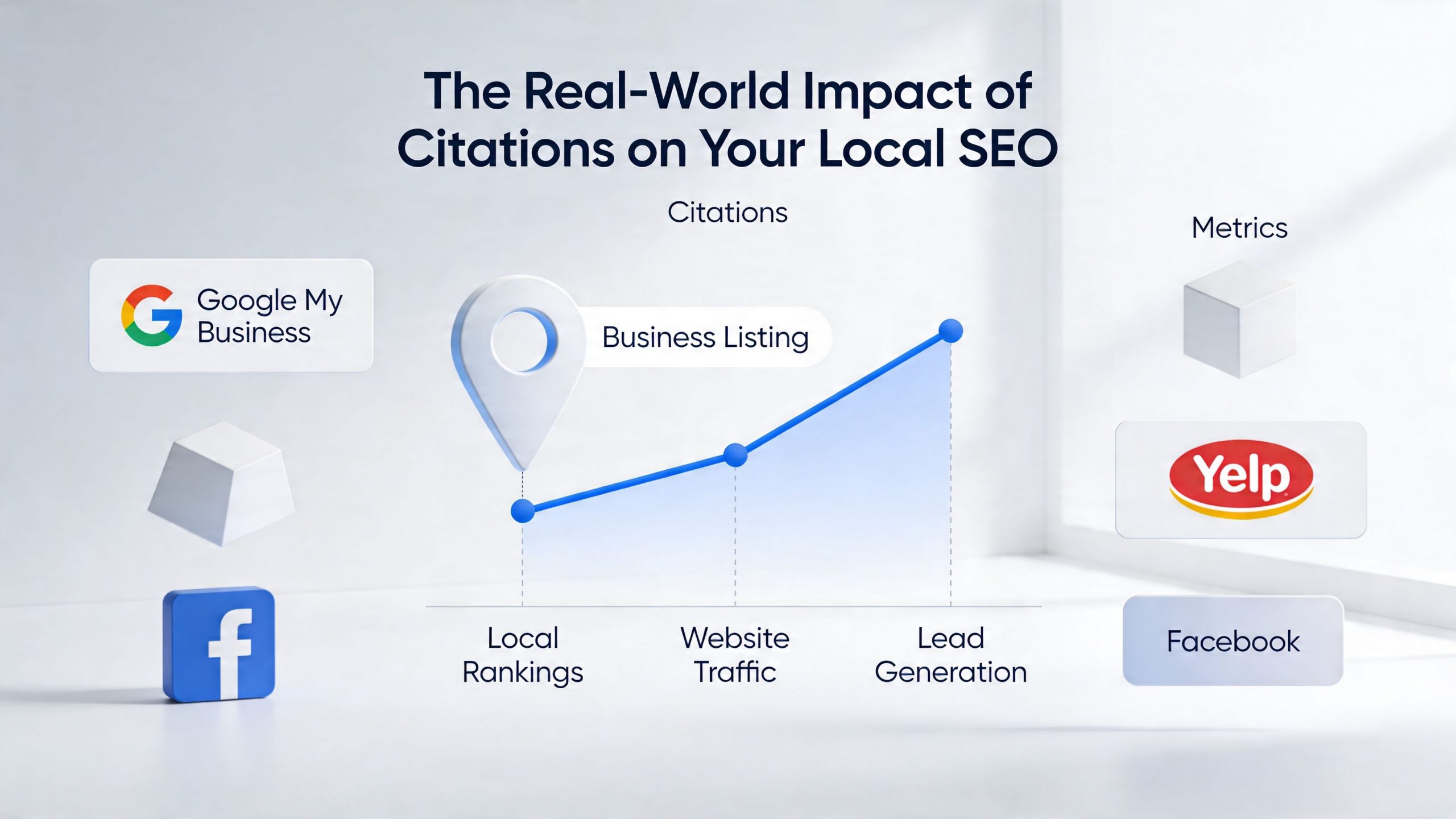
A lot of business owners hear “citation building” and think of it as technical cleanup with vague SEO value. In practice, citations affect whether your company shows up where buying decisions happen. That means the map pack, local finder results, branded searches, and platform searches inside apps people use every day.
Why Google cares about citation depth
Google uses multiple local ranking signals, but citations play a direct role in how prominent and trustworthy your business appears.
According to WordLead's local citation statistics, local citations are the third most important local ranking factor, with a 13.3% influence on ranking position. The same source reports that top-ranking local businesses average 81 citations, which gives business owners a useful benchmark for how much confirmation Google often sees behind strong local performers.
For a service company, that's not abstract. If you're trying to rank for city-based intent searches, your citations help validate that you're established in the area you serve.
That's also why keyword targeting and citation work need to align. If you're building service pages and Google Business Profile categories around location intent, your citation profile should reinforce those same signals. This guide to local SEO keywords from Sight AI is useful if you're mapping service terms to specific cities and service areas.
How citations support leads, not just rankings
The business value shows up in more than one place.
- Map pack exposure: Clean citations support your ability to appear in the local results users notice first.
- Voice and mobile discovery: If someone searches on the go, consistency helps platforms trust the business details they surface.
- Call quality: Accurate listings reduce wrong-number calls and wasted leads.
- Website engagement: A person who sees matching details across Google, Apple Maps, and directories is more likely to trust your website when they land there.
A good local strategy connects these pieces instead of treating them as separate checklists. That's why businesses that want stronger local visibility usually need more than just a website refresh. They need alignment across listings, content, technical SEO, and conversion paths, which is also why these Lake Mary local SEO tips matter more when they're executed together.
If your competitors appear everywhere and your business appears inconsistently, search engines aren't the only ones noticing. Prospective customers are noticing too.
What works is building a citation profile that supports your service geography and category relevance. What doesn't work is assuming one claimed Google listing is enough.
Critical Citation Mistakes Costing You Customers
Bad citation management doesn't fail loudly. It fails subtly. Your rankings soften, your map visibility slips, and your competitors absorb demand that should have found you first.
The inconsistency problem
The biggest issue is inconsistent NAP data. That includes obvious errors, but it also includes operational clutter. A tracking number appears on one listing. An old office address lives on another. Facebook has one version of your name, Apple Maps has another, and an old directory still lists a former suite number.
According to Seobility's local citation overview, inconsistent NAP can drop map pack visibility by 20-40% in competitive markets like Orlando or Charlotte. The same source states that exact NAP match is the #2 local ranking factor, and businesses that fix citation errors often see a 15% traffic uplift within three months.
If you're a business that depends on inbound calls, that's not a minor technical issue. It's a sales issue.
What business owners usually miss
The obvious mistakes aren't the only ones that hurt. These are common problems that drag performance down:
- Duplicate listings: Two versions of the same business split trust signals and confuse users.
- Old location data: A previous address can keep circulating long after a move.
- Unclaimed profiles: If you don't control the listing, bad data can stick around.
- Inconsistent business naming: Adding extra keywords in one place and using the legal name elsewhere creates unnecessary variation.
- Neglected niche directories: Industry-specific listings often carry more practical value than another generic directory submission.
A messy citation profile makes your business look less certain, less established, and less trustworthy than it really is.
There's also a trade-off business owners often get wrong. They focus on building more listings before fixing the broken ones. That's backwards. If the foundation is inconsistent, adding volume just spreads the problem further.
A clean citation profile doesn't guarantee top rankings by itself. But a dirty one can absolutely suppress performance even when the rest of your marketing is solid.
How to Audit and Build Accurate Local Citations
Citation management is one of those tasks that sounds simple until you start. Then you realize your business exists in more places than you thought, under more variations than you expected, with more duplicate records than anyone on your team wants to clean up manually.
Start with one official version of your business data
Before you touch any platform, define the exact version of your business information that will be used everywhere.
Use one official format for:
- Business name: Decide whether you'll include legal suffixes, and keep it consistent.
- Address: Choose one formatting standard and stick to it.
- Phone number: Use the primary number you want customers to call.
- Website URL: Pick the canonical version and avoid switching between variants.
- Core business details: Hours, categories, and short descriptions should also stay aligned.
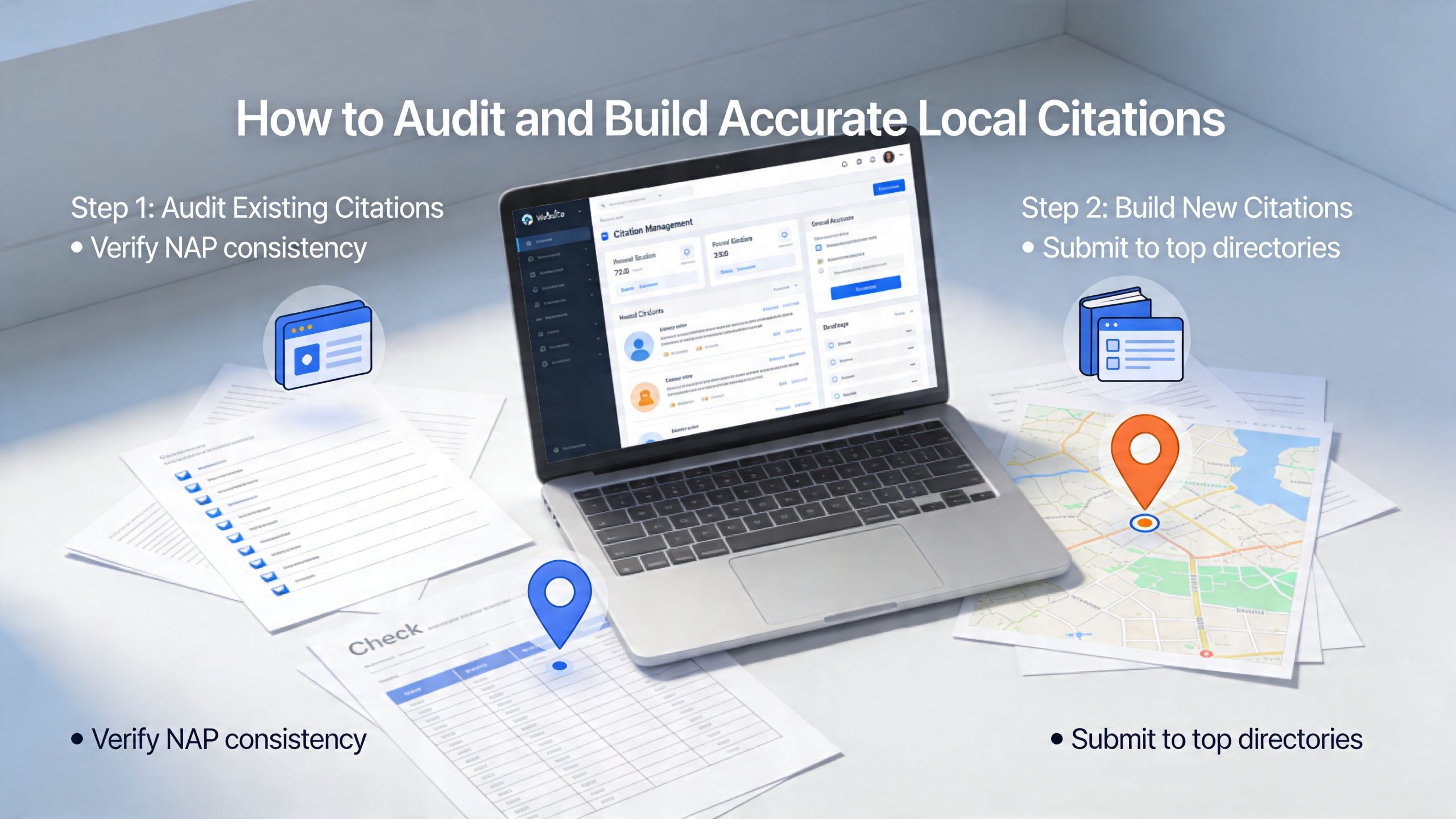
Then run an audit. Search your business name, old phone numbers, old addresses, and common name variations. Check major platforms first, then mapping apps, social platforms, niche directories, chambers, and local business listings.
A lot of agencies and in-house teams use platforms like BrightLocal or Moz Local for this process. Some businesses also use managed local listing services through their SEO provider. For companies that want this handled as part of a broader strategy, Emulous Media's answer engine optimization approach fits naturally alongside local listing accuracy because both rely on clean business entity signals.
Build in the right order
Don't submit blindly. Prioritize in layers.
- Claim and correct your core profiles first. Google Business Profile, Apple Maps, Facebook, Bing, Yelp, and other major directories come before anything else.
- Clean duplicates before expanding. If multiple records exist, remove or merge them so authority isn't split.
- Move to industry-specific sites. Lawyers should care about legal directories. Healthcare providers should care about medical listings. Home service companies should focus on platforms buyers already use.
- Add geo-specific opportunities. Local chambers, regional business directories, and reputable city sites can reinforce local relevance.
- Monitor over time. Citations drift. Platforms update fields, pull data from other sources, and occasionally create duplicate entries.
A short comparison helps clarify the trade-off:
| Approach | Result |
|---|---|
| Build random listings fast | More clutter, weak control, hard cleanup later |
| Audit first, then build strategically | Cleaner trust signals and better long-term stability |
Strong citation work is repetitive, detail-heavy, and worth doing correctly the first time.
What works is disciplined cleanup, prioritized claiming, and selective expansion. What doesn't work is treating all directories as equally valuable.
Your Next Step Toward Local Dominance
By now, the answer to what is a local citation should be clear. It's not just an online mention. It's part of the trust framework that helps search engines verify your business and helps customers feel confident enough to contact you.
For local businesses, especially service-based companies, citations sit at the base of the lead generation stack. They support visibility, reduce confusion, and strengthen the signals behind your local SEO efforts. If that base is unstable, every other tactic has to work harder.
That includes paid ads. It includes your website. It includes your content strategy. A business can spend good money driving traffic and still lose revenue because the market sees mixed signals about who they are, where they are, or how to reach them.
There’s also a practical reality. You can manage this yourself, and some business owners do. But it takes patience, process, documentation, and follow-up. For most owners, that time is better spent running operations, closing deals, serving clients, and leading the business.
If your listings are inconsistent, duplicated, outdated, or incomplete, fixing them is one of the cleanest ways to strengthen your digital foundation. If your citations are already in decent shape, refining them can support stronger map visibility and better conversion paths.
When you're ready to turn listing cleanup into a broader local growth plan, request a proposal and get clarity on where your digital presence is helping you, and where it's holding you back.
If you want a practical review of your local visibility, book a free consultation with Emulous Media Inc, call 689-255-6327, or visit the contact page to talk through your citation profile, local SEO setup, website performance, and the next steps to make your business the go-to option in your market.