Your firm may have decades of legal experience, a solid referral base, and clients who appreciate your work. Yet when a family in Orlando searches for help with a will after the birth of a child, or an adult child in Charlotte looks up probate guidance after losing a parent, your firm may be nowhere to be found.
That gap is expensive.
SEO for estate planning attorneys isn't a branding exercise. It's client acquisition infrastructure. If your website, local listings, content, and technical setup don't align with how people search, Google sends those prospects to firms that invested earlier and executed better. The firms winning online aren't always the most experienced. They're the most visible, the clearest, and the easiest to contact in the moment of need.
Table of Contents
- Why Your Firm Is Invisible to Your Next Best Client
- Building Your Digital Foundation for Client Trust
- Dominating Local Search and Your Google Business Profile
- Creating Content That Attracts and Converts Clients
- Essential On-Page and Technical SEO for Law Firms
- Ethical Link Building to Signal Authority and Trust
- Measuring What Matters and Turning Traffic into Clients
Why Your Firm Is Invisible to Your Next Best Client
A lot of estate planning firms have the same problem. They're respected offline and weak online. The partner assumes referrals will keep carrying the practice, while competitors with cleaner websites, sharper local SEO, and stronger Google Business Profiles capture the people who don't already know a lawyer.
That's the part many firms underestimate. Search demand is already there. Estate-planning-related keyword volume grew from an estimated 361,400 monthly searches in 2021 to 733,760 by 2024, more than doubling in four years, according to VIP Marketing's estate planning lawyer SEO analysis. If you serve a market like Orlando or Charlotte, that means people are actively looking for wills, trusts, probate help, and local legal guidance right now.

The firms that rank don't just get “traffic.” They get first contact with high-intent prospects. In estate planning, first contact matters because trust forms early. If a prospect lands on a page that answers their exact question, explains the process clearly, and offers an easy next step, that consultation often goes to the visible firm, not the more qualified invisible one.
Visibility problems usually start before SEO work even begins
Most firms blame rankings. Often the primary issue is weaker digital positioning:
- The site talks like a lawyer, not a client: “Advanced testamentary planning” doesn't match how people search.
- Service pages are too thin: A short paragraph on trusts won't compete with a robust local page.
- Local signals are inconsistent: Google sees mixed business details and hesitates.
- Conversion paths are clumsy: If someone can't call or book in seconds, they leave.
Your next best client isn't comparing every lawyer in town. They're comparing the few firms Google put in front of them.
If your firm has ever asked why it's not appearing where it should, this guide on why a business may not be showing up on Google is a practical place to diagnose the blind spots.
Building Your Digital Foundation for Client Trust
SEO for estate planning attorneys starts with a simple truth. Google ranks pages that match intent, and people hire firms that feel credible within seconds. Your website has to do both.
A 2025 law firm traffic survey found that 53% of website visits came from organic search, making it the largest traffic source by a wide margin, according to Forward Push's review of SEO for estate planning lawyers. If your site architecture is weak, you're not just losing rankings. You're undermining the channel that drives the largest share of legal website traffic.
Start with client language, not legal labels
Keyword research for estate planning firms should begin with actual client situations. Not broad vanity terms. Not whatever your competitors stuffed into footers.
Think in buckets:
| Client situation | Better page/topic angle |
|---|---|
| New parents | guardianship planning, wills for young families |
| Retirees | trust planning, incapacity documents, asset transfer |
| Adult children after a death | probate process, executor guidance |
| Business owners | succession planning, trusts, asset protection coordination |
That approach changes the site from a brochure into a decision tool. Someone searching “living trust lawyer in Orlando” needs a different page than someone searching “do I need probate in North Carolina.” Give each intent its own destination.
For firms evaluating how paid and organic search can support one another, Come Together Media LLC lawyer ads consulting offers a useful perspective on legal search marketing from the case acquisition side.
Structure the site like a decision path
A high-performing estate planning website should feel obvious to use. Not clever. Not abstract. Obvious.
Use a structure like this:
- Core service pages for wills, trusts, probate, powers of attorney, and related work.
- Location pages for the cities or regions you serve.
- Attorney bio pages that show credentials, focus, and personality.
- FAQ and resource content tied to real client concerns.
- Clear consultation paths in the header, body copy, and mobile interface.
Practical rule: Every important service should have its own page, its own search intent, and its own call to action.
If your current website doesn't support that structure, it's not a design problem alone. It's a revenue problem. A custom build focused on trust, speed, and lead flow usually outperforms a generic legal template, especially in competitive local markets. This breakdown of custom website design shows what to prioritize before you spend money on more traffic.
Dominating Local Search and Your Google Business Profile
Local SEO is where estate planning firms win or lose the easiest opportunities. Your prospects usually want someone nearby, licensed in their state, and available to answer sensitive questions without friction. If your local presence is weak, your competitor with fewer credentials but stronger local execution will keep getting the calls.
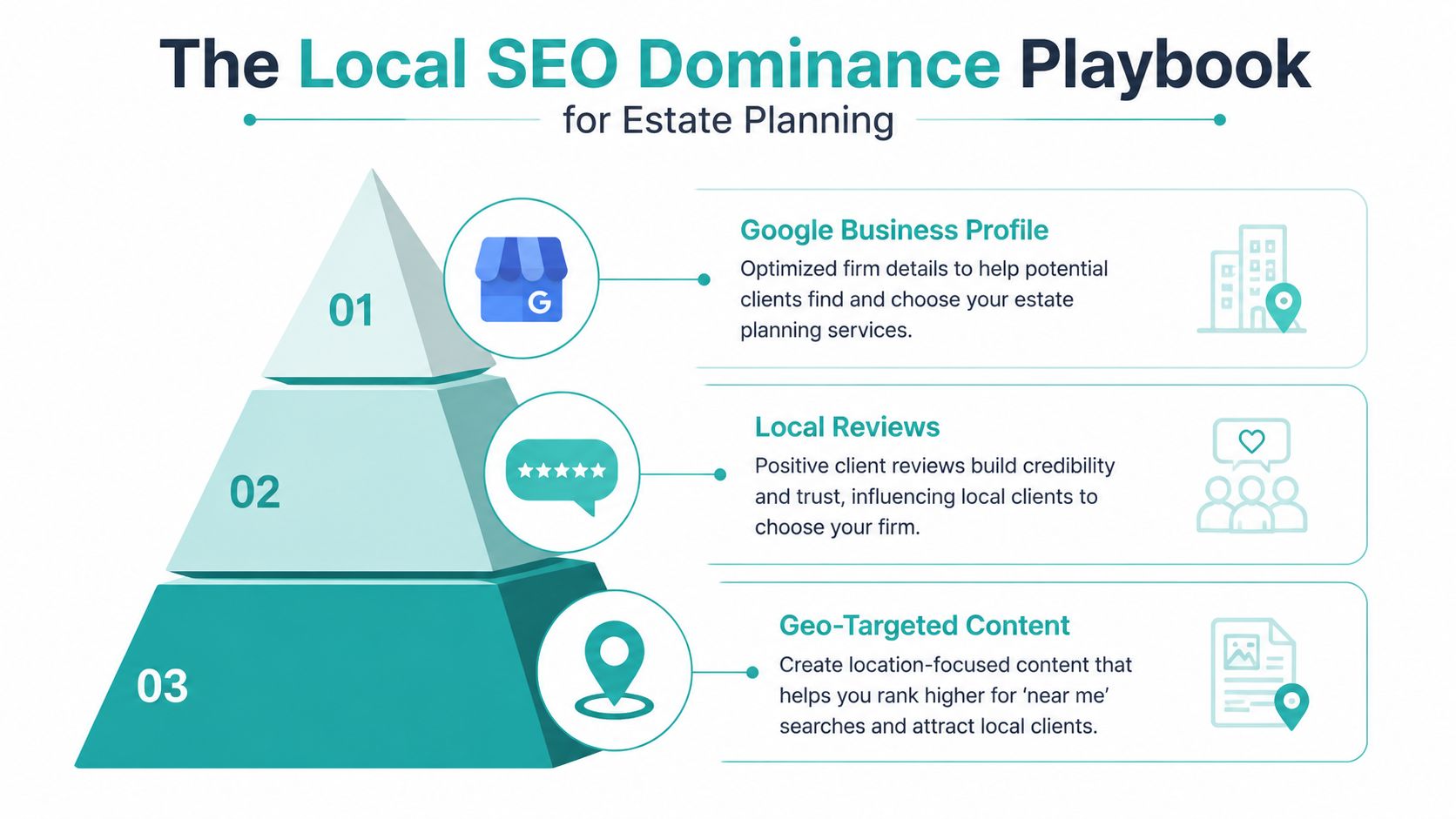
The strongest local setup has three parts working together: Google Business Profile, reviews, and geo-targeted website content.
Treat your Google Business Profile like a practice area page
Most law firms underuse their Google Business Profile. They claim it, add a logo, and stop. That's lazy.
A strong profile should include:
- Accurate primary and secondary categories: Your listing should clearly reflect estate planning and related legal services.
- Complete services: Add wills, trusts, probate, powers of attorney, and similar matters where appropriate.
- Business description written for humans: Mention your markets, your focus, and the types of clients you help.
- Q&A content: Seed common questions prospects ask before they call.
- Fresh posts and photos: Keep the listing active and credible.
A significant and growing share of high-intent searches happens on mobile or through voice search during stressful decision moments. That's why terms like “estate planning attorney near me open now” and mobile actions like click-to-call matter, as noted in Daniel Solin's discussion of SEO for estate planning attorneys.
Reviews, NAP, and mobile intent work together
Local rankings don't come from one trick. They come from consistency.
Here's the practical local playbook:
- Get reviews steadily: Don't ask once every few months. Build a repeatable process after a successful matter or meaningful client milestone.
- Keep NAP consistent: Your name, address, and phone number must match across your site, legal directories, and local citations.
- Build location relevance on-site: Create city-specific and service-specific pages instead of stuffing all cities into one paragraph.
- Make mobile contact effortless: Sticky call buttons, short forms, and tap-to-call functionality matter because many estate planning searches happen in moments of urgency.
If a prospect has to pinch, zoom, hunt for your phone number, or guess whether you serve their city, you already lost them.
For firms tightening local visibility, this guide on how to optimize a Google Business Profile covers the operational details that usually move rankings and map visibility.
Creating Content That Attracts and Converts Clients
Most estate planning content fails because it's written from the firm's perspective. It lists services, repeats legal terms, and says almost nothing about the client's actual problem. That won't rank well, and it won't convert well either.
Good content meets people at emotionally specific moments. A couple just had their first child. A widow is trying to understand probate. A business owner wants to protect family assets without creating a future mess. Those are content opportunities with commercial intent.

Write for life events, not for your sitemap
A useful content calendar for seo for estate planning attorneys looks more like a client intake log than a marketing brainstorm.
Examples:
- New parent search intent: “Do both parents need a will if we have young kids?”
- Recent loss search intent: “What happens first in probate in Florida?”
- Blended family concern: “How can a trust protect children from a prior marriage?”
- Aging parent issue: “When should a durable power of attorney be updated?”
Those topics work because they lower anxiety while proving competence. They also create natural paths to consultation pages.
If you want a broader framework for how firms scale authority through professional services content, that resource is worth reviewing. The key takeaway is simple. Expertise becomes visible only when it's packaged in a format people will consume.
Use content formats that lower anxiety fast
Blogs matter, but they aren't enough by themselves. Estate planning firms should use multiple content formats because trust builds faster when people can choose how they learn.
A stronger mix looks like this:
- Service pages with embedded FAQs: Good for ranking and conversion.
- Short videos answering one question each: Good for reassurance and time-on-page.
- Downloadable checklists: Useful for lead capture when the topic justifies it.
- Comparison pages: For example, wills versus trusts, or probate versus trust administration.
- Local guides: Focused on state-specific and city-specific legal realities.
This video format is a good example of content that can support education without overwhelming the visitor:
The best legal content doesn't try to impress peers. It helps a worried prospect make the next decision.
One useful test is this. If a page ranks but doesn't produce calls, it probably answers the topic without guiding action. Add consultation prompts, attorney context, related links, and next-step language. This guide on how to increase website traffic organically is useful if your firm needs both stronger reach and better content targeting.
Essential On-Page and Technical SEO for Law Firms
Technical SEO sounds intimidating to lawyers because agencies often make it sound mysterious. It isn't. It's operational housekeeping. Google needs to crawl your site, understand what each page is about, and trust that users will have a good experience when they arrive.
If your website is your digital office, technical SEO is the difference between a clean front desk and a pile of unlabeled files.
Fix the signals Google reads first
Start with the basics that directly influence visibility and clicks:
- Title tags: Each service page needs a clear, location-aware title that matches search intent.
- Meta descriptions: These don't guarantee rankings, but they strongly affect whether someone clicks.
- Header structure: Use one clear H1 and logical subheadings that support readability.
- Internal links: Connect related pages so authority flows to the services that make you money.
- Schema markup: LegalService and organization schema help search engines understand your firm.
A weak page often has a generic title, no meaningful internal links, and copy that wanders. A strong page tells Google exactly what it is, who it serves, and how it relates to the rest of the site.
Technical SEO is operational discipline
Here is the point where many law firms hinder performance:
| Technical issue | Business consequence |
|---|---|
| Slow mobile pages | prospects leave before reading |
| Broken links | trust drops and crawl efficiency suffers |
| Duplicate service pages | Google gets mixed relevance signals |
| Thin location pages | local rankings stay weak |
| Poor mobile layouts | fewer calls and form submissions |
Mobile performance matters especially for estate planning because many searches happen outside office hours, on phones, during stressful family moments. Your site should load quickly, display clearly, and make calling easy.
For firms that need a practical starting point, expert keyword research tips for a stronger SEO strategy can help align page targets with real search intent before technical fixes get implemented in the wrong places.
One operational note matters here. Some firms manage this with internal staff, some use a freelance developer, and some use a full-service partner. Emulous Media Inc is one option for firms that need website design, SEO execution, analytics, and AI-supported workflow improvement in one stack instead of across disconnected vendors.
Ethical Link Building to Signal Authority and Trust
Link building for law firms should look like reputation building because that's what it is. Google treats quality links like professional references. If respected organizations connect to your site, your authority becomes easier for search engines to trust.
Estate planning attorneys should care less about link volume and more about the type of institution doing the linking.
The right links look like real-world reputation
Good links usually come from work your firm is already doing offline:
- Local community sponsorships: charities, educational events, foundations, and civic organizations
- Professional directories: established legal profiles that clients and search engines both recognize
- Referral partner content: financial advisors, CPAs, and elder care professionals
- Local media mentions: commentary on probate, guardianship, or planning issues in your region
- Bar and association profiles: professional credibility with local relevance
A link should make sense to a prospective client even if Google didn't exist.
That standard keeps you out of trouble. It also produces better links.
Avoid tactics that cheapen your brand
Do not buy random links from generic blogs. Don't outsource authority building to agencies that publish spun legal articles on junk sites. Don't chase placements that have no relationship to your market, your practice, or your reputation.
For estate planning firms, bad link building creates two problems at once. It can weaken SEO, and it can make a serious practice look careless. The safer and smarter approach is to publish useful assets worth citing, build local relationships, and pursue placements where your name belongs naturally.
A single relevant link from a trusted local or professional source is worth more than a pile of irrelevant mentions. That's how serious firms should approach off-page SEO.
Measuring What Matters and Turning Traffic into Clients
The end goal isn't rankings. It's retained clients.
Too many firms look at SEO reports full of impressions, clicks, and keyword movement, then realize they still can't tie that activity to consultations. If you can't connect search visibility to intake and signed matters, you're managing a dashboard, not a growth system.

Track the path from search to signed engagement
Measure performance in this order:
Organic visibility for core service terms
Track whether your money pages are becoming easier to find.Organic traffic to service and location pages
Not all traffic matters equally. Focus on the pages closest to consultation intent.Calls and form submissions from organic users
This is where SEO starts becoming a real business channel.Consultations booked
A lead that never gets scheduled has limited value.Signed clients by source
This is the number partners care about, and they should.
Use tools like Google Search Console, Google Analytics, call tracking, form tracking, and CRM tagging. If your intake process is still manual and inconsistent, fix that before demanding better marketing performance.
Traffic without intake discipline is wasted demand
Many firms improve rankings and still underperform because no one owns lead response. Calls go to voicemail. Forms get emailed to a general inbox. Follow-up is slow. That's not an SEO issue. It's an operations issue.
Here's a simple review framework:
- Was the lead source identified clearly
- Did someone respond quickly
- Was the caller routed to the right attorney or coordinator
- Did the firm track whether the matter signed
- Did common intake questions feed future content and FAQ updates
For firms that need help on the intake side, using an intake specialist can improve how new inquiries are handled once your marketing starts producing more conversations.
Strong SEO creates opportunity. Strong intake converts it.
If your estate planning firm wants sustainable growth in Orlando, Central Florida, or the Charlotte market, the formula is straightforward. Build a site that earns trust fast. Own local search. Publish content tied to real life events. Keep the technical foundation clean. Earn authority ethically. Then measure consultations and signed matters, not vanity metrics.
If your firm is ready to turn search visibility into qualified consultations, Emulous Media Inc can help you build the strategy and execution behind it. Book a free consultation, call 689-255-6327, or visit the contact page to talk through your website, local SEO, content, and lead generation goals.