Traffic is coming in. Your ads are getting clicks. People are landing on the site. Then the trail goes cold.
That's where a lot of Central Florida business owners are right now. A home services company in Orlando gets form visits but weak lead quality. A healthcare practice in Lake Mary sees pageviews but low appointment requests. An e-commerce brand pushes paid traffic to product pages and still watches carts get abandoned. The usual response is to tweak headlines, swap images, or increase budget. Sometimes that helps. Often it doesn't, because the actual problem sits underneath all of it.
The problem is usually guesswork about the customer.
A lot of business owners are skeptical about building user personas, and that skepticism is earned. Most personas are fluff. They're made-up names, stock photos, and broad statements like “busy mom” or “price-conscious buyer.” They look polished, but they don't improve conversion rates, ad performance, or sales calls. Nielsen Norman Group puts the standard clearly: personas “must be based on user research” and should be created from methods like interviews and surveys early in the process, not from opinions or internal brainstorming alone (Nielsen Norman Group on research-based personas).
That difference matters. When personas come from real behavior, they stop being a branding exercise and start acting like a decision tool. They help you choose the right landing page structure, write ad copy that sounds relevant, and build automations that respond to what buyers care about. That's why smart businesses treat persona work as part of a broader growth system, not a one-off workshop. If you're already investing in integrated marketing solutions, building user personas is one of the clearest ways to make every channel work harder.
Table of Contents
- Why Most Business Personas Fail
- The Foundation Research and Data Collection
- From Data to Persona Segmentation and Creation
- Putting Your Personas to Work in Marketing
- Conclusion The End of Guesswork
Why Most Business Personas Fail
Most failed personas break down for one simple reason. They were never built to influence decisions.

A weak persona usually starts with assumptions. The owner describes their “ideal client.” The marketing team adds demographic details. Someone downloads a template and fills in favorite brands, hobbies, and a vague pain point. The result looks complete, but it doesn't answer the questions that matter in practice. Why did this person search today? What almost stopped them from converting? What information do they need before they trust you?
The three failure patterns
There are a few patterns that show up again and again.
- The memorable-customer trap: One loyal client becomes the model for the whole market. That's risky because one customer's behavior can distort your targeting, messaging, and offer structure.
- Persona sprawl: Teams create too many narrow profiles. Nielsen Norman Group notes that overly narrow personas become hard to maintain and less actionable, while overly broad ones lose discriminative power. Their guidance also points to a practical benchmark that a persona should map to roughly 20% of users to stay useful (Nielsen Norman Group on why personas fail).
- Decorative deliverables: The document gets presented once, then disappears into a shared drive.
Practical rule: If a persona can't help your team decide what headline to test, what audience to target, or what friction to remove from a form, it isn't finished.
Another common issue is isolation. Personas created only by marketing tend to get ignored by sales. Personas created only by UX tend to miss revenue signals. Personas created only by leadership often reflect internal bias. Better work happens when customer service, sales, paid media, and website teams all contribute evidence from what they are hearing and seeing.
What strong personas look like in practice
A useful persona is narrow enough to drive action and broad enough to matter commercially. It captures patterns, not fantasies. It helps answer questions like these:
| Business decision | Weak persona answer | Strong persona answer |
|---|---|---|
| Homepage message | “They want quality” | “They need fast proof that you handle urgent jobs and can be trusted in their neighborhood” |
| PPC strategy | “Target homeowners” | “Target people searching with immediate service intent and write ads around speed, reassurance, and financing questions” |
| Lead form design | “Keep it short” | “Ask only for what sales needs at first contact because this segment drops off when forms feel like homework” |
That's also why persona work should connect to measurement. If you're not tying personas to close rate, qualified lead volume, page engagement, and funnel drop-off, you're guessing twice. Businesses that want cleaner visibility into those signals usually need stronger reporting discipline first, which is where something like a structured marketing metrics and KPI framework becomes useful.
The Foundation Research and Data Collection
You don't need a massive research budget to start building user personas well. You need discipline, access to the right signals, and the willingness to listen without forcing a conclusion too early.

The fastest way to weaken persona work is to start with demographics. Age, title, and income can matter, but they rarely explain buying behavior on their own. Research-backed personas begin with evidence from real users, then look for meaningful differences in goals, constraints, and actions.
What to pull from systems you already use
Start with the information already sitting inside your business. Most companies have more usable research than they think.
Look in these places first:
- Google Analytics or GA4: Review landing pages, device mix, path exploration, top conversion pages, and where users drop off.
- Google Ads and Meta Ads Manager: Study search terms, ad copy winners, audience performance, and conversion lag.
- Your CRM: Compare lead source, lead quality, sales cycle notes, objections, and close outcomes.
- Call recordings and intake notes: These show the words buyers use when they describe the problem in their own language.
- Customer service inboxes: Repeated questions often reveal friction that a good persona should capture.
- Sales team debriefs: Ask what separates the easy wins from the poor-fit leads.
A business that wants to go deeper can also layer in analytics interpretation, qualitative tagging, and AI-assisted pattern detection through tools and services like AI-driven consumer insights, but the starting point is still the same. Gather the evidence before you write the profile.
Stop asking, “Who is our customer?” Start asking, “Which types of buyers behave differently enough that we should market to them differently?”
How to talk to customers without getting useless answers
Interviewing customers doesn't need to be formal, but it does need structure. Nielsen Norman Group's guidance is clear that personas should come from research methods such as interviews and surveys, grounded in real user clusters rather than invented opinions, which is what keeps them credible in practice.
A simple interview set works well:
- What was happening when you first realized you needed help with this?
- What options did you consider before choosing a provider or product?
- What nearly stopped you from moving forward?
- What mattered more to you: speed, confidence, price, convenience, or something else?
- What did you need to see on the website before you trusted it?
- What frustrated you about other companies you looked at?
- What happened after you bought or booked?
These questions surface motives and friction. They produce better insights than “Tell me about yourself” or “How old are you?” because they connect directly to sales and user experience.
If you need to recruit the right mix of participants, a practical resource on writing effective screener questions can help you filter for the people who match the behaviors you're trying to understand.
A short explainer can help if your team needs a visual walk-through of the research mindset:
From Data to Persona Segmentation and Creation
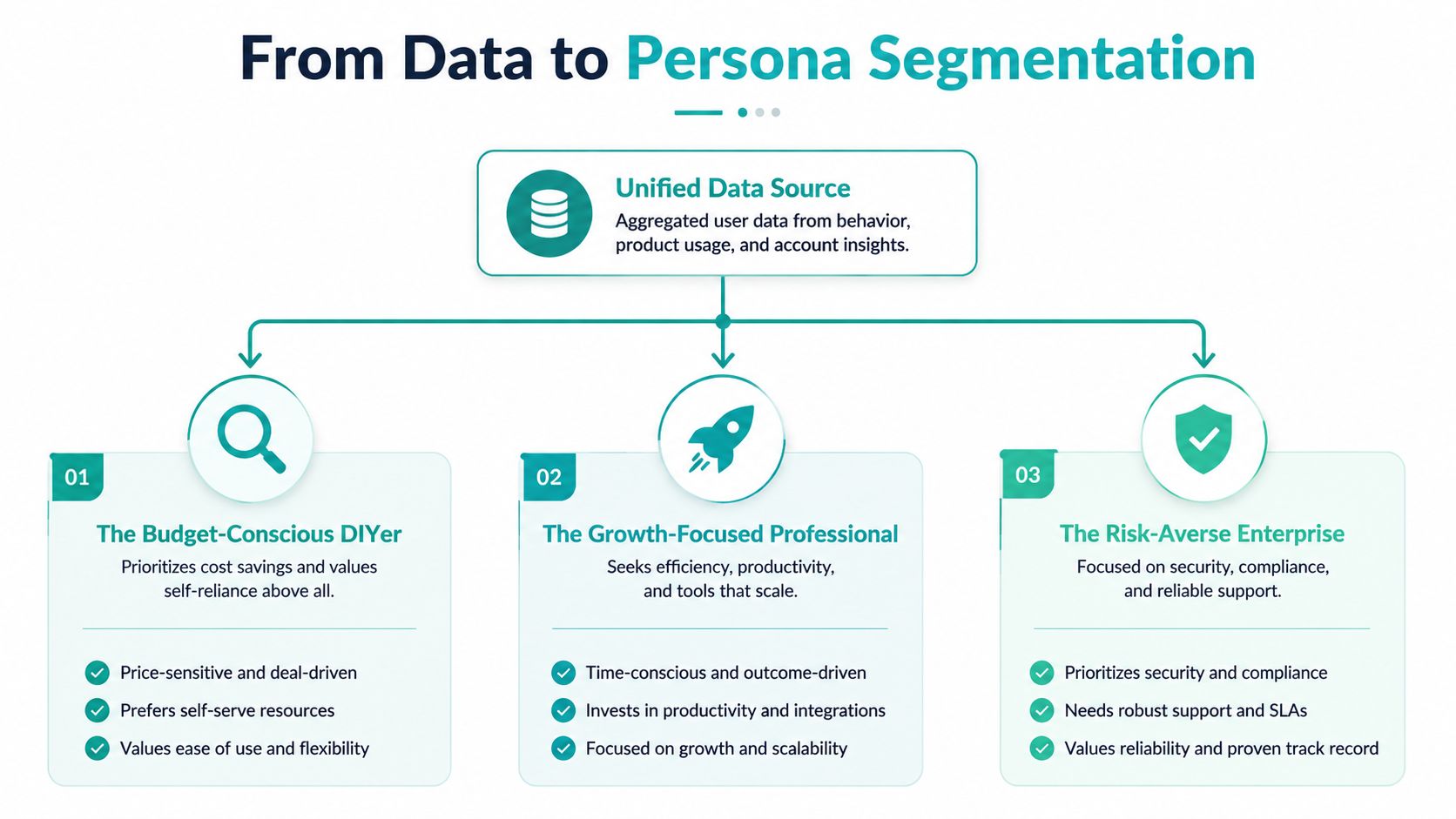
A pile of interview notes does not help a business decide what headline to test, which keyword to bid on, or what kind of follow-up sequence to send. Segmentation does. The job here is to sort people by how they buy, what slows them down, and what they need to see before they act.
Qualtrics outlines a more statistical version of that process, using quantitative inputs and clustering methods such as Latent Class Analysis, Hierarchical Clustering, Factor Analysis, or K-Means/K-Modes to identify audience patterns that are easy to miss by intuition alone (Qualtrics on statistically informed personas). Smaller businesses usually do not need formal modeling to get value. They do need discipline. Group the audience first, then build personas from those groups.
Start with segments, not characters
Useful segments reflect different buying behavior, not surface traits. For a Central Florida home services company, the split often has less to do with age or gender and more to do with urgency, price sensitivity, and how much effort someone will invest before contacting you.
A practical breakdown might look like this:
- Urgent fix buyers who need service now and care most about speed and trust
- Price-checking planners who compare options and want clear scope before booking
- Delegating professionals who value convenience, scheduling ease, and minimal back-and-forth
That distinction changes execution fast. Urgent fix buyers need fast-loading service pages, obvious phone numbers, trust signals, and PPC copy built around response time. Price-checking planners respond better to estimate ranges, FAQs, comparison content, and retargeting that answers objections. Delegating professionals often convert better with online scheduling, text updates, and shorter forms.
Ask one question before naming any persona: What causes this group to choose differently?
That filter keeps the work tied to revenue. If a segment does not lead to a different page structure, offer, ad angle, sales script, or automation path, it is probably not a useful segment.
Businesses that want a more advanced system often add intent scoring and probability-based grouping. For a more operational approach, predictive audience modeling for marketing segmentation can help teams decide which audience is most likely to convert, not just describe who they are.
A persona template that drives decisions
Once the segments are clear, turn each one into a working document your team can use without interpretation. Long persona decks usually fail because nobody references them during campaign setup. A shorter format works better if each field maps to a marketing choice.
A strong persona document usually includes:
- Role and situation: What is happening when the need appears?
- Primary goal: What result are they trying to get right now?
- Top frustrations: What creates doubt, delay, or confusion?
- Decision criteria: What makes one provider feel safer or easier to choose?
- Communication preference: Do they want a call, text, form, estimate tool, or detailed page?
- Buying blockers: What makes them hesitate or leave?
- Proof requirements: Reviews, certifications, before-and-after examples, pricing clarity, response time
- Scenario snapshot: A short buying moment that gives context and urgency
The extra field on proof requirements matters. It directly affects page design, ad extensions, and follow-up emails.
For example, a local service persona might be a working homeowner who discovers a problem after business hours, searches on mobile, scans for legitimacy in seconds, and abandons sites that hide reviews, service areas, or contact options. That profile is useful because it points to action. Put click-to-call high on the page. Show review volume early. Run mobile-first landing pages. Use PPC copy that promises speed and clear next steps. Trigger an SMS follow-up instead of a long email sequence.
The overlooked personas that still affect conversion
Many companies model only the end user and miss the person who shapes the decision.
In healthcare, a caregiver may do the research. In B2B, an operations lead may want the solution while finance or procurement slows approval. In legal or family services, a spouse, parent, or adult child may make first contact. Those people have different objections, different information needs, and different urgency levels.
Research on older disadvantaged adults in remote primary care shows how persona work can capture overlapping barriers such as access, confidence, and decision power, instead of reducing people to age alone (study on personas and intersecting barriers in remote primary care).
That matters in practice. If ads speak to the user but the website needs to reassure an approver, conversion rates suffer. If the site answers the patient's questions but ignores the caregiver's concerns about logistics or trust, lead quality drops. Good persona work accounts for everyone who can speed up, stall, or redirect the sale.
Putting Your Personas to Work in Marketing
A persona only earns its keep when it changes execution. If the document never affects your website structure, ad targeting, or automation logic, you didn't build a persona. You built a poster.

Mural's guidance is especially relevant here. Personas are most useful as living models for segmentation and experimentation, not static profiles. That matters even more now because AI tools, accessibility preferences, and changing search behavior keep shifting how people discover and evaluate brands (Mural on creating user personas as living models).
Website design that matches buying intent
Website conversion problems often come from a mismatch between page structure and user intent.
A high-urgency persona doesn't want a long brand story before seeing service areas, trust signals, and a clear path to contact. A research-heavy persona may want FAQs, process details, financing information, or comparison content before they're ready to convert. A strong site architecture reflects those differences.
For example:
- Urgent local lead: Put phone, trust signals, and fast-action CTAs above the fold.
- Careful evaluator: Add proof, process explanation, and objection-handling near the conversion point.
- High-consideration buyer: Use layered content, not one thin page trying to do everything.
That's where persona work directly improves UX and conversion. The page stops talking at everyone and starts helping the right visitor move forward. If that's a current bottleneck, improving website conversion rates usually starts with this alignment before it moves into design tweaks.
PPC and social ads with sharper hooks
Most paid campaigns underperform because the message is too broad.
A persona gives you the hook. Not “high quality service.” Not “trusted solutions.” Those phrases are weak because they don't map to a felt problem. A better ad starts with the reason the prospect is searching in the first place.
Here's the difference in practice:
| Persona type | Weak ad angle | Better ad angle |
|---|---|---|
| Urgent service seeker | “Professional repairs available” | “Need service fast? Book with a local team that shows pricing clarity and easy scheduling” |
| Price-checking shopper | “Top-rated company” | “Compare options, understand the scope, and request an estimate without a long phone call” |
| Time-starved professional | “We get results” | “Done-for-you service built to save time and reduce back-and-forth” |
The same logic applies to paid social. Creative should reflect the persona's trigger, objection, and desired outcome. If you're running Reels, Shorts, or similar creative, platform-specific execution still matters. A practical guide to mastering the short-form video algorithm can help teams shape content format around viewer behavior, but the underlying message still has to come from persona insight.
AI and automation that feel relevant
AI is useful here, but only if the inputs are good.
A chatbot without persona logic usually feels generic. An email sequence without persona logic sends the same nurture path to everyone. A lead scoring model without persona logic often favors activity volume over buying intent. The fix is to build automation around known segment differences.
Use personas to shape:
- Lead routing rules: Send urgent, high-intent leads to fast-response workflows.
- Email sequences: Give cautious buyers educational proof and implementation details.
- Chat prompts: Show different opening questions based on page context and likely intent.
- Remarketing paths: Serve different offers to compare-mode visitors than to abandoned checkout users.
A good persona doesn't just improve messaging. It improves logic.
This is also why persona work can't stay static. Assistive technologies, AI-assisted search, voice input, and translation tools all change how people move through a digital experience. Segmenting by goals and constraints keeps your marketing usable when behavior shifts.
Keep personas inside recurring decisions
The most reliable way to keep personas alive is to attach them to work your team already does.
Use them in:
- Campaign planning: Which persona is this campaign for, and what proof does that person need?
- Landing page reviews: What would this visitor still hesitate about after reading this page?
- Sales feedback loops: Which persona is closing fastest, and which one is stalling?
- Quarterly optimization: Are the segments still valid based on current user behavior?
One practical option for businesses that need execution support across ads, websites, content, and automation is working with a full-service team such as Emulous Media Inc, which handles advertising, website design, media production, marketing, and AI automation. That kind of setup matters when persona insight needs to move beyond a document and into daily production.
Conclusion The End of Guesswork
Building user personas isn't about making your marketing feel more organized. It's about making your marketing spend less wasteful.
When personas are grounded in research, segmented by meaningful behavior, and tied to recurring execution, they sharpen almost every growth lever you control. Your website becomes easier to use. Your ad copy gets more specific. Your follow-up sequences sound more relevant. Your team wastes less time debating what customers want because the decision rules are clearer.
The payoff can be substantial when the work is done well. A Forrester benchmark, cited in UX practice literature, found that teams using personas effectively achieved approximately a four-fold return on investment compared to teams that did not (Forrester benchmark cited by Radiant Digital). That doesn't mean every persona project automatically works. It means strong data, clear governance, and real adoption can create measurable business value.
For business owners in Central Florida, and for growing brands expanding into markets like Charlotte, this matters because competition is tighter and attention is more expensive. Guesswork gets punished faster. The companies that win tend to understand not just who their buyers are, but how different buyer groups think, hesitate, compare, and convert.
That's the ultimate advantage of building user personas. You stop broadcasting generic messages and start building marketing systems that respond to actual human behavior.
If you want help turning customer research into personas that improve website conversions, ad performance, and automation workflows, Emulous Media Inc can help. Book a free consultation, call 689-255-6327, or visit the contact page to talk through your goals.