Your company still does good work, but the brand doesn't say so anymore. The website looks dated on mobile. Sales calls keep attracting price shoppers instead of the clients you want. New competitors sound sharper, look more credible, and show up better in local search. Internally, your team explains the business five different ways depending on who answers the phone.
That's usually when owners start thinking about rebranding the company. Not because they want a prettier logo, but because the current brand has stopped helping the business grow. A rebrand done well fixes more than appearance. It resets positioning, improves lead quality, sharpens conversion paths, and gives your digital presence a chance to perform like an actual revenue asset.
In local markets like Central Florida and Charlotte, that matters even more. A rebrand touches your website, paid ads, Google Business Profiles, customer trust, and the consistency of every place your brand appears online. If you treat it like a cosmetic project, you risk confusion. If you treat it like an operational upgrade to your lead-generation engine, you give the business room to scale.
Table of Contents
- When a Rebrand is a Growth Strategy Not a Last Resort
- The Brand Audit Before You Build Anything New
- Your New Brand Strategy and Market Position
- Developing Your New Visual and Verbal Identity
- Executing the Digital Rollout and Website Update
- Measuring Rebrand Success and Final Thoughts
When a Rebrand is a Growth Strategy Not a Last Resort
A lot of owners hesitate because rebranding feels like admitting something failed. In practice, the opposite is often true. Strong companies rebrand because the business evolved faster than the brand did.
The clearest sign is misalignment. Your service mix changed, but your messaging still reflects the company you were years ago. Your pricing moved upmarket, but your visual identity still attracts bargain hunters. Your expansion plans got serious, but your website still feels local in the wrong way, small instead of focused.
That's why rebranding the company should be viewed as a business decision first and a creative decision second. The market doesn't reward the brand that looks nicest. It rewards the brand that makes the right buyer understand, trust, and act.
The data supports that mindset. 79% of S&P 100 companies have rebranded, with the average time-to-first-rebrand now just 4.2 years according to rebranding campaign statistics compiled here. The same source notes that Old Spice saw 107% sales growth in one month after a bold repositioning, while Apple's “Think Different” rebrand helped turn a $1 billion annual loss into a $309 million profit the next year.
The real trigger points
A rebrand is usually warranted when one or more of these conditions show up:
- Your market changed: New competitors reframed the category and your current message sounds generic.
- Your business matured: You now offer better service, better systems, or broader capabilities than your old brand communicates.
- Your sales team works too hard: Reps spend too much time correcting assumptions instead of moving prospects forward.
- Your digital presence leaks trust: The site, ads, and brand assets create friction before a conversation even starts.
Rebranding works best when the business already has momentum and needs a better vehicle, not when leadership expects a logo to fix broken operations.
If you want a solid outside perspective on the decision process, this guide on rebranding a company is a useful companion read because it frames the process as a strategic move rather than a surface update. For a deeper look at the reasons businesses make the shift in the first place, this piece on why companies rebrand is also worth reviewing.
What doesn't work
A rebrand fails when leadership treats it like paint over structural damage. If your offer is muddled, customer experience is inconsistent, and the website still can't convert qualified traffic, new colors won't save you.
What does work is pairing brand change with operational clarity. Apple didn't just change messaging. It made hard business decisions. Old Spice didn't just change visuals. It changed how buyers saw the product. That's the standard. The rebrand needs to support a better business model, a clearer market position, or a stronger growth plan.
The Brand Audit Before You Build Anything New
Most bad rebrands start with premature creativity. Somebody gets excited about names, logos, colors, and taglines before the company has diagnosed what's wrong. That's backward.
A proper audit tells you what to keep, what to change, and what must never make it into the next version of the brand. It also prevents the expensive mistake of rebuilding a weak message into a better-looking package.

A disciplined process takes time. A structured 6-12 month process has a 70-85% success rate, while rushed efforts fail 40% of the time. The Brand Audit and Research phase alone should take 2-3 months and account for 20-30% of the rebranding budget, according to this rebranding strategy resource.
What to inspect before any creative work starts
Start with your digital footprint. Pull up your website on a phone, not just a desktop. Check whether the homepage explains what you do in plain language. Review page speed, accessibility, form friction, and whether service pages map cleanly to the terms people search. Use tools like Google Analytics, Google Search Console, PageSpeed Insights, SEMrush, and Hotjar to see where users hesitate or drop.
Then look at your search environment. If you're a Central Florida service business, compare your site and Google Business Profile presence against nearby competitors in Orlando, Lake Mary, Winter Park, and surrounding markets. If Charlotte expansion is in play, audit that market separately. Different cities often reveal different brand weaknesses. One market may expose messaging problems. Another may expose trust gaps or thin local content.
Your customer voice data matters just as much as your analytics. Talk to your best clients, not just the loudest ones. Ask why they chose you, what nearly stopped them, and what words they'd use to describe you to a colleague. Those answers often reveal the value proposition you should have been leading with all along.
What a strong audit produces
A brand audit should leave you with a short list of hard conclusions, not a folder full of observations.
- Messaging gaps: What buyers misunderstand, what the current site buries, and where the brand attracts the wrong audience.
- Performance baselines: Current conversion paths, branded search behavior, top landing pages, and weak points in mobile UX.
- Competitive realities: Which competitors own the premium position, which ones dominate local intent, and which ones look more modern.
- Internal alignment issues: Whether leadership, sales, and operations describe the company consistently or create confusion.
Practical rule: If you can't explain why the current brand underperforms in concrete terms, you're not ready to approve a new one.
A good audit also identifies your essential core values. Maybe your existing name still has equity and shouldn't change. Maybe customers trust your expertise but find the site hard to use. Maybe your logo isn't the problem at all, but your copy sounds like every other company in the category. Those distinctions matter.
This stage is diagnostic work. Think of it like checking the foundation before renovating the house. If you skip it, every design decision that follows becomes guesswork.
Your New Brand Strategy and Market Position
Once the audit is done, the next move isn't design. It's direction.
Brand strategy sounds abstract until you force it to answer practical questions. Who exactly are you for now? What problem do you solve better than the alternatives? Why should a buyer trust your company over the local incumbent, the low-cost provider, or the flashy newcomer with louder ads?
Positioning has to guide selling
The strongest rebrands produce a market position that changes how the business sells. That means your strategy has to shape homepage copy, paid search messaging, email language, sales decks, and even how your receptionist answers the phone.
For a Central Florida home service company, the position might emphasize responsiveness, trust, and clean execution. For a healthcare or legal firm, authority and clarity may matter more than boldness. For e-commerce brands, the position usually has to work harder on differentiation because buyers can compare alternatives in seconds.
A useful strategy answers four things clearly:
| Decision area | What it should clarify |
|---|---|
| Audience | Which buyer you want more of, and which buyer you're fine losing |
| Value proposition | The specific business outcome or experience you deliver |
| Market category | What space you want to own in the buyer's mind |
| Brand promise | What clients should consistently expect from every interaction |
One mistake shows up often here. Companies write a positioning statement that sounds smart in a workshop but falls apart in real channels. If your strategy can't help write a stronger service page or a more persuasive PPC ad, it's too vague.
A useful strategy document is specific
Good brand strategy is operational. It should identify your ideal client profile, your offer hierarchy, your proof points, your tone, and the words you want associated with the brand. It should also spell out what you are not.
That last part matters. A rebrand gets stronger when it stops trying to appeal to everyone. If your company is moving upmarket, your strategy should give you permission to stop sounding cheap, broad, or overly accommodating. If you're entering a new city, your strategy should account for how local trust gets built there.
A strong position acts like a filter. It makes future decisions easier because not every idea deserves to survive contact with the strategy.
If your current brand still feels fuzzy after the audit, this breakdown of brand strategy and identity is a useful reference for turning broad business goals into a sharper market position.
Developing Your New Visual and Verbal Identity
This is the part often called “the rebrand,” but it's really translation. Strategy gets translated into things people can see, hear, and remember.
That translation has two parts. The first is visual identity: logo system, typography, color palette, image style, layout logic, iconography, and design rules for web and ad creative. The second is verbal identity: positioning language, tone of voice, key phrases, offer framing, headlines, and the way the brand sounds in public.
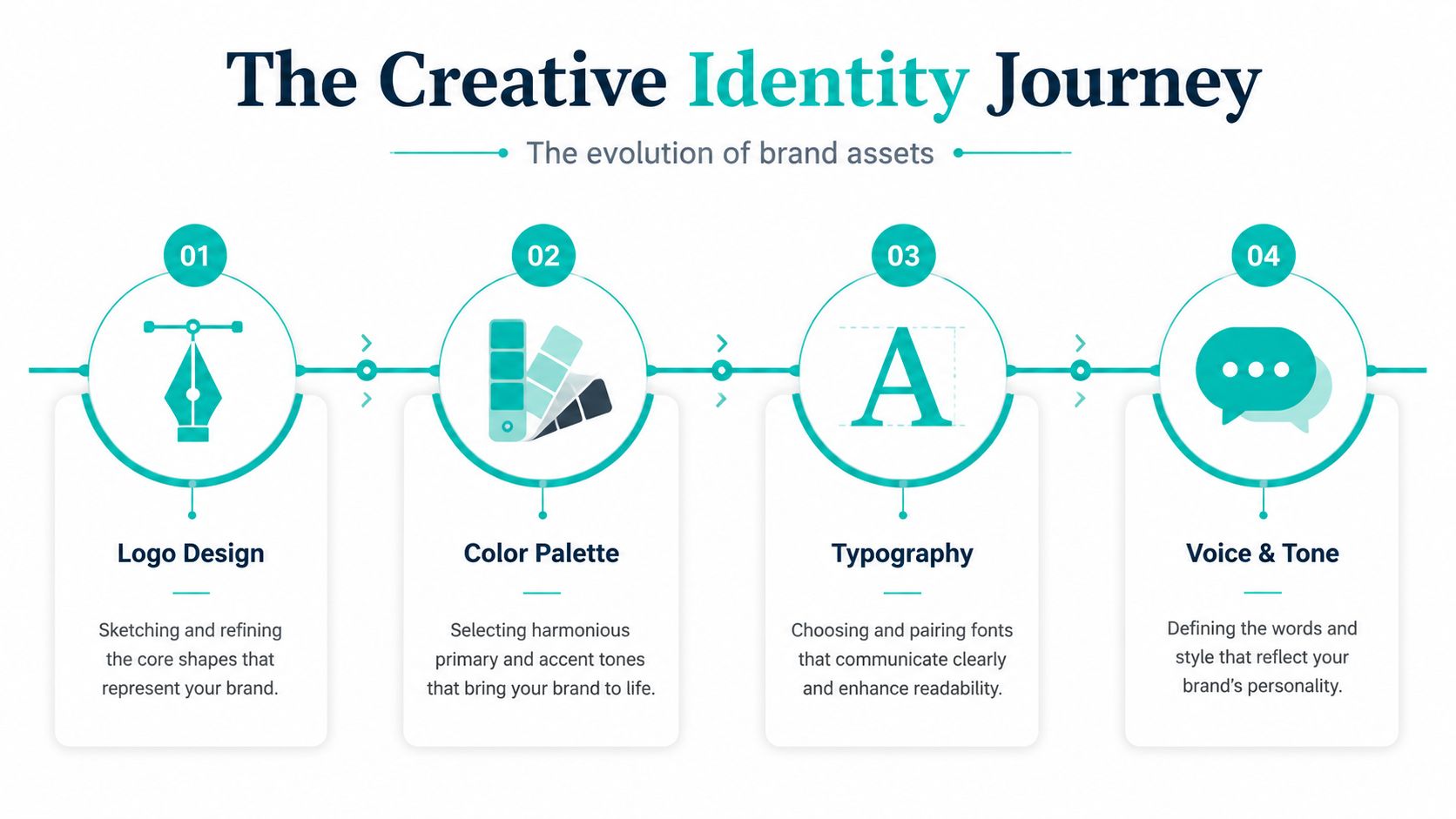
Good design has a job to do
The logo should work on a truck wrap, a favicon, a social profile, a proposal, and a mobile header. Color choices should support readability, not fight it. Typography should feel distinctive without hurting comprehension. If the brand looks good in a pitch deck but breaks on a website, it isn't finished.
The same goes for voice. Many businesses spend weeks polishing visuals and then let their website copy sound generic. That's a mistake. Buyers often meet your words before they meet your team. If the copy sounds like everyone else, the rebrand loses force.
A few practical tests help:
- Recognition test: Can someone glance at the brand and understand the level of company you are?
- Consistency test: Does the voice on the homepage match your ads, emails, and sales materials?
- Usability test: Do the visual choices make digital experiences easier to use or harder?
- Flexibility test: Can the system scale across locations, campaigns, and formats without falling apart?
If you want to study how strong identity systems are expressed through real logo work, view Studio Liddell's portfolio. It's useful for seeing the difference between a decorative mark and a system built to carry a brand.
Where AI helps and where it hurts
AI has become part of the creative process whether teams admit it or not. It can speed up concept exploration, generate naming directions, support moodboards, and help organize messaging variants. Used well, it saves time.
Used poorly, it creates bland sameness. “Vibes-based rebrands” fail 72% of the time, and a Q1 2026 Gartner report showed 55% of rebrands using AI underperform due to poor prompt engineering and weak human oversight. A hybrid approach yields 28% better engagement, according to this cited summary of AI rebranding pitfalls.
That lines up with what experienced teams see in practice. AI can produce options fast, but it doesn't know your actual market context, your buyer psychology, or the subtle trust signals your industry requires. It tends to average. Brands need intent.
Don't ask AI to decide your identity. Ask it to accelerate pieces of a decision process led by humans who understand your category, offer, and audience.
For businesses working through the creative side of rebranding the company, the most useful setup is hybrid. Use AI for exploration and production support. Use experienced designers, strategists, and writers for judgment. If you want to understand how a complete creative system comes together, these graphic design services show the kind of broader execution thinking a modern identity needs.
Executing the Digital Rollout and Website Update
A rebrand isn't real on launch day because the logo file exists. It's real when every customer touchpoint reflects the new brand accurately, consistently, and without breaking performance.
That's where many businesses stumble. They focus on the announcement and neglect the infrastructure. Then leads dip, pages disappear from search, old visuals linger in third-party listings, and the market gets mixed signals.

The rollout needs sequencing not chaos
Treat launch like a coordinated changeover, not a reveal. Your website, landing pages, ad creative, social profiles, email templates, sales collateral, CRM assets, directory listings, and internal documents should move in a planned order.
A practical sequence usually looks like this:
Lock the core system
Finalize messaging, design rules, page templates, redirect plans, and asset libraries before public release.Update the website first
Your site is the source of truth. If ads and social profiles point to a half-finished site, trust drops fast.Refresh active campaigns
Branded search ads, paid social creative, retargeting, and lead forms need synchronized language and visuals.Change owned channels
Social bios, email signatures, proposals, invoices, onboarding docs, and customer communication templates all need alignment.Push updates to external platforms
This includes business directories, review profiles, map listings, associations, sponsorship pages, and media references.
A website redesign is usually the center of this move because it carries the heaviest workload. It has to communicate the new position, preserve search equity, improve mobile experience, and convert traffic better than the old version. That's why businesses planning a serious transition often start with a full website redesign and modernization roadmap instead of isolated page edits.
Local SEO is where many rebrands break
This risk gets underestimated, especially by multi-location service businesses. A 2025 Moz study found 68% of multi-location rebrands lose local search visibility due to inconsistent asset updates across Google Business Profiles. The same source notes that 46% of “near me” searches drive immediate business, as cited in this rebranding guide for 2025 examples.
If you serve Central Florida and are expanding toward Charlotte, local rollout discipline matters. Your business name, address, phone number, categories, hours, services, photos, and descriptions need to match wherever the brand appears. Inconsistency creates confusion for both customers and platforms.
The highest-risk areas are usually:
- Google Business Profiles: Old logos, old service descriptions, and inconsistent naming across locations.
- Directory citations: Legacy listings that still carry outdated branding or contact details.
- Location pages: Thin or duplicated copy that doesn't support the new market position.
- Paid local campaigns: Ads that use new messaging while landing pages still reflect the old brand.
If your rebrand touches multiple locations, protect local search before you chase the splash of launch day.
A short explainer can help teams align before the rollout gets hectic:
Your launch message also needs a plan
Don't assume customers will instantly understand why the brand changed. If the company name changes, or if the shift is substantial, explain it cleanly. Focus on continuity where continuity matters and change where change matters. Existing customers need reassurance. New prospects need clarity.
For companies that want a stronger public announcement, these rebranding press release examples for startups can help structure the message without making it sound self-congratulatory.
The best launches feel coordinated because they are. Design, SEO, paid media, web development, content, and operations all move together. Anything less creates friction the customer can feel.
Measuring Rebrand Success and Final Thoughts
The launch isn't the finish line. It's the start of accountability.
A successful rebrand should make the business easier to understand, easier to trust, and easier to buy from. If it doesn't improve those outcomes over time, something in the strategy, execution, or follow-through needs attention.
Measure business outcomes not applause
The first trap is vanity metrics. Compliments on the new logo are nice. Team excitement matters. Social engagement can be useful. None of that proves the rebrand is working.
Instead, watch for movement in the indicators tied to your original business goal. If the point was better lead quality, review lead quality. If the point was stronger local visibility, monitor branded search demand, map performance, and location page engagement. If the point was higher conversion efficiency, study form completion, call tracking patterns, and sales pipeline quality.
A simple post-launch scorecard should track:
- Lead quality: Are better-fit prospects coming in?
- Conversion behavior: Do users complete key actions more smoothly on the new site?
- Sales alignment: Are prospects arriving with a clearer understanding of what you do?
- Search presence: Is branded and local visibility holding or improving after launch?
- Message consistency: Are ads, pages, profiles, and sales materials still aligned weeks later?
The best rebrands reduce friction. Sales calls get shorter because prospects understand the offer sooner.
What strong rebrands usually get right
Strong rebrands usually share a few traits. They start with honest diagnosis. They commit to a position instead of trying to please everybody. They build a usable identity system, not just a good-looking one. They roll out digitally with discipline. Then they keep measuring after launch.
Weak rebrands usually fail for predictable reasons. Leadership skips the audit. Creative work starts too early. AI gets used as a shortcut instead of a support tool. The website launch is rushed. Local profiles are updated unevenly. Nobody owns post-launch performance review.
If you need a practical framework for the measurement side, this guide to tracking marketing metrics and KPIs is a solid place to start.
Rebranding the company is a serious move. It affects perception, operations, digital performance, and growth. But when it's handled with strategy and execution, it does more than refresh the brand. It upgrades the whole system buyers experience.
If your business has outgrown its current brand, Emulous Media Inc can help you approach the change strategically, from brand positioning and messaging to website redesign, local SEO, paid media, media production, and AI-supported execution. To talk through your goals, book a free consultation, call 689-255-6327, or visit the contact page through the main website.