Your marketing probably feels stuck for one of two reasons.
You're paying for traffic every month, leads come in, and the second you pull back ad spend the pipeline goes quiet. Or you invested in a website, some content, maybe even a few SEO updates, and months later you're still waiting for meaningful visibility. Most business owners in Central Florida end up trapped between those two frustrations.
That trap exists because you're asking the wrong question. The question isn't SEO or PPC. The fundamental question is whether you've built a search system that can create demand capture now and compound value later. If you haven't, your marketing will keep acting like a series of disconnected expenses instead of a growth engine.
Smart businesses don't separate seo and ppc services into different buckets with different goals and different reports. They run them as one coordinated search engine marketing system.
Table of Contents
- The Digital Marketing Tug-of-War
- The Two Engines of Search What Are SEO and PPC
- The Multiplier Effect How SEO and PPC Services Work Together
- Tailoring Your Strategy for Your Business Type
- Choosing a Partner Pricing Models and What to Expect
- Measuring What Matters KPIs Beyond Traffic and Clicks
- Your Next Steps to Dominating Search
The Digital Marketing Tug-of-War
A home services company in Orlando launches Google Ads because the phone needs to ring this week. The ads work, but the owner starts noticing something ugly. Every month begins with the same question: how much do we need to spend just to stay visible?
At the same time, a law firm in Charlotte invests in a polished website and a handful of SEO pages. The site looks credible. The branding is solid. But if nobody finds it, that website is a brochure sitting in the dark.
That's the tug-of-war most businesses live in. PPC feels fast but expensive. SEO feels valuable but slow. So owners bounce between them, cut one, overfund the other, and wonder why growth never becomes predictable.
Practical rule: If your leads disappear when ad spend pauses, you don't have a marketing engine. You have a rented pipeline.
This isn't a budget problem first. It's a system design problem. Search works best when paid and organic do different jobs inside the same machine.
PPC is your fast-response channel. It captures active demand, tests offers, and gives you real query-level feedback. SEO is your compounding channel. It builds authority, visibility, and lower-friction acquisition over time. Treating them like competitors guarantees waste.
Business owners who get unstuck usually stop asking, “Which one is better?” They start asking better questions:
- Where do we need speed right now?
- Where do we need long-term visibility later?
- Which search terms deserve paid coverage, organic coverage, or both?
- How are we measuring overlap without double-counting conversions?
That last question matters more than most agencies admit. If your reports credit both channels for the same win, your strategy will drift and your budget decisions will get worse.
The Two Engines of Search What Are SEO and PPC
The farm and the grocery store
SEO and PPC do not solve the same problem, even though they both live inside search.
SEO is the farm. You prepare the ground, plant strategically, improve the infrastructure, and build something that keeps producing. It takes work. It takes time. But once it's established, it becomes an asset your business owns. That's what strong search engine optimization services should do. They should improve technical health, content relevance, local visibility, and authority so your site earns traffic instead of renting it.
PPC is the grocery store. You go today, get exactly what you need, and pay for immediate access. That's why businesses keep using it. Search ad spending is projected to reach $351.55 billion in 2025, average Google Search Ads cost per click is $2.69, and one marketing benchmark reports that visitors from PPC ads are 50% more likely to convert than organic visitors according to these PPC statistics and benchmarks.
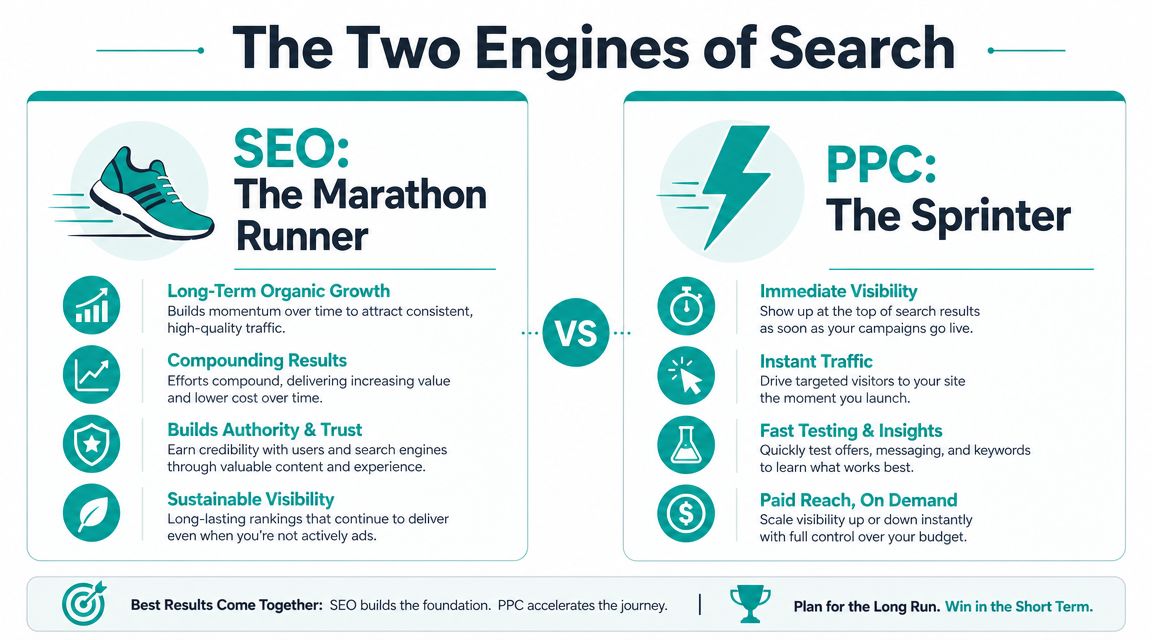
The mistake is assuming one replaces the other. It doesn't. You don't build a business by living only at the grocery store, and you don't eat tonight by waiting for harvest season.
A similar pattern shows up in marketplace search too. If you sell products and want a useful example of how search visibility and conversion optimization intersect on retail platforms, this guide on how teams have optimized my listings on Amazon is worth reviewing.
SEO vs. PPC at a glance
| Attribute | SEO (The Farm) | PPC (The Grocery Store) |
|---|---|---|
| Speed | Slower to gain traction | Immediate visibility |
| Cost model | Ongoing investment in content, technical work, and authority | Pay for clicks and management |
| Longevity | Compounds over time | Stops when spend stops |
| Control | Less instant control over rankings | Tight control over keywords, budgets, copy, and landing pages |
| Testing | Slower feedback loop | Fast message and offer testing |
| Best use | Durable visibility and trust building | Fast demand capture and rapid experimentation |
SEO builds future leverage. PPC buys present attention.
If you only run PPC, you stay dependent on spend. If you only run SEO, you wait too long to validate what buyers respond to. Businesses need both engines because search behavior itself has both timelines built into it.
The Multiplier Effect How SEO and PPC Services Work Together

Running seo and ppc services separately creates duplicate work, muddy reporting, and weaker performance. Running them together creates a feedback loop.
One channel gives you speed. The other gives you staying power. The significant payoff comes when the same keyword strategy, landing page logic, and conversion goals power both.
Why siloed channels underperform
A lot of companies let one vendor handle SEO and another handle paid search. That sounds fine until you look under the hood.
The PPC team learns which queries produce qualified leads. The SEO team writes content around different language. Paid traffic lands on pages the organic team never optimized for search intent. Reporting lives in separate dashboards. Nobody owns the overlap.
That setup is common, and it's inefficient.
In trust-driven sectors, the gap gets even clearer. A 2025 benchmark showed Legal Services SEO converting at 4.4% versus 2.2% for PPC, and Real Estate SEO converting at 2.8% versus 0.8% for PPC in this SEO versus PPC conversion comparison. Those numbers don't mean PPC is weak. They mean buyers in certain categories research, compare, and validate before converting.
How the feedback loop works
Here's what integrated search looks like in practice:
- PPC tests intent fast: Launch campaigns on high-intent keywords and watch which terms, headlines, and offers produce real conversions.
- SEO builds around proven winners: Turn that paid search data into service pages, location pages, blog clusters, and supporting content.
- Organic improves paid efficiency: When buyers already recognize your brand from organic listings, they're more likely to trust the ad click.
- Shared landing pages reduce waste: One strong landing page architecture can support both paid traffic and organic visibility when built correctly.
- Search results domination matters: Showing up in both the ad placements and the organic results pushes competitors lower and increases perceived authority.
If you're evaluating what that paid side should look like operationally, this overview of Google Ads and PPC management outlines the mechanics behind campaign structure, targeting, and optimization.
A short walkthrough helps clarify the handoff:
When both channels target the same business goal, the result isn't additive. It's multiplicative.
That's why a blended search model works. PPC captures demand now. SEO reduces dependency later. Together they create a system that learns faster and scales more cleanly than either channel can alone.
Tailoring Your Strategy for Your Business Type
Generic SEM advice is useless. A dentist in Lake Mary, an Orlando HVAC company, a multi-state e-commerce brand, and a B2B consulting firm should not run the same playbook.
The right mix of seo and ppc services depends on sales cycle, geography, buying behavior, and margin structure.

Local service businesses
If you serve a defined market like Orlando, Lake Mary, or Charlotte, local intent is your money zone. Buyers search when they need help, and they usually want a provider nearby.
A typical local SEO program runs about $500–$1,500 per month with a 30–90 day time to impact, while supporting PPC can run about $500–$2,500 per month plus ad spend and produce results in days, based on local SEO and PPC small-business benchmarks.
For local service businesses, the blueprint is straightforward:
- Own your local presence: Google Business Profile optimization, citation cleanup, and location-specific landing pages need to be in place.
- Buy urgent intent: PPC should target high-intent service terms and emergency queries where speed matters.
- Match pages to neighborhoods or service categories: Don't send every click to the homepage.
- Track calls and form leads together: Local campaigns fail when phone conversions live outside the reporting system.
E-commerce brands
E-commerce brands need search coverage at both category and product level. Paid search captures shoppers ready to buy. SEO builds durable visibility around collections, comparisons, and product discovery.
Technical execution matters for these results. Product pages need clean structure, useful copy, strong merchandising, and fast load times. Paid campaigns should send traffic to pages built for conversion, not pages built only to look pretty.
If your store is scaling aggressively and you need channel planning tied to a broader growth roadmap, a digital marketing strategy for startups and growth-focused brands can help frame the right sequence.
B2B and professional services
B2B search is slower, more skeptical, and more research-heavy. That changes the balance.
Start with content-led SEO around service categories, problem-aware searches, and authority-building resources. Use PPC selectively for bottom-of-funnel keywords, branded protection, and retargeting around high-value pages. For firms in legal, healthcare, finance, or consulting, trust signals often matter more than sheer click volume.
What works: Build the organic case for expertise, then use paid campaigns to capture demand when buyers are ready to act.
The point isn't to split your budget evenly. It's to assign each channel a clear job based on how your buyers make decisions.
Choosing a Partner Pricing Models and What to Expect
Most businesses don't need a cheaper agency. They need a clearer one.
If you're shopping for seo and ppc services, the wrong pricing model can hide weak strategy just as easily as the right one can support strong execution. Price matters, but structure matters more.
The pricing models you'll actually see
You'll usually run into three models.
Monthly retainer. This is the standard for ongoing campaign management. It makes sense when you need continuous SEO work, ad optimization, content updates, landing page testing, and reporting.
Project-based pricing. This fits one-time work such as a technical SEO audit, analytics cleanup, campaign rebuild, or landing page redesign.
Hybrid model. This is often the healthiest arrangement for growing companies. One fee covers the strategic foundation, then ongoing management supports execution and optimization.
A good agency should explain what is included. Strategy, tracking setup, creative, reporting, technical fixes, and landing page work shouldn't be blurred together in a vague proposal. If you want a clean overview of service categories, these marketing and advertising services show the kind of scope a full-stack partner can cover.
What a healthy agency relationship looks like
The true test isn't the invoice. It's the operating model.
Look for signs that the partner thinks in systems:
- Shared ownership of results: The team talks about qualified leads, sales quality, and attribution, not just traffic.
- Transparent deliverables: You know what gets built, optimized, tested, and reported each month.
- Technical awareness: They care about pages, tracking, site speed, and user experience, not only keywords and ads.
- Decision-making discipline: They can explain why budget moves from one campaign or page set to another.
If an agency reports clicks separately, conversions separately, and revenue vaguely, they're not managing growth. They're managing activity.
One practical example belongs here. Emulous Media Inc operates across advertising, marketing, website design, media production, and AI automation, which is relevant when a business needs SEO, PPC, landing pages, analytics, and creative execution to work together instead of living in separate silos.
The right partner should make your search program easier to understand, not harder.
Measuring What Matters KPIs Beyond Traffic and Clicks
Traffic is not the scoreboard. Clicks are not the scoreboard. Even conversion totals can lie if your reporting setup is sloppy.
That's where most businesses get misled. They receive one SEO report and one PPC report, both look positive, and nobody asks whether the same customer path got counted twice.

The attribution problem most reports ignore
A buyer searches your service, finds your organic result, leaves, sees a paid ad later, clicks, and converts. Which channel gets credit?
If your answer is “both,” you need better attribution logic. A critical gap in most strategies is accurately assigning revenue when SEO and PPC overlap on the same keywords and landing pages, as discussed in this analysis of integrated SEO and PPC attribution challenges.
That's why siloed dashboards create false confidence. They overstate performance, distort budget allocation, and push teams toward the wrong optimizations.
What to measure instead
Advanced search programs track the relationship between channels, not just the outputs inside each one.
Start with these:
- Blended cost per acquisition: One number across paid and organic support costs tied to actual acquisition.
- Assisted conversions: Cases where one channel influenced a conversion that another channel closed.
- Impression share and visibility overlap: Whether you're owning high-value search terms across paid and organic.
- Landing page efficiency: Not just visits, but how each shared page performs by source and intent.
- Query-to-conversion mapping: Which search terms deserve stronger paid coverage, stronger organic coverage, or both.
Technical alignment also matters more than many owners realize. Site speed, crawlability, structured data, internal linking, and content relevance affect organic rankings, and those same factors influence landing-page quality and conversion performance. Structured data such as LocalBusiness, Product, and Review markup can improve result context and click behavior according to technical SEO guidance for small business growth.
If you're trying to diagnose broken attribution, duplicated events, or weak conversion architecture, these Google Ads conversion audit use cases are a useful reference for what typically goes wrong.
A mature KPI framework should also live in one operating view. This guide to tracking marketing metrics and KPIs is useful for businesses that need a more disciplined reporting baseline.
Hard truth: If your team can't tell you how SEO assists PPC conversions, or how PPC informs SEO priorities, they're measuring channels. They are not measuring growth.
Your Next Steps to Dominating Search
Build one system, not two channels
If your business has been treating SEO and PPC like separate line items, that's the first thing to fix.
Keep PPC for speed. Keep SEO for compounding visibility. But stop planning, building, and measuring them in isolation. Shared intent targeting, shared landing pages, shared conversion tracking, and shared attribution logic are what turn search into a scalable acquisition system.
That matters even more now because a major blind spot remains unresolved in many campaigns: revenue attribution when both channels influence the same customer journey. Strong agencies need a real framework for cross-channel attribution and incrementality testing so businesses can prove the ROI of an integrated approach in a privacy-focused environment. That problem is central to modern search strategy, not an optional advanced topic.
If you run e-commerce, this becomes even more important as volume grows. Clean data architecture shapes budget decisions, merchandising insights, and campaign efficiency. For teams dealing with larger stores and more complex funnels, this overview of ecommerce tracking architecture for high-volume brands is a useful outside perspective.
Business owners in Central Florida usually don't need more marketing activity. They need tighter coordination. They need search campaigns built on strong websites, clean tracking, conversion-focused pages, and a system that can tell the truth about where revenue comes from.
That's the difference between marketing that feels busy and marketing that scales.
If you want help building a unified search strategy, book a free consultation with Emulous Media Inc, call 689-255-6327, or visit the contact page to discuss your SEO, PPC, website, and tracking setup.