You launch the site, turn on a few paid campaigns, post across social, and ask AI to draft the copy. Traffic shows up. Conversions do not. That pattern is common in early-stage startups because activity gets mistaken for strategy.
A strong digital marketing strategy for startups starts with position. Then it turns your website into a sales asset, chooses a small set of channels that fit the buying cycle, and runs a disciplined test, learn, scale process. AI helps speed up research, production, scoring, and follow-up, but it does not fix a weak offer or muddy message.
Poor marketing burns cash, hides real demand signals, and sends founders chasing the wrong channels. The startups that grow predictably usually do fewer things, with tighter positioning, cleaner measurement, and faster feedback loops.
That work starts before the first campaign. Clear messaging, a conversion-ready site, and a usable measurement setup give a small team the chance to beat larger competitors that move slower and carry more internal drag. If your positioning still feels fuzzy, tighten your brand strategy and identity before you buy traffic.
Table of Contents
- Before You Spend a Dollar Nailing Your Startup's Positioning
- Your Digital Foundation Building a Website That Converts
- Choosing Your Channels A Prioritized Startup Marketing Mix
- The First 90 Days A Practical Digital Marketing Launch Plan
- The AI Force Multiplier How Startups Can Outsmart Competitors
- Measuring What Matters KPIs That Connect Marketing to Revenue
- From Startup to Scale-Up Your Path Forward
Before You Spend a Dollar Nailing Your Startup's Positioning
The biggest startup myth is simple. Build something useful, put up a site, and buyers will figure out why it matters.
They won’t.
Most early marketing problems aren’t really ad problems or SEO problems. They’re positioning problems. If your message is vague, every click gets more expensive, every sales call takes longer, and every landing page underperforms because the offer doesn’t feel specific enough to the right buyer.

Build the message before you buy traffic
Start with a narrow customer definition. Not “small businesses.” Not “busy professionals.” Not even “homeowners.” A better starting point is the buyer with a painful, expensive, urgent problem and a clear path to purchase.
For a Central Florida startup, that might mean:
- Local service firms that need booked appointments, not just website visits
- E-commerce brands with repeat-purchase potential and room to improve conversion
- Professional practices that need trust and lead qualification before the first call
- Regional startups entering Orlando or Charlotte and needing local search visibility fast
Your first pass at audience research doesn’t need a giant budget. Read reviews on competitor Google Business Profiles. Study competitor headlines. Look at their service pages, ad language, FAQs, and offer structure. You’re trying to find three things: what buyers care about, what competitors keep repeating, and what nobody is saying clearly.
Practical rule: If your homepage headline could belong to five competitors, your positioning isn’t finished.
A simple positioning framework that holds up
Use this five-part framework:
Who you serve
Name the buyer as specifically as possible. “HVAC companies in growth mode” beats “small businesses.”What problem you solve
Focus on the friction they already feel. Slow lead flow, poor conversion, inconsistent demand, high no-show rates, weak trust signals.What outcome they want
More qualified leads. Better booked-call rates. Stronger local visibility. Cleaner handoff from marketing to sales.Why your approach is different
Faster implementation, clearer reporting, more specialized vertical knowledge, stronger creative, better automation.Why buyers should believe you
Process, proof, credentials, clarity, and a site that looks like a serious company built it.
A rough positioning statement can look like this:
We help [specific audience] solve [specific problem] through [distinct approach], so they can achieve [business outcome] without [common frustration].
That statement won’t become your final tagline. It will become the filter for your website copy, ad angles, sales deck, and content strategy.
If your brand still feels broad, fix that before campaign launch. The work you do around brand strategy and identity changes how every future marketing dollar performs. Good positioning lowers confusion. Lower confusion improves conversion.
Your Digital Foundation Building a Website That Converts
A startup website is not a brochure. It’s not a placeholder. It’s not something you “clean up later.”
It’s your best sales rep that works all day, handles first impressions at scale, and either moves buyers toward action or sends them back to search results.

Your site is a sales system
Founders often underestimate how much a weak site drags down everything else. You can buy traffic with Google Ads. You can create demand with content. You can get attention on social. But if the landing experience is slow, confusing, thin, or generic, you’re paying to expose your own bottleneck.
A strong startup site usually does five things well:
- It clarifies the offer fast. Buyers should understand what you do, who it’s for, and what they should do next within seconds.
- It works on mobile first. A site that feels cramped or awkward on a phone leaks trust immediately.
- It loads quickly and feels stable. Slow pages kill momentum, especially on paid traffic.
- It reduces risk. Reviews, certifications, guarantees, case examples, FAQs, and plain language all help.
- It asks for the next step clearly. Contact, book, call, request a quote, start a trial. One page should support one primary action.
Founders who need a reality check on their conversion path should study examples of high-converting landing pages. Most underperforming sites don’t fail because they’re ugly. They fail because they don’t guide decisions.
What a startup website must do on day one
You do not need a huge site to launch. You do need the right pages.
A lean startup site should usually include:
- Homepage with a clear promise, proof, and CTA
- Service or product pages tied to actual search intent
- About page that builds legitimacy
- Contact or booking page with low-friction conversion
- Basic tracking setup so you know what’s working
- At least one strong landing page for campaigns or a focused offer
Here’s the practical test. If a first-time visitor lands on your site and can’t answer these questions quickly, the page needs work:
| Question | What the page should make obvious |
|---|---|
| What is this business? | The offer and audience |
| Can I trust them? | Proof, professionalism, clarity |
| Is this for someone like me? | Specific language and examples |
| What do I do next? | One clear CTA |
A well-built website also gives your SEO, PPC, email, and retargeting a shared destination. That’s why website design sits in the center of a serious digital marketing strategy for startups.
Why cheap builds usually cost more later
Cheap templates and one-click AI site generators can be useful for mockups. They’re risky as production systems. They often create bloated pages, generic copy, weak information hierarchy, and thin conversion paths. The site may look “done” while still doing very little.
A startup doesn’t need the biggest website in its market. It needs the clearest one.
This short walkthrough explains the gap between a page that exists and one that converts.
When founders treat the website as a side project, marketing becomes harder than it should be. When they treat it as the operating hub, every channel gets stronger.
Choosing Your Channels A Prioritized Startup Marketing Mix
A founder launches Google Ads, posts on LinkedIn, experiments with TikTok, starts an email newsletter, and pays a freelancer for SEO. Six weeks later, traffic is up, pipeline is flat, and nobody can say which channel is producing qualified demand. That pattern is common in startups because activity is easy to mistake for progress.
Channel selection is a resource allocation decision. Early-stage teams do not need more platforms. They need a small system that produces signal fast, then gets better with each cycle of data, creative, and follow-up. Larger competitors often win on budget. Startups can still beat them on speed, tighter positioning, cleaner attribution, and faster use of AI to test messaging and automate routine work.
Start with buyer behavior. A company selling emergency plumbing services should not use the same mix as a B2B SaaS startup with a 60-day sales cycle. Search captures intent that already exists. Social creates demand when the buyer is not searching yet. Email turns captured attention into repeat touches without paying for every visit again.
Social deserves a clear-eyed view. Content influences purchasing decisions for a large share of social users, younger buyers often use social as a primary research tool, and influencer investment is still growing, according to Marketing Dive’s 2025 digital marketing statistics. If your audience skews young or your product is visual, social is often part of evaluation, not just awareness.
Startup Channel Prioritization Matrix
| Channel | Best For (Business Type) | Time to Results | Initial Budget Level |
|---|---|---|---|
| SEO | Local services, B2B firms, companies with high-intent search demand | Slower | Moderate |
| PPC | Local lead generation, urgent demand capture, offer testing | Faster | Moderate to high |
| Social Media | E-commerce, visual brands, younger audiences, community-led growth | Medium | Low to moderate |
| Email Marketing | Startups with lead capture already in place, nurturing and retention | Medium | Low |
Use that matrix to narrow choices, not to justify doing everything at once.
The strongest startup mix usually has three parts. One primary acquisition channel. One support channel that improves conversion or lowers CAC. One retention channel that increases the value of the traffic you already paid for or earned.
How to pick a primary and secondary channel
Use this decision logic:
- If buyers search with urgency, start with Google Ads and local SEO. This fits home services, legal, healthcare, and many professional services.
- If buyers need education first, start with content plus retargeting. This fits B2B services, SaaS, and complex offers with longer consideration periods.
- If the product is visual or impulse-friendly, social content and paid social often generate faster feedback than search.
- If you already get traffic, email should move up the list because follow-up raises the value of every visit.
There are trade-offs in each path. PPC gives fast learning but can drain cash if the offer or landing page is weak. SEO compounds over time but usually moves too slowly to be the only acquisition bet in the first quarter. Social can create sharp bursts of attention, but attention without a capture mechanism rarely turns into predictable revenue. Email is cheap to send and easy to automate, but it only works after you earn the contact.
That is where AI changes the economics for startups. Small teams can use AI to cluster search terms, draft ad variants, score leads, summarize call notes, and trigger segmented follow-up without adding headcount. The advantage is not automation for its own sake. The advantage is faster learning from smaller budgets. A documented content marketing strategy helps keep those experiments tied to search intent, messaging, and conversion goals instead of producing disconnected assets.
Influencer marketing can also work, especially for e-commerce and niche consumer brands. Start with creators who have audience fit and believable product context. Reach matters less than trust. In practice, founders usually get better returns from several smaller creators with clear niche relevance than from one broad creator with weak buying intent.
If short-form video is part of the plan, platform choice matters. This guide on making sense of TikTok and YouTube Shorts is useful because it explains the trade-offs around discovery, production style, and platform behavior in plain language.
A startup marketing mix should be simple enough to manage and rigorous enough to measure. Pick fewer channels. Instrument them well. Use automation to remove repetitive work. Then commit budget and attention to the channels that produce qualified pipeline, not vanity metrics.
The First 90 Days A Practical Digital Marketing Launch Plan
Monday morning, the founder opens Ads Manager, GA4, the CRM, and Stripe. Traffic is coming in. A few leads have landed. Revenue is still uneven, and nobody can say which activity is creating it.
That is a normal early-stage startup problem. The fix is not more channels. The fix is a 90-day operating plan that turns scattered activity into a measurable growth system.
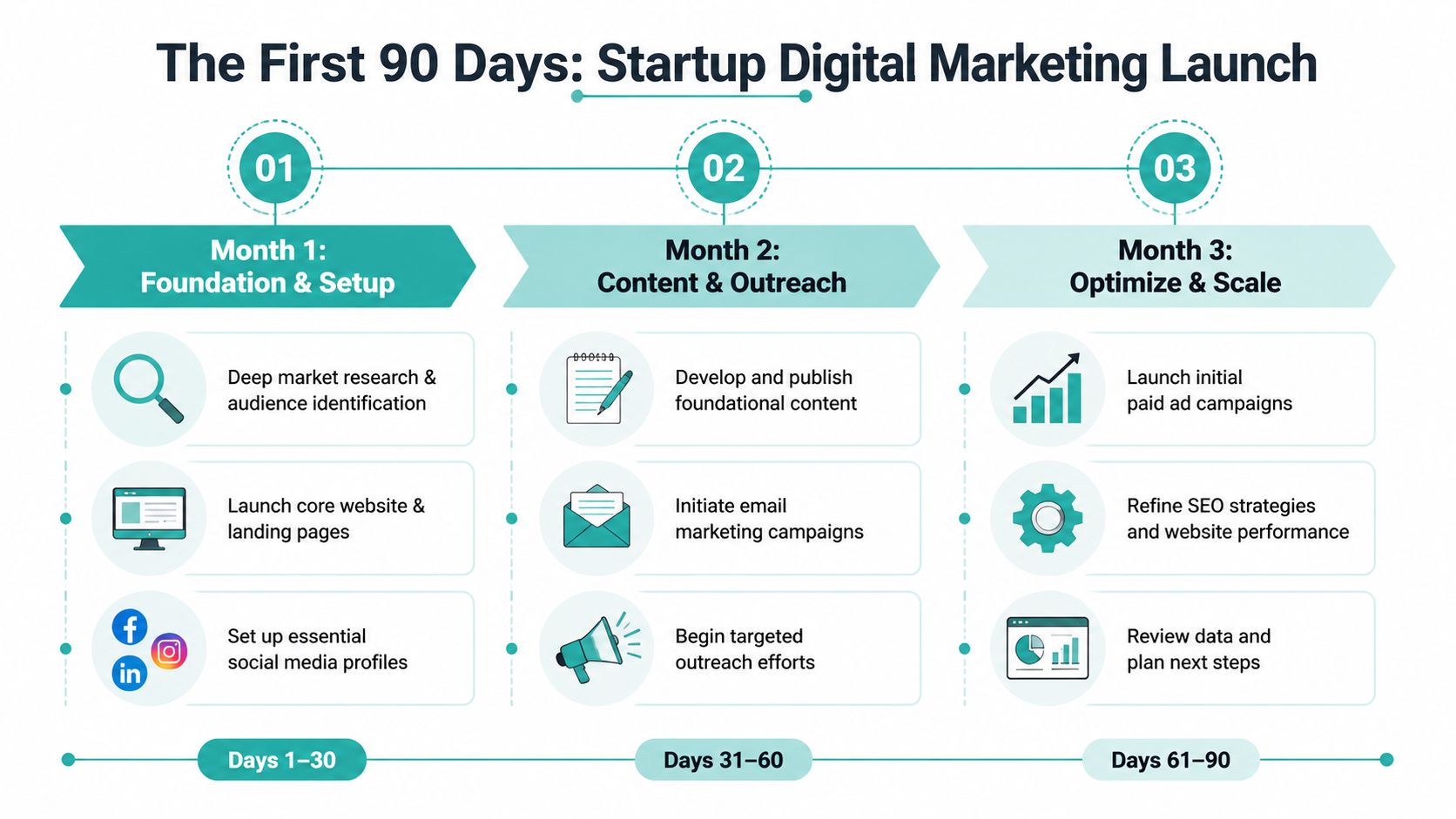
Break the first quarter into three 30-day sprints. Days 1 to 30 are for setup and signal collection. Days 31 to 60 are for message refinement and asset creation. Days 61 to 90 are for budget allocation, process documentation, and selective automation. As noted earlier, poor marketing decisions contribute to startup failure often enough that discipline here matters.
Days 1 to 30 foundation and quick wins
Month one is for getting clean data and a credible first test.
Set up GA4 with conversion events for the actions that matter. That usually means booked calls, demo requests, purchases, trial starts, or qualified form fills. Connect ad platforms to your CRM. Build one landing page for one offer. Then launch one paid test on the channel with the strongest buyer intent.
Keep the scope tight:
- GA4 with conversion tracking tied to revenue-related actions
- Core social and search profiles where buyers will verify you
- One landing page with one audience and one CTA
- One paid acquisition test with a fixed budget cap
- Basic CRM workflows so every lead gets routed and answered
The trade-off is simple. A startup can test three channels badly or one channel well. One channel well usually wins.
Channel choice should match buying behavior. A local service startup may start with Google Ads and a city-specific page. A B2B company may test search around a pain-point keyword set or run LinkedIn ads against one industry segment. An e-commerce brand may begin with paid social and a focused collection page, but only if product-market fit and margin can support customer acquisition costs.
Do not judge the channel yet. Judge whether the offer is clear, the page is credible, and the tracking works.
Days 31 to 60 momentum and asset building
Month two is where weak operators panic and restart from zero. Founders see mixed early results, assume the channel failed, and switch platforms before they have enough data to learn anything useful.
Stay with the test long enough to answer the right questions. Which message earned the click? Which keyword or audience produced conversions, not just traffic? Which objections are showing up on the landing page or in sales calls?
Use those answers to tighten the system:
- Review ad copy, search terms, and audience performance
- Identify the conversion paths with the lowest friction
- Rewrite weak sections of the page
- Publish one durable content asset tied to a real buying question
- Add email capture and follow-up for visitors who are interested but not ready
That content asset should pull double duty. It should support search visibility and help sales handle objections. A strong example is a detailed comparison, implementation guide, or cost breakdown tied to commercial intent. If your team is also thinking about AI search visibility, this is a good stage to study how to rank in ChatGPT, because search behavior is already shifting toward answer engines and cited sources.
Traffic without follow-up is wasted spend. Well-structured lead generation funnels turn that early interest into booked conversations, nurtured prospects, and clearer attribution.
Days 61 to 90 scaling and systemization
Month three is where startup marketing starts to look like an operating system instead of a set of tasks.
By now, there should be enough signal to make budget decisions with more confidence. Increase spend on the campaigns producing qualified opportunities. Cut the tests that generate cheap clicks but weak pipeline. If a page converts but attracts the wrong lead type, fix the message before adding spend. Volume hides problems. Good operators remove them first.
This is also the point where AI starts to pay for itself in a practical way. Use it to summarize call notes, cluster search queries, generate ad variations from winning angles, flag lead quality patterns, and trigger segmented follow-up. The goal is faster iteration with a small team, not automation for its own sake.
Ask hard questions every week:
- Which channel is producing qualified pipeline?
- Which campaign has the best cost per qualified lead?
- Which landing page converts first-time visitors without heavy sales intervention?
- Which content topics assist deals later in the funnel?
- Where do leads stall between click, form, meeting, and close?
Document what works. Create templates for reporting, page briefs, ad tests, follow-up emails, and weekly review meetings. A startup that finishes the first 90 days with clean tracking, one working funnel, and a short list of proven messages is in a much stronger position than one that spread effort across six channels and learned nothing.
The AI Force Multiplier How Startups Can Outsmart Competitors
A lot of founders talk about AI as if it’s one tool. It isn’t. It’s a layer you add to research, production, optimization, follow-up, and reporting.
That’s why AI works so well for startups. You don’t need it to “replace marketing.” You need it to remove repetitive work, tighten response time, and personalize communication without hiring a large team.

Use AI where speed and consistency matter
The opportunity gap is real. Startups using AI for marketing see 30% to 50% higher engagement rates, yet only 22% of small businesses have adopted AI tools, according to BolsterBiz’s report on startup marketing strategies.
That gap matters because larger competitors often move slowly. They need approvals, meetings, handoffs, and committee decisions. A startup can use AI to move from insight to action much faster.
The highest-value uses are usually practical:
- Predictive lead scoring so sales follows the best opportunities first
- Churn and lifetime value forecasting to guide budget allocation
- Ad and channel mix optimization based on performance patterns
- Email sequence automation triggered by behavior
- Content ideation and repurposing from one pillar asset into multiple formats
- Customer feedback analysis from reviews, calls, and form responses
The companies seeing the best results don’t let AI publish unedited garbage at scale. They use it to accelerate research, drafting, tagging, segmentation, summarization, and testing, then put human judgment on top.
What founders should automate first
If you’re resource-constrained, start with the tasks that steal time every week:
- Lead routing and follow-up
- Appointment reminders and nurture emails
- Creative variations for ads
- Reporting summaries from GA4 and ad platforms
- Content briefs from recurring customer questions
The smartest AI workflow is the one that shortens the distance between buyer intent and team response.
There’s also a newer layer founders shouldn’t ignore. Search behavior is shifting toward AI-assisted discovery, which means your content needs to be structured clearly enough to surface in those environments. If you’re trying to understand that shift, this guide on how to rank in ChatGPT is a useful starting point.
The winning pattern is simple. Use AI for speed, use humans for judgment, and build systems that improve as data accumulates. For startups investing in long-term organic visibility, that’s where tools and workflows behind generative content engines become strategically useful instead of gimmicky.
Measuring What Matters KPIs That Connect Marketing to Revenue
It’s Monday morning. The ad platform says clicks are up, GA4 shows a traffic spike, and LinkedIn posts got decent engagement. Then sales says the pipeline still looks thin.
That gap is where startup marketing usually breaks. Founders are not short on data. They are short on measurement that ties spend to revenue.
The fix is to track a small set of metrics in sequence, from first touch to closed deal to retained customer. That gives you a working growth model, not a pile of channel reports.
The numbers that deserve your attention
Likes, followers, impressions, and raw traffic are early signals. They help with diagnosis. They do not tell you whether marketing is creating profitable demand.
Watch the metrics that connect activity to business outcomes:
- CAC tells you what it costs to acquire a customer
- LTV tells you what that customer is worth over time
- ROAS shows whether ad spend is producing revenue efficiently
- CPL helps you compare front-end efficiency across channels
- Conversion rate tells you whether the page, offer, and traffic quality are aligned
Used together, these metrics show where the system is breaking. High CPL and strong close rates usually point to a top-of-funnel volume problem. Low CPL and weak sales conversion often mean the targeting or offer is off. Strong click-through rates with poor on-page conversion usually send you back to the landing page, not the ad account.
That is why structured data-driven frameworks outperform intuition. Startups grow faster when they can trace spend to leads, leads to pipeline, and pipeline to revenue, then adjust weekly instead of arguing from opinions.
AI makes this process faster if you use it correctly. Use automation to pull reporting from ad platforms, your CRM, and GA4 into one weekly view. Use AI to summarize changes, flag anomalies, and surface patterns by channel or audience. Keep human review on top, because a model can spot a drop in conversion rate, but it cannot tell you whether the underlying issue is weak positioning, a broken form, or a sales follow-up problem.
A simple rule keeps teams honest. Ask, “Did this channel create qualified demand at a cost the business can sustain?”
If you can’t trace a lead back to a channel, a message, and a page, you’re tracking activity, not performance.
From Startup to Scale-Up Your Path Forward
A startup doesn’t need a bloated marketing stack or a trendy channel list. It needs a system.
That system starts with sharp positioning, then a website built to convert, then a small set of channels chosen for intent and buying behavior, then a disciplined ninety-day launch plan. Add AI where it removes drag, and measure only what connects effort to revenue.
The hard part isn’t understanding the playbook. The hard part is executing it while also building the company. Founders have to make hiring decisions, manage operations, serve customers, and still find time to review landing pages, fix tracking, approve creative, and interpret performance.
That’s why the best operators seek strategic advantages. They don’t outsource strategy blindly, and they don’t try to do every specialized task themselves. They bring in experienced execution where speed, clarity, and accountability matter most.
If you want help turning this digital marketing strategy for startups into a working growth engine, Emulous Media Inc can help. We build conversion-focused websites, performance campaigns, media assets, and AI-powered marketing systems for businesses in Central Florida and beyond. Book a free consultation, call 689-255-6327, or visit the contact page to start the conversation.