
UI/UX Design Strategy In Lake Mary
Stop frustrating your visitors. Start building digital experiences they actually want to use.
Website Design Services
- Custom Website Design
- E-commerce Development
- UI/UX Design Strategy
- High-Converting Landing Pages
- Website Maintenance & Care
- Mobile-First Responsive Design
- CMS Development
- Website Redesign & Modernization
- API Integration & Custom Functionality
- AI Chatbot Integration
- Voice Search Optimization (AEO)
- Consultation and Strategy
689-255-6327
Request a Consultation
UI/UX Design Strategy in Lake Mary: Create Digital Experiences That Convert
Stop losing potential customers to confusing navigation. We build data-driven design strategies that eliminate friction and frustration, turning your website or app into a seamless experience that users love and trust.
Your website or app frustrates users. They leave without converting. You need strategic UI/UX design that guides visitors smoothly from landing to action, removing friction and confusion at every step.
Emulous Media delivers UI/UX design strategy services for Lake Mary businesses. We research your users, map their journeys, design intuitive interfaces, and test solutions that turn confused visitors into satisfied customers who complete desired actions.
Ready to fix your user experience problems? Call Emulous Media at 689-255-6327 to discuss your Lake Mary UI/UX design strategy needs.
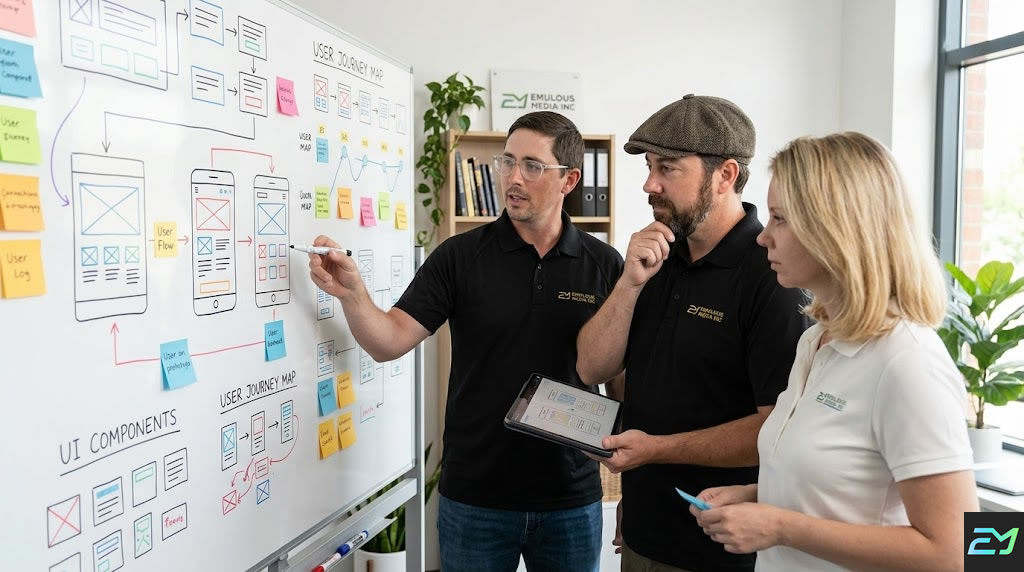
Stop letting minor design flaws cost you major sales. Our dedicated support team continuously monitors and tweaks your digital products, ensuring a flawless, intuitive journey that keeps users coming back.
Poor user experience costs you customers and revenue. Visitors abandon confusing websites. Users delete frustrating apps. Strategic UI/UX design removes barriers between users and conversions.
The business impact is measurable:
- 88% of users won't return to a website after a bad user experience
- UI improvements increase conversion rates by 200-400%
- 70% of online businesses fail because of poor usability
- Good UX design increases customer retention by 400%
- Every dollar invested in UX returns $100 (10,000% ROI)
- 94% of first impressions relate to design and user experience
- Mobile users abandon sites that take over 3 seconds to load
Your Lake Mary competitors invest in professional UI/UX strategy. Their websites work intuitively. Their apps delight users. Their conversion rates justify the investment.
You compete for the same customers. Your user experience needs to match or exceed theirs.
Strategic UX design goes beyond making things look nice:
User Research and Analysis
Understanding who uses your product and why:
- User interviews and surveys
- Behavioral analytics review
- Demographic and psychographic profiling
- User pain point identification
- Competitor user experience analysis
- Accessibility requirement assessment
- Device and platform usage patterns
- Task and goal identification
Research reveals what users need instead of what you assume they need.
User Personas and Journey Mapping
Documenting user types and behaviors:
- Creating detailed user personas
- Mapping user journey stages
- Identifying touchpoints and interactions
- Documenting pain points and frustrations
- Highlighting opportunities for improvement
- Understanding emotional states throughout journeys
- Defining success metrics per journey stage
- Planning personalized experiences
Journey maps show where users struggle and where design interventions help most.
Information Architecture
Organizing content logically:
- Creating site structure and hierarchy
- Planning navigation systems
- Organizing content categories
- Designing search and filtering
- Creating content taxonomies
- Planning URL structures
- Designing menu systems
- Establishing content relationships
Good information architecture helps users find what they need quickly.
Wireframing and Prototyping
Planning layouts before visual design:
- Creating low-fidelity wireframes
- Developing interactive prototypes
- Testing user flows
- Planning responsive layouts
- Designing component libraries
- Establishing design patterns
- Creating clickable prototypes
- Validating concepts before development
Wireframes and prototypes let you test and refine before expensive development.
Interface Design
Creating the visual layer:
- Designing visual hierarchy
- Creating component designs
- Establishing typography systems
- Developing color palettes
- Designing icons and graphics
- Creating interaction states
- Planning animations and transitions
- Ensuring brand consistency
Interface design makes wireframes beautiful while maintaining usability.
Interaction Design
Defining how users interact:
- Designing button and link behaviors
- Planning form interactions
- Creating feedback mechanisms
- Designing error states and messages
- Planning loading and processing states
- Designing micro-interactions
- Creating transition animations
- Ensuring intuitive controls
Interaction design makes digital products feel responsive and natural.
Accessibility Design
Making products usable by everyone:
- Following WCAG accessibility guidelines
- Designing for screen readers
- Ensuring keyboard navigation
- Planning color contrast
- Creating alt text strategies
- Designing for cognitive accessibility
- Testing with assistive technologies
- Ensuring ADA compliance
Accessible design serves more users while reducing legal risk.
Usability Testing
Validating designs with real users:
- Conducting user testing sessions
- A/B testing design variations
- Analyzing heat maps and recordings
- Measuring task completion rates
- Identifying usability issues
- Testing on multiple devices
- Gathering qualitative feedback
- Iterating based on findings
Testing reveals problems you miss sitting too close to your own product.
Every UX project follows structured methodology:
Step 1: Discovery and Research
We understand your business and users:
- Interviewing stakeholders
- Reviewing analytics and data
- Conducting user research
- Analyzing competitors
- Auditing current experience
- Identifying business goals
- Understanding technical constraints
- Defining success metrics
Discovery prevents designing solutions to wrong problems.
Step 2: User Personas and Journey Mapping
We document who uses your product and how:
- Creating detailed user personas
- Mapping current user journeys
- Identifying pain points
- Highlighting opportunities
- Planning ideal future journeys
- Prioritizing improvements
- Setting experience goals
Journey maps align teams around user needs.
Step 3: Information Architecture
We organize content logically:
- Creating site maps
- Planning navigation structures
- Organizing content categories
- Designing search and filtering
- Creating content hierarchies
- Planning URL structures
IA determines whether users find what they need.
Step 4: Wireframing and Flow Design
We plan layouts and interactions:
- Creating wireframes for key screens
- Designing user flows
- Planning responsive layouts
- Establishing component patterns
- Creating interactive prototypes
- Testing with stakeholders
Wireframes validate concepts before visual design investment.
Step 5: Visual Design
We create the interface layer:
- Designing visual systems
- Creating component libraries
- Developing style guides
- Designing key screens
- Planning responsive variations
- Ensuring accessibility
Visual design makes wireframes beautiful while maintaining usability.
Step 6: Prototyping and Testing
We validate designs with users:
- Creating clickable prototypes
- Conducting usability tests
- Gathering user feedback
- Analyzing test results
- Iterating based on findings
- Refining designs
Testing prevents launching products users struggle with.
Step 7: Design System Documentation
We document designs for development:
- Creating design specifications
- Documenting component behavior
- Providing interaction details
- Creating style guides
- Documenting design patterns
- Ensuring developer handoff clarity
Good documentation prevents implementation errors.
Step 8: Implementation Support
We assist during development:
- Reviewing implementations
- Answering developer questions
- Ensuring design fidelity
- Testing builds
- Identifying issues
- Refining details
Design support ensures final products match design intent.
Step 9: Post-Launch Optimization
We improve based on real usage:
- Analyzing user behavior
- Identifying friction points
- A/B testing improvements
- Measuring metrics
- Iterating designs
- Continuous optimization
UX work continues after launch based on real user data.
Professional UX strategy requires specialized tools:
Research: UserTesting, Hotjar, Google Analytics, Surveys, Interviews for understanding users.
Journey Mapping: Miro, Figma, Lucidchart for documenting user journeys and workflows.
Wireframing: Figma, Sketch, Adobe XD for creating layouts and structures.
Prototyping: Figma, InVision, Principle for interactive prototypes and testing.
Design: Figma, Sketch, Adobe XD for interface design and component systems.
Testing: Maze, UserTesting, Optimal Workshop for usability testing and validation.
Analytics: Google Analytics, Mixpanel, Amplitude for behavioral data analysis.
Accessibility: WAVE, axe, Screen readers for accessibility testing and validation.
We select tools based on project needs and team preferences.
Lake Mary businesses benefit from local UX strategists:
- Face-to-face user research and testing sessions
- Understanding of local market and user preferences
- In-person workshops and collaboration
- Quick iteration and feedback cycles
- Knowledge of Lake Mary business environment
- Partnership approach for ongoing optimization
UX strategy benefits from close collaboration. Local teams communicate better.
Stop losing customers to poor user experience. Contact Emulous Media today at 689-255-6327 for professional UI/UX design strategy in Lake Mary.
Our UI/UX strategy experience covers multiple sectors:
Technology and SaaS: Software applications, web apps, mobile apps, and platforms requiring intuitive interfaces for complex functionality.
E-Commerce: Online stores needing streamlined shopping experiences from browsing through checkout.
Healthcare: Patient portals, appointment systems, telehealth platforms, and medical applications requiring accessible, compliant interfaces.
Financial Services: Banking apps, investment platforms, insurance portals, and fintech products needing secure, trustworthy experiences.
Education: Learning management systems, online courses, student portals, and educational apps requiring engaging, effective interfaces.
Professional Services: Client portals, booking systems, project management tools, and service platforms streamlining professional workflows.
Real Estate: Property search, virtual tours, agent platforms, and listing systems helping users find properties efficiently.
Each industry has specific UX requirements and user expectations. We adapt strategies to your sector.
Standard UI/UX strategy timelines:
- UX audit: 1-2 weeks
- User research: 2-3 weeks
- Journey mapping and strategy: 2-4 weeks
- Wireframes and prototypes: 3-5 weeks
- Complete UI/UX design: 6-10 weeks
- Mobile app design: 6-12 weeks
- Design system: 4-8 weeks
- Usability testing: 2-3 weeks
Timeline includes research, design, testing, iteration, and documentation.
Rush service available for urgent projects with expedited fees.
The difference between amateur and professional UX design:
Research-Based: Professional UX bases decisions on user research and data. Amateur UX relies on assumptions and personal preferences.
User-Focused: Professional UX prioritizes user needs over client preferences. Amateur UX builds what clients want without considering users.
Iterative: Professional UX tests and refines continuously. Amateur UX designs once without validation.
Strategic: Professional UX aligns design with business goals. Amateur UX focuses on aesthetics without strategy.
Accessible: Professional UX ensures products work for everyone. Amateur UX ignores accessibility.
Data-Driven: Professional UX measures and optimizes based on metrics. Amateur UX never validates assumptions.
Documented: Professional UX creates comprehensive documentation. Amateur UX leaves developers guessing.
Mobile drives majority of digital interactions:
Mobile-First Thinking: Designing for mobile constraints first ensures excellent experiences on all devices.
Touch Targets: Buttons and links sized appropriately for finger tapping (minimum 44x44 pixels).
Simplified Navigation: Streamlined menus and actions fitting small screens.
Performance: Mobile users have less patience. Experiences must load and respond instantly.
Progressive Disclosure: Revealing information progressively rather than overwhelming mobile screens.
Gestures: Supporting swipe, pinch, and other mobile-native interactions.
Thumb-Friendly: Placing important actions within easy thumb reach.
Over 70% of digital interactions happen on mobile devices. Mobile UX determines success.
Turning visitors into customers:
Clear Value Propositions: Communicating value immediately upon arrival.
Reduced Friction: Removing unnecessary steps and form fields.
Strategic Calls to Action: Placing CTAs where users are ready to act.
Trust Signals: Reviews, testimonials, security badges, and guarantees reducing hesitation.
Error Prevention: Designing to prevent user mistakes and frustration.
Progressive Forms: Breaking long forms into manageable steps.
Exit Intent: Capturing abandoning users with well-timed offers.
UX directly impacts conversion rates and revenue.
Designing for all users:
WCAG Compliance: Following Web Content Accessibility Guidelines (Level AA minimum).
Screen Reader Support: Ensuring content works with assistive technologies.
Keyboard Navigation: Full functionality without mouse or touch.
Color Contrast: Sufficient contrast for visibility with visual impairments.
Alternative Text: Descriptive alt text for images and graphics.
Captions and Transcripts: Text alternatives for audio and video content.
Cognitive Accessibility: Simple language, clear structure, and intuitive interactions.
Accessible design serves 15-20% more users while reducing legal risk.
Tracking user experience effectiveness:
Quantitative Metrics:
- Conversion rates
- Task completion rates
- Time on task
- Error rates
- Bounce rates
- Page views per session
- Form abandonment rates
Qualitative Metrics:
- User satisfaction scores
- Net Promoter Score (NPS)
- System Usability Scale (SUS)
- User feedback and comments
- Support ticket volume
- Feature adoption rates
Business Metrics:
- Revenue per visitor
- Customer lifetime value
- Customer acquisition cost
- Return on investment
- Customer retention rates
Data guides continuous UX improvement.
Maintaining coherent experiences at scale:
Component Libraries: Reusable design elements ensuring consistency.
Pattern Documentation: Established solutions for common problems.
Style Guides: Typography, colors, spacing, and visual standards.
Code Components: Development-ready components matching designs.
Governance: Processes for maintaining and evolving systems.
Versioning: Managing updates without breaking existing implementations.
Design systems accelerate development while ensuring consistency.
Working across all devices and contexts:
Responsive Layouts: Designs that adapt fluidly to any screen size.
Breakpoint Strategy: Planned adjustments at key screen widths.
Adaptive Content: Showing appropriate content based on device capabilities.
Performance Budgets: Ensuring fast loading across connection speeds.
Touch and Mouse: Supporting both input methods seamlessly.
Orientation Changes: Handling portrait and landscape modes.
Users access digital products on countless devices. Designs must work everywhere.
A Lake Mary SaaS company redesigned their product with UX strategy. User onboarding completion increased 185%. Customer churn decreased 42%. Support tickets dropped 35%.
A healthcare provider rebuilt their patient portal focusing on UX. Appointment bookings increased 156%. Phone calls for simple tasks decreased 67%. Patient satisfaction scores improved 40%.
An e-commerce business redesigned checkout flow based on UX research. Cart abandonment decreased from 68% to 41%. Average order value increased 28%. Revenue per visitor grew 73%.
A financial services company improved their mobile app UX. App store ratings increased from 3.2 to 4.7 stars. Active users grew 210%. Transaction volume increased 165%.
Your success story comes next.
Your users struggle with your current experience. Contact Emulous Media now at 689-255-6327 for professional UI/UX design strategy in Lake Mary.
Your digital products frustrate users. They abandon carts. They delete apps. They choose competitors with better experiences.
Strategic UI/UX design fixes these problems. Your users accomplish goals easily. Your conversion rates improve. Your customers stay longer and spend more.
Emulous Media makes professional UX strategy accessible to Lake Mary businesses. We combine research, design expertise, and testing. You get experiences users love and business results you need.
Contact us today. We'll audit your current experience. We'll explain our approach. We'll provide a detailed proposal.
Your improved user experience launches in weeks. Your conversion rates increase immediately. Your business benefits from design that works for users and achieves your goals.
Schedule your consultation now. Let's create UI/UX strategy that turns your Lake Mary digital products into experiences users love and recommend.
Call 689-255-6327. Your UI/UX design strategy project starts today.
Choose a User Interface / Experience Package
UI / UX Pricing. No Surprises
Our Promise: We provide exact quotes based on your unique needs. No hidden fees. Professional UX generates ROI through increased conversions, reduced support costs, and improved user retention.
$2000
Project Minimum
- Scope: Diagnostic & Foundation
- Comprehensive UX Audit
- Expert Recommendations
- Light User Research
- Heuristic Evaluation
- 1-Time Project
$4000
Project Minimum
- Scope: Structure & Interaction
- User Research & Personas
- User Journey Mapping
- Low-Fidelity Wireframes
- Strategy Development
- 1-Time Project
$8000
Project Minimum
- Scope: End-to-End Execution
- Everything in Tier 2
- Detailed UI Design (10-20 Screens)
- Interactive Prototype
- Design System Creation
- Best for Websites
$3000
Monthly Management Fee
- Scope: Optimization & Retention
- Post-Launch Optimization
- A/B Testing & Analysis
- Ongoing Usability Testing
- Monthly CRO Reporting
- Focus on ROI
Frequently Asked Questions About User Interfaces and User Experiences
Most Popular UI/UX Questions
UI/UX design strategy is a research-based approach to creating digital products that align user needs with business goals. While UI (User Interface) focuses on the visual elements like buttons and colors, UX (User Experience) focuses on the overall feel and logic of the journey. A strategic approach ensures your website or app isn't just "pretty," but is functionally designed to remove friction, reduce confusion, and guide Lake Mary users toward a specific conversion goal.
Professional UI/UX design can increase conversion rates by 200% to 400%. By using research-driven layouts, clear calls-to-action (CTAs), and simplified navigation, you remove the "cognitive load" that causes users to abandon a site. When a Lake Mary business makes it easier for a customer to find information or complete a checkout, the likelihood of that visitor turning into a lead or sale increases dramatically.
The return on investment for UX design is exceptionally high; studies show that every $1 invested in UX returns $100 (a 10,000% ROI). This happens because good design increases customer retention by up to 400%, lowers customer acquisition costs, and significantly reduces the need for expensive customer support by making the digital experience self-explanatory.
In Lake Mary, a standard UI/UX strategy project typically takes 6 to 12 weeks, depending on complexity. A basic UX audit might take only 1-2 weeks, while a complete mobile app design involving deep user research, wireframing, interactive prototyping, and usability testing usually falls in the 8-to-12-week range.
A wireframe is a low-fidelity "blueprint" of a screen that focuses on structure and layout without colors or graphics. A prototype is an interactive, clickable model of the final product. At Emulous Media, we use prototypes to simulate the real user experience, allowing us to test flows and catch usability issues before a single line of code is written.
With over 70% of digital interactions now occurring on mobile devices, a mobile-first strategy ensures your site works perfectly on the smallest screens first. This involves designing for touch targets (minimum 44x44 pixels), thumb-friendly navigation, and fast loading speeds. If a mobile experience takes longer than 3 seconds to load, most Lake Mary users will abandon the site.
Accessibility design ensures that your digital products are usable by everyone, including people with visual, auditory, or cognitive impairments. Following WCAG guidelines (Web Content Accessibility Guidelines) includes implementing high color contrast, screen reader support, and keyboard-friendly navigation. This not only serves an additional 15-20% of the population but also reduces legal risks for Lake Mary businesses.
UI/UX pricing varies by project scope, but common ranges include:
UX Audit & Recommendations: $2,000 – $5,000
Complete Website UI/UX Design: $8,000 – $20,000
Mobile App UI/UX Design: $10,000 – $25,000 Strategic design is an investment that pays for itself through increased revenue and reduced development rework.
Information Architecture is the science of organizing and labeling content so users can find what they need quickly. It involves creating logical site maps, navigation menus, and search hierarchies. Effective IA ensures that your Lake Mary customers never feel "lost" on your website, which is one of the leading causes of high bounce rates.
We measure success using both quantitative and qualitative data. Key metrics include conversion rate increases, reduced bounce rates, and higher task completion rates. We also look at qualitative feedback through usability testing and satisfaction scores. Continuous optimization after launch ensures the design continues to perform as user behaviors evolve.
Testimonials
Client Feedback & Reviews.
EXCELLENT Based on 19 reviews
 Posted on Google
 Amanda CarlsonAaron and his company are the best. I am Someone who understands nothing about websites etc so of course he made me my site-and was there for me to change and update every step of the way. Always responsive to emails and texts. It was a great experience and I’m So happy to have found him.Posted on Google
 T & B RenovationsAaron and his team are awesome at what they do! We have used them to redo our website and integrate new CRM. They are responsive and handle all requests as needed. Highly recommend!Posted on Google
 Dexter JairamWhen I started working with Aaron's team, they rebuilt my flooring company website and Google marketing. I've been booked out for months in advance!Posted on Google
 ironwerxAaron is a real professional. He does not over promise and underdeliver. He makes sure that his clients understand what it is going to take to succeed when marketing online.He's knowledgeable and trustworthy.Posted on Google
 Medicine Shell PhotographySeriously an amazing company to work with!! Their advanced thinking in the marketing world is a must for businesses looking to grow.Posted on Google
 Luis Gustavo Ortiz RodriguezThis company is very professional I will recommend %100Posted on Google
 Prime Digital SEOAaron and the Emulous team do an amazing job at lead generation and producing quality leads for clients. Highly recommend if you can take on more work!Verified by TrustindexTrustindex verified badge is the Universal Symbol of Trust. Only the greatest companies can get the verified badge who has a review score above 4.5, based on customer reviews over the past 12 months. Read more
Need UI&UX Services? Give Us a Call
Whether you need a new digital presence, search engine optimization, a targeted PPC campaign, or a comprehensive marketing roadmap, Emulous Media is your partner in success. Contact us today to elevate your brand.
User Experience Services in Lake Mary
Located between Lake Mary and Heathrow, Florida, Emulous Media is a premier full-service agency dedicated to transforming businesses through strategic advertising, marketing, and high-impact website design. Our team of experts delivers elite media production and data-driven solutions, helping Central Florida brands dominate their markets and achieve remarkable, long-term growth today.
Our expertise spans five core pillars: Advertising, Marketing, Media Production, Website Design and AI Automation. Whether you need to dominate local search results, launch a national ad campaign, build a custom digital storefront, or automate your workforce with intelligent agents, we provide the enterprise-level capabilities you need with the personal accessibility of a local partner.
We believe that the best partnerships are built on transparency and face-to-face collaboration. We aren't a faceless remote team; we are your neighbors in Central Florida, ready to help you outpace the competition. Our local presence ensures personalized service and strategic excellence as we work together to grow your brand.
Based in Lake Mary, our team is mobile. We bring elite media production directly to your doorstep. We serve the entire Central Florida region, arriving fully equipped with high-end technology and strategic expertise to capture your brand’s story on-site, ensuring a seamless, professional experience that fits perfectly within your busy schedule.