You’re probably in the same spot as a lot of business owners in Central Florida right now. You know online ads matter, but every platform claims it’s the one you need. Google says search wins. Facebook says discovery wins. Microsoft operates with less fanfare and often costs less. Meanwhile, your budget doesn’t have room for guessing.
That’s why understanding ppc advertising networks matters. The platform is not the strategy. The right network depends on how your business makes money. A local roofing company in Lake Mary should not advertise the same way as an e-commerce brand shipping nationwide. If you treat them the same, you burn budget.
Table of Contents
- Why Your Ad Budget Needs a Better Plan
- What Exactly Are PPC Advertising Networks
- The Major Players Google Meta and Microsoft
- Choosing the Right Network for Your Business
- Smart Implementation and AI-Powered Optimization
- Take Control of Your PPC Strategy
Why Your Ad Budget Needs a Better Plan
A lot of owners start advertising the same way. They put a few dollars behind a boosted post, try a handful of keywords, then decide paid ads “don’t work.” That usually isn’t a platform problem. It’s a planning problem.

Stop boosting posts and start buying intent
PPC works because it lets you buy attention from people who are already close to a decision, or who fit the audience you want to influence. That’s a much smarter use of budget than tossing money into broad awareness and hoping it turns into leads.
According to HubSpot’s PPC statistics roundup, PPC advertising generates double the website visitors of SEO and converts 50% better than organic traffic. The same source reports that leads from search engines close at 14.6%, compared with 1.7% for outbound leads, and 74% of brands consider PPC a major business driver.
Practical rule: If you need leads this quarter, PPC belongs in the plan. SEO matters, but it’s slower. PPC gives you a direct line to demand.
For a local HVAC company in Orlando, that means showing up when someone searches for repair help. For a healthcare practice, it means getting in front of patients looking for a provider now. For an online store, it means capturing purchase intent instead of waiting for social posts to maybe get traction.
Networks are where strategy gets real
Most wasted ad spend happens before the first click. Businesses pick a platform because it’s familiar, not because it fits the buying journey. That’s backward.
Your budget needs a job description. Some networks are built to capture active demand. Others are better at creating demand, building familiarity, or bringing visitors back after they leave. If you don’t match the network to the business model, the campaign looks busy but doesn’t produce enough revenue to justify the spend.
A smart plan starts with one question. Where does your customer take the next step? Search, social, video, shopping, remarketing. The answer determines the network mix.
What Exactly Are PPC Advertising Networks
The term sounds more technical than it is. A PPC advertising network is the system that connects advertisers with digital ad space and charges based on clicks.
Think of a network like a digital marketplace
Think of it as a marketplace. On one side, businesses want visibility. On the other, websites, apps, search results, social feeds, and video platforms have ad inventory. The network runs the auction, handles targeting, and delivers the ad to the right person in the right place.
That’s the basic idea behind Google Ads, Meta Ads, Microsoft Advertising, LinkedIn Ads, YouTube placements, and programmatic display platforms. They all sell access to attention. They differ in where the ads appear, how targeting works, and what kind of user intent is present.
If you want a clean primer before you build campaigns, these PPC insights for marketing teams do a good job of breaking down the moving parts without drowning you in jargon.
The four network types that matter most
Here’s the simple version most business owners need.
- Search networks put text or shopping-style ads in front of users actively looking for something. Buyers actively show their interest in this setting.
- Display networks place visual ads across websites and apps. Good for visibility, reminders, and audience expansion.
- Social media networks target people based on interests, behavior, demographics, and engagement patterns. Strong for discovery and retargeting.
- Video networks help you sell visually, explain offers fast, and build trust before a click.
If your business relies on demand capture, search deserves first attention. If you need to shape demand or stay in front of a market over time, social and video become more important. If your visitors leave without buying, display retargeting earns its keep.
For brands using broader awareness campaigns, programmatic display advertising becomes useful because it gives you more control over placements, audiences, and cross-site visibility than a basic boosted social campaign.
Why intent should drive your budget split
Owners usually overcomplicate things. You don’t need to memorize platform features. You need to understand intent.
The strongest example is the gap between search and display. According to Digital Applied’s PPC data points, Google’s Search Network has an average conversion rate of 3.17%, while the Display Network converts at 0.46%. That difference exists because search users are actively looking for solutions.
Search traffic is expensive in the right situations for one reason. It’s closer to money.
That doesn’t mean display is bad. It means display has a different job. Search closes more directly. Display supports awareness, retargeting, and repeat exposure. Owners who expect display to behave like search usually shut off good campaigns for the wrong reason.
The Major Players Google Meta and Microsoft
Three networks dominate most serious PPC conversations. They don’t do the same job, and they shouldn’t get the same budget by default.
Google Ads is the foundation
For most businesses, Google Ads is where PPC starts. Not because it’s trendy, but because it captures people at the moment they’re searching for a product, service, or answer.
According to That Company’s PPC stats, Google Ads holds 73.1% of the paid search market share and generated $175 billion in 2023. The same source reports that businesses earn $2 in revenue for every $1 spent on Google Ads.
That’s why Google usually becomes the base layer for lead generation campaigns, shopping campaigns, branded defense, and location-based demand capture. If someone in Orlando searches for emergency plumbing, a Google search ad meets them in the highest-intent moment available.
A lot of companies don’t need more channels first. They need tighter Google execution first. Better keyword selection, cleaner account structure, stronger landing pages, better call tracking, and disciplined bidding. That’s why many businesses start with focused Google Ads PPC management before expanding into more channels.
Meta Ads creates demand before people search
Meta is not the same animal. Facebook and Instagram don’t rely on active search behavior. They let you target users based on interests, engagement, behaviors, and audience characteristics.
That makes Meta powerful when your customer isn’t searching yet, but is still persuadable. Home design brands, elective healthcare offers, fitness services, events, beauty, retail, and visually driven local businesses often get strong traction there because the creative does more of the selling.
Meta is also useful for retargeting. Someone visits your site, leaves, and then sees a reminder in their feed. That’s often the nudge that gets them back.
Where businesses get in trouble is using Meta for offers that demand urgent intent. If someone needs a tow truck, they don’t browse Instagram first. They search. Meta supports demand creation. It usually doesn’t replace direct response search for urgent local services.
Microsoft Advertising is the overlooked profit play
Microsoft Advertising gets ignored far too often, especially by service businesses that assume all worthwhile search traffic lives on Google. That’s lazy planning.
Microsoft can be a smart move when your Google campaigns are crowded, expensive, or too broad. It’s also a useful hedge when you want to diversify lead flow and avoid depending on a single auction environment. For some local and regional campaigns, that lower-pressure environment is exactly what makes the economics work.
If your market is competitive and your margins are tight, a second search network can improve efficiency faster than adding another social campaign.
It won’t replace Google for most brands. But it can absolutely sharpen a service business’s cost structure, especially when the account is organized around narrow location targeting, strong keyword intent, and clean conversion tracking.
Choosing the Right Network for Your Business
Most generic articles miss the mark here. They list platforms. They don’t tell you what to do. So here’s the blunt version. Pick networks based on how your business gets bought.
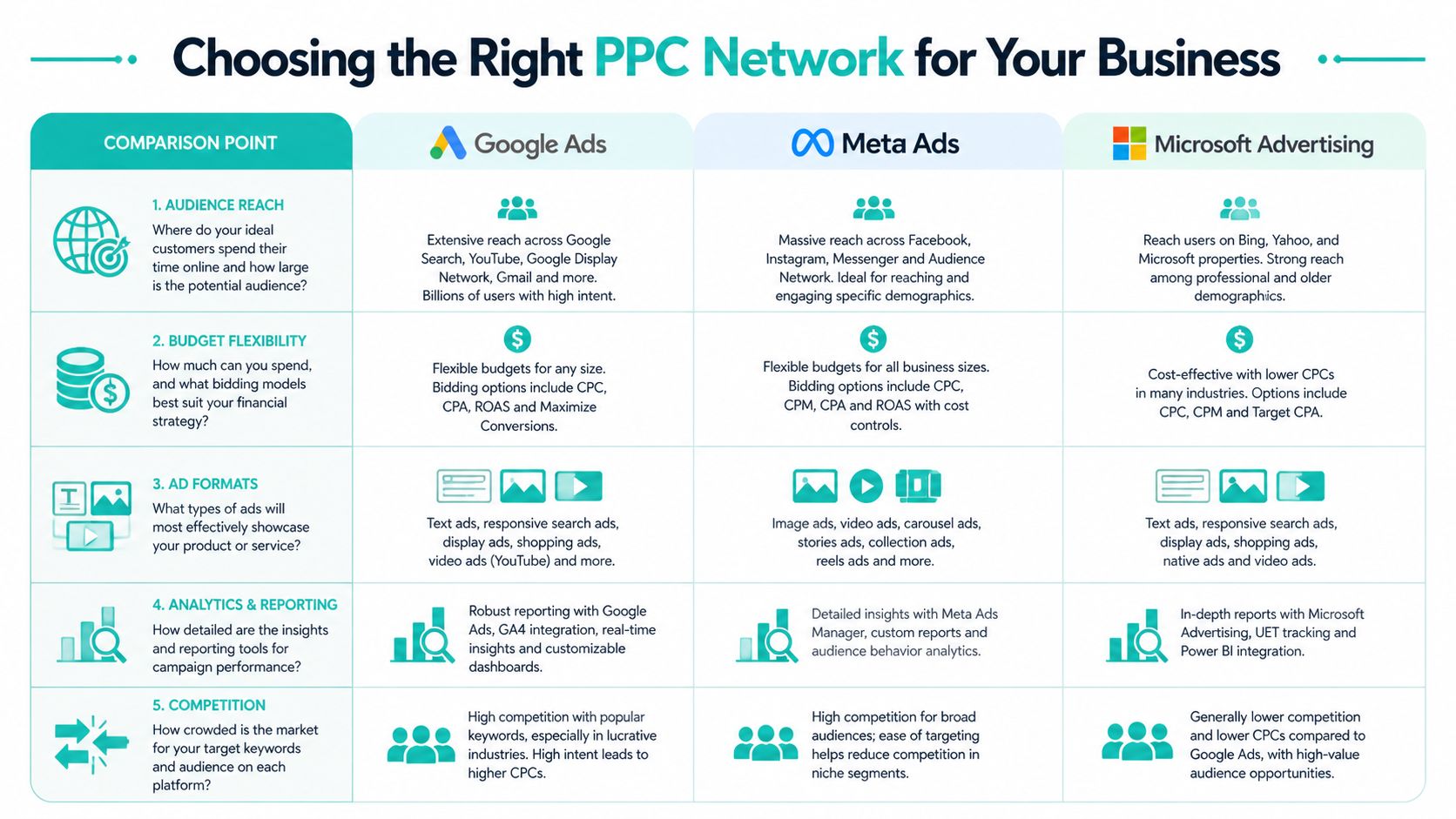
E-commerce businesses need a multi-network path
If you sell products online, your network mix should follow the buying cycle.
Google is your intent capture engine. It’s where buyers search for specific products, compare options, and click when they’re close to purchase. Meta helps with product discovery, creative testing, and remarketing abandoned visitors. Retail media networks can become useful when your catalog and margins justify channel expansion.
According to Business of Fashion’s report on underserved marketing channels, retail media networks like Amazon DSP and Walmart Connect are growing 25% YoY, and the same source notes that AI-powered bidding in Microsoft Advertising can outperform Google’s by 18% in conversion lift for regional demand spikes. For e-commerce brands, that tells you two things. First, alternatives matter. Second, bidding logic is becoming a competitive advantage.
Use this rule set:
- Start with Google when product demand already exists.
- Layer Meta when creative can drive discovery and bring non-buyers back.
- Test retail media when marketplace behavior aligns with how customers already shop.
- Use video when the product needs demonstration, trust, or comparison context.
Here’s a useful walkthrough if you want to see platform differences in action before spending more budget.
Service businesses should prioritize high-intent lead flow
If you run a home service company, legal firm, healthcare practice, or local professional service, your first job is not “building awareness.” Your first job is capturing buyers who need help now.
That means search gets priority. Then you support it with retargeting, selective social campaigns, and local audience expansion where appropriate. For Central Florida service businesses, Microsoft deserves more attention than it usually gets.
According to CallRail’s guide to PPC ad networks for SMBs, Microsoft Advertising can offer CPCs up to 35% cheaper than Google for service-based SMBs in markets like Central Florida, and SMBs can waste 25% of PPC budgets by leaning too hard on overly competitive keywords in crowded auctions.
That’s why a local contractor in Lake Mary, a med spa in Orlando, and a law firm preparing for Charlotte expansion shouldn’t all copy the same setup. They need local intent mapping, competitor-aware keyword selection, and ad creative built around action, not vanity metrics.
If social is part of the mix, use it for retargeting, offer awareness, and audience qualification. Don’t ask it to do Google’s job. For businesses that need that second layer, social media advertising can support the core search engine instead of distracting from it.
Don’t choose a network because it has reach. Choose it because it fits the moment your buyer decides.
PPC Network At-a-Glance Comparison
| Network | Primary Strength | Best For | Targeting Style |
|---|---|---|---|
| Google Ads | Capturing active demand | Local services, e-commerce, lead generation | Keyword and intent based |
| Meta Ads | Audience discovery and retargeting | Retail, lifestyle brands, visual offers, remarketing | Interest, behavior, demographic, audience based |
| Microsoft Advertising | Lower-cost search diversification | Regional service businesses, B2B, cost-conscious lead gen | Keyword based with less saturated auctions |
A simple decision framework helps.
- If the customer searches before buying, start with Google and test Microsoft.
- If the customer browses and compares visually, add Meta early.
- If the customer leaves without converting, build retargeting before expanding cold traffic.
- If your margins are thin, protect efficiency first. Don’t chase vanity reach.
Smart Implementation and AI-Powered Optimization
Picking the network is step one. Profits are generated in setup, testing, and ongoing optimization. Here, mediocre campaigns die and disciplined ones scale.

Good campaigns are built on control
You need four things working together. Budget control. Bid strategy. Creative that earns the click. Landing pages that finish the job.
Most underperforming campaigns fail because one of those pieces is weak. Good ads can’t rescue a bad landing page. Smart bidding can’t fix muddy conversion tracking. Strong keywords won’t help if the offer is vague or the page loads like it’s stuck in traffic on I-4.
A good launch plan usually includes:
- Tight campaign structure so search terms, audiences, and creatives stay relevant.
- Clear conversion actions such as calls, form submissions, booked appointments, or purchases.
- Offer alignment between the ad promise and the landing page headline.
- Fast feedback loops so poor queries, weak creatives, and wasted spend get cut quickly.
AI helps when it solves a real bidding problem
A lot of AI talk in advertising is fluff. The useful part is straightforward. AI helps when it reads signals faster than a human can and adjusts bids in time to matter.
That’s especially useful when demand changes by device, time of day, market conditions, seasonality, or regional events. Businesses dealing with volatile lead demand, fast-moving inventory, or multi-network campaigns should pay attention here.
If you want a broader primer on the mechanics, this guide to AI-powered advertising is a worthwhile read. For businesses that already know PPC matters but don’t want to hand-bid every variable, tools and services built around AI-powered bid management can help maintain efficiency across changing auction conditions.
The right use of automation is simple. Let machines react faster. Let humans decide what success looks like.
Track the numbers that affect revenue
Business owners get buried in dashboards full of movement that doesn’t mean much. Keep the scoreboard tight.
Watch these closely:
- Conversion rate tells you whether traffic and landing pages are doing their job.
- Cost per lead or cost per acquisition shows whether the account is commercially viable.
- Return on ad spend matters most for e-commerce and any campaign tied directly to revenue.
- Search term quality reveals whether the network is matching you to the right intent.
- Lead quality tells the truth that platform metrics can hide.
One practical option for companies that want strategy, execution, landing-page alignment, and automation under one roof is Emulous Media Inc, which offers advertising, web design, media production, and AI automation services for businesses that need tighter performance from their digital campaigns.
Take Control of Your PPC Strategy
There’s a clear takeaway here. PPC advertising networks are not interchangeable. Google, Meta, Microsoft, retail media, video, and display all have a role, but they don’t serve the same business goal.
If you run an e-commerce brand, build around intent capture, product discovery, and remarketing. If you run a service business, prioritize search-driven lead flow and use social as support, not a substitute. If your campaigns are already running, stop asking whether you need “more ads” and start asking whether your network mix matches how customers buy.
Here’s a practical next-step list.
Your Next Steps
| Action |
|---|
| Audit where your current leads or sales actually come from |
| Match each campaign to a specific business goal such as calls, forms, bookings, or purchases |
| Cut weak keywords, weak audiences, and weak landing pages before adding budget |
| Add remarketing to bring back non-converting visitors through retargeting and remarketing |
| Test one new network only after the primary network is structured and tracked correctly |
You can manage all of this in-house. Some companies do. Most hit a ceiling when platform complexity, creative demands, and reporting gaps start pulling attention away from the business itself.
That’s usually the moment when better execution becomes more valuable than more effort.
If you want a clearer PPC plan built around your business model, talk with Emulous Media Inc. We help Central Florida and growing U.S. businesses turn ad spend into measurable lead flow and sales with better strategy, stronger creative, and smarter optimization. Book a free consultation, call 689-255-6327, or visit the contact page to start the conversation.