Your firm solves a problem people know they have, agree they should address, and still delay for months or years. That’s the frustration behind marketing for estate planning. You’re not selling novelty. You’re selling responsibility, protection, and clarity in a category many prospects avoid until something forces action.
That creates a strange business reality. The service is important, the client value is high, and the buying cycle is packed with hesitation. Most firms respond the wrong way. They buy traffic before they clarify positioning. They send clicks to weak websites. They publish generic blog posts no one remembers. Then they call marketing ineffective.
It’s not ineffective. It’s usually underbuilt.
Estate planning firms don’t need louder promotion. They need a client acquisition system that reduces friction, builds trust fast, and makes the next step feel simple. That means clearer messaging, stronger web conversion paths, disciplined local SEO, smart use of Google Local Service Ads, and ruthless ROI tracking. If your marketing doesn’t move a prospect from “I know I should do this” to “I’m booking a consultation,” it’s failing.
Table of Contents
- The Estate Planning Marketing Paradox
- Define Your Foundation Market Position and Client
- Build Your Digital Office A High-Converting Website
- Generate Leads on Autopilot with SEO and Content
- Amplify Your Reach with Targeted Advertising
- Your 90-Day Estate Planning Marketing Blueprint
- Measure True ROI Not Vanity Metrics
The Estate Planning Marketing Paradox
A common scene plays out in estate planning firms every week. Someone attends a seminar, downloads a guide, or says on the phone that they’ve “been meaning to get this done.” They sound serious. They understand the stakes. Then they disappear.
That isn’t a lead quality problem by default. It’s often a momentum problem.
The market itself makes this clear. Despite 83% of Americans recognizing the importance of estate planning, only 31% have created a will, and 55% have no estate planning documents whatsoever, according to Trust & Will’s estate planning report. That gap between belief and action is the central marketing problem in this category.
Why good firms still struggle to generate consistent demand
Most legal marketing advice is shallow. It tells firms to “post content,” “run ads,” and “build a brand.” None of that is wrong. It’s just incomplete.
Estate planning is emotionally sensitive and cognitively heavy. Prospects worry they’ll make the wrong decision, spend more than expected, or start a process they don’t understand. If your marketing increases confusion, even slightly, hesitation wins. If your intake process feels vague, hesitation wins. If your website looks polished but doesn’t reduce uncertainty, hesitation wins.
Practical rule: In estate planning, trust doesn’t come from sounding sophisticated. It comes from making a complex decision feel manageable.
The real job of marketing for estate planning
The point of your marketing isn’t to convince people estate planning matters. Most already know that. The point is to remove enough friction that they finally act.
That means your system should do four things well:
- Clarify the problem: Show prospects what’s at risk if they keep delaying.
- Simplify the path: Explain what happens first, second, and third.
- Signal credibility: Use proof, authority, and consistent presentation across every touchpoint.
- Create momentum: Give people a low-friction next step they can take today.
Firms that understand this stop chasing random tactics. They build campaigns around psychology, timing, and conversion design. That’s what produces better clients, not more noise.
Define Your Foundation Market Position and Client
Before you spend money on ads, fix your strategy. Most firms skip this because it feels less urgent than launching campaigns. It isn’t. Weak positioning poisons every channel downstream.
The estate planning market is large, but it’s not easy. It represents a $114.11 billion opportunity globally in 2026, projected to reach $171.17 billion by 2035, while 62% of potential users cite complexity and lack of awareness as major obstacles, according to Business Research Insights on the estate planning services market. If complexity is the barrier, generic messaging is malpractice from a marketing standpoint.

Stop marketing to everyone
A firm that says “we help individuals and families with all estate planning needs” sounds interchangeable. That isn’t positioning. That’s a category label.
You need a sharper answer to two questions. Who is your best-fit client, and why should that client choose you over the other competent lawyer in your market?
For many firms, the answer sits in a few profitable segments:
- Young families: They care about guardianship, basic wills, and protecting children.
- Pre-retirees: They think about asset protection, healthcare directives, and avoiding future messes.
- Business owners: They need succession planning and coordination between personal and business assets.
- High-net-worth households: They want tax-aware structuring, trust strategy, and legacy planning across generations.
These audiences don’t respond to the same language. A young family doesn’t book because you mention dynasty planning. A business owner doesn’t care about “peace of mind” unless you tie it to control, continuity, and risk reduction.
Build a message clients instantly understand
Your message should reduce confusion in the first few seconds. Not after a consultation. Not on page five of your brochure. Immediately.
A strong position usually includes these elements:
| Element | Weak version | Stronger version |
|---|---|---|
| Audience | Estate planning for everyone | Estate planning for Florida families, retirees, and business owners |
| Value | Experienced legal services | Clear, guided planning that removes confusion and speeds decision-making |
| Differentiation | Personalized attention | Fixed process, simple education, and responsive support from intake through signing |
| Promise | Protect your future | Help your family avoid delay, conflict, and preventable mistakes |
Your intake team should be able to explain your offer in plain English without sounding rehearsed. If they can’t, your positioning is still muddy.
Use your client data, consult history, and referral patterns to refine this. If you want a more advanced way to identify likely buyers before campaign launch, predictive audience modeling helps firms align messaging with higher-probability segments instead of guessing.
Firms that win in this category don’t just look credible. They feel easier to hire.
That’s the foundation. Everything else depends on it.
Build Your Digital Office A High-Converting Website
Most law firm websites are dressed-up brochures. They describe services, list attorney bios, and hope credibility alone will carry the conversion. It won’t.
Your website is your digital office. It has to reassure, educate, and convert people who are anxious, skeptical, and often browsing on a phone between other obligations. If it can’t do that, every traffic source underperforms.
Your homepage is not the hero
Many firms obsess over the homepage. That’s backwards. Service pages, location pages, landing pages, and consultation flows usually do the heavy lifting.
A prospect searching “estate planning attorney Orlando” or “will and trust lawyer near me” should land on a page built for that intent. They should see a clear headline, plain-language explanation, trust signals, and one obvious action. Not a maze of menu options and law-firm self-congratulation.
Dedicated conversion pages outperform traditional site layouts. A focused consultation page with a single CTA usually converts better than a general page full of competing exits. If you want to see the structure behind that approach, review these high-converting landing pages.
What high-converting legal websites actually include
A strong estate planning site usually has these essential elements:
- Clear service segmentation: Separate pages for wills, trusts, probate, asset protection, and related services.
- Strong above-the-fold CTA: “Schedule a consultation” or “Talk with our team” should appear immediately.
- Trust signals: Reviews, credentials, bar memberships, speaking engagements, media features, and recognizable verification badges where applicable.
- Simple process framing: Show how a new client starts. Inquiry, consultation, plan design, signing.
- Mobile-first usability: Short forms, click-to-call buttons, readable text, and fast page loads.
- Lead capture beyond contact forms: Offer a checklist, planning guide, or workshop registration for prospects not ready to book yet.
A website should answer the prospect’s first silent question. “Can these people make this easier for me?”
Here’s where firms often fail. They write like lawyers instead of advisors. They lead with technical terms instead of real client concerns. They make users hunt for pricing approach, next steps, office location, or phone number. Every unnecessary moment of friction costs inquiries.
The trust stack matters more than visual polish alone
Good design matters. But visual polish without conversion architecture is expensive decoration.
A credible estate planning website should stack trust in layers:
- Immediate trust through clean design and professional presentation.
- Institutional trust through credentials and recognitions.
- Social trust through reviews and testimonials.
- Process trust through a clear explanation of what happens next.
- Accessibility trust through easy contact, responsive mobile design, and obvious office details.
If your site looks modern but doesn’t make action easy, rebuild the experience. The right website doesn’t just attract attention. It moves qualified people into your pipeline.
Generate Leads on Autopilot with SEO and Content
Paid ads can fill the pipeline quickly. SEO builds the asset that keeps producing after the campaign ends. For estate planning firms, that matters because prospects often research before they’re ready to speak with anyone. If you’re absent during that research phase, another firm becomes the trusted option first.
SEO works best when you stop treating it like a bag of tricks and start treating it like a local authority system.
Treat SEO like a local authority engine
The mobile experience isn’t optional in this category. Over 60% of estate planning queries occur on mobile, and reaching top-3 local rankings for terms like “estate planning attorney [city]” can produce 5-10x more leads than paid ads at a lower long-term cost, according to VIP Marketing’s guide to marketing for estate planning lawyers.
That should shape your priorities immediately.
Your local SEO stack should include:
- Google Business Profile optimization: Accurate hours, services, categories, photos, and routine review collection.
- Location-specific service pages: Not one generic estate planning page. Build pages tied to the places you serve.
- On-page optimization: Clean titles, descriptive headers, strong internal linking, and pages built around one primary intent.
- Technical health: Mobile responsiveness, fast load times, and crawlable page structure.
- Review strategy: Ask satisfied clients consistently, not randomly.
If your team needs a practical outside perspective on foundational execution, this guide to local SEO strategies for small businesses is a useful companion to legal-specific planning.
For firms that want more than surface-level optimization, a disciplined search engine optimization SEO strategy should connect content, technical performance, local signals, and conversion paths into one system.
Content should answer buying questions, not impress peers
Most law firm content is written for colleagues, not clients. That’s a mistake.
The content that pulls in qualified estate planning traffic usually answers practical questions tied to moments of intent. Think in clusters:
| Client concern | Useful content angle |
|---|---|
| “Do I need a will or a trust?” | Plain-English comparison page |
| “What happens if I die without a plan?” | State-specific explainer |
| “We just had a child” | Guardianship and family protection article |
| “I’m retiring soon” | Planning checklist for pre-retirees |
| “I own a business” | Succession-focused estate planning guide |
Through this approach, firms gain their competitive edge. One article doesn’t matter much. A library of focused answers does. When someone searches repeatedly, sees your name across multiple useful pages, and finds consistent guidance, trust compounds before the first call.
Write for the question a prospect types into Google at night, not the presentation you’d give another attorney at lunch.
What content production should look like in practice
A sensible content rhythm for estate planning marketing often includes:
- Evergreen service pages: The core revenue pages that should rank and convert.
- FAQ articles: Short, direct content targeting specific objections and uncertainties.
- Local pages: Content specific to cities, counties, and nearby service areas.
- Lead magnets: Checklists or planning guides tied to email capture.
- Refresh cycles: Update useful pages instead of endlessly publishing net-new fluff.
The firms that dominate local search usually aren’t publishing the most content. They’re publishing the clearest answers, organized around search intent, local relevance, and conversion.
Amplify Your Reach with Targeted Advertising
SEO is the long game. Advertising is how you create immediate demand capture while SEO compounds. But not all ad channels deserve equal budget.
For estate planning firms, the smartest paid strategy usually starts with search-based intent, not broad awareness campaigns. Someone actively looking for help is worth more than someone casually scrolling.
LSAs versus standard PPC
Many firms overspend by jumping straight into standard Google Ads, bidding on broad keywords, and burning money on weak clicks. In many local markets, Google Local Service Ads operate on a pay-per-lead model instead of pay-per-click, appear at the top of the page, and include a Google Screened badge that can produce 2-3x higher quality leads than traditional PPC for local services, based on Go Constellation’s estate planning marketing analysis.
That structure matters because estate planning is trust-heavy. The badge helps. The placement helps. The pay-per-lead model helps.
Here’s the practical comparison:
| Channel | Best use | Main strength | Main risk |
|---|---|---|---|
| Google LSAs | High-intent local demand capture | Strong trust signal and lead-based billing | Poor setup can waste lead quality |
| Standard Google PPC | Precise keyword testing and landing-page control | Flexible messaging and targeting | Easy to overspend on non-buying traffic |
| Paid social | Audience building and lead magnet promotion | Good for education and retargeting | Lower intent than search |
| Retargeting | Re-engaging warm visitors | Keeps your firm visible after site visits | Weak creative makes it forgettable |
For many estate planning practices, LSAs should be the first paid channel tested. They align with local buyer intent better than broad social campaigns, and they let firms start with cleaner demand capture. If your team wants a more specialized framework, Google Local Services Ads management is where the operational details start to matter.
Where paid social and events fit
Paid social is useful, but only if you stop treating it like direct-response search. Users on Facebook or Instagram are generally not planning to hire an estate planning lawyer in that exact moment. That means your offer has to match the stage of awareness.
Good paid social offers for this category include:
- Educational guides: Checklists, family planning PDFs, workshop invitations.
- Life-event messaging: Newly married couples, new parents, nearing retirement, recent relocation.
- Retargeting sequences: Follow up with people who visited key pages but didn’t convert.
- Seminar promotion: In-person or virtual education sessions for pre-retirees, families, and business owners.
Events still work because estate planning clients often need confidence before commitment. A strong workshop, webinar, or local presentation can shorten that trust-building cycle. But the event itself isn’t the strategy. The follow-up is. If attendees don’t enter a structured nurture flow, you’ve hosted an expensive branding exercise.
Paid traffic works when the offer matches the buyer’s level of readiness. Search captures urgency. Social creates familiarity. Retargeting recovers missed opportunities.
Use advertising as part of a system, not as a substitute for one.
Your 90-Day Estate Planning Marketing Blueprint
Most firms don’t need more ideas. They need a sequence. Good marketing for estate planning works when the pieces launch in the right order.
A practical starting point is a focused ninety-day build. Not endless planning. Not random execution. A structured push that creates a usable foundation, launches demand capture, and gives you enough data to improve decisions.
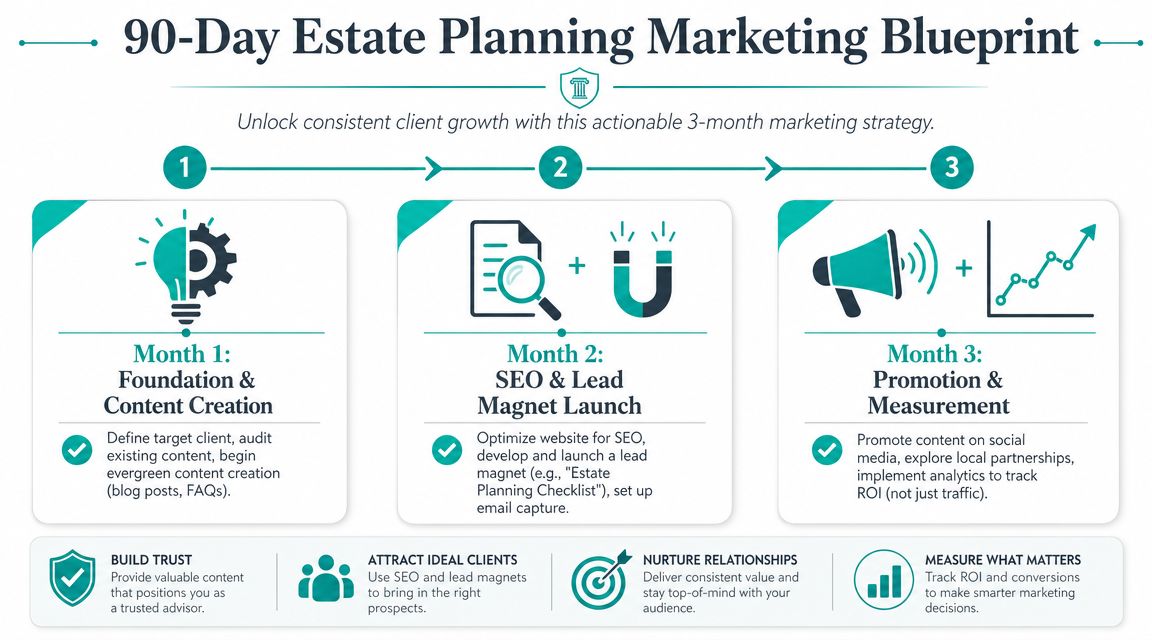
Month 1 build the foundation
The first month is about tightening the basics that most firms neglect.
Start with positioning. Define your top client segments, your service priorities, and the language each audience responds to. Then audit the website. Fix weak calls to action, confusing page structure, broken trust signals, and poor mobile usability. Clean up your Google Business Profile and make sure intake workflows are consistent.
Use this checklist as your standard:
- Clarify offer: What exactly are you promoting first, wills, trusts, family planning, probate avoidance, or business succession?
- Improve web conversion: Shorten forms, simplify copy, and make consultation paths obvious.
- Organize service pages: Give each core service its own page with clear local relevance.
- Prepare tracking: Set up source attribution inside your CRM or intake process.
Month 2 launch demand capture
Now you can turn on acquisition without sending traffic into a weak funnel.
Publish the first wave of content around real client questions. Build a lead magnet such as an estate planning checklist or basic planning guide. Launch or refine your Google Local Service Ads. Create one dedicated landing page for consultation traffic and another for guide downloads or seminar registrations.
A modest budget can work if the system is disciplined. The key is not spending more. It’s wasting less. The earlier source data allowed an ad spend range for LSAs, and many firms use that as a starting point, but the right allocation still depends on lead quality and close rate. Don’t anchor on spend first. Anchor on economics.
Month 3 optimize and scale
By the third month, your job is to learn fast.
Review which pages attract calls, which ads produce qualified inquiries, and where prospects drop off. Tighten headlines. Improve intake scripts. Refine page copy. Add FAQ content based on actual consultations. If one client segment is clearly responding better than others, shift resources toward it.
A simple operating model looks like this:
| Month | Primary objective | Core actions |
|---|---|---|
| Month 1 | Foundation | Positioning, website fixes, GBP cleanup, intake tracking |
| Month 2 | Launch | Content rollout, lead magnet, LSAs, dedicated landing pages |
| Month 3 | Optimization | Review lead quality, improve messaging, test conversions, refine follow-up |
The firms that get traction quickly usually do one thing differently. They treat marketing as an operating system, not a collection of tasks.
Measure True ROI Not Vanity Metrics
If your agency sends reports full of impressions, clicks, reach, and “engagement,” ask one question. How many qualified consultations did this produce, and at what cost?
If they can’t answer that clearly, you don’t have marketing accountability. You have decorative reporting.
A major weakness in estate planning marketing guidance is the lack of hard ROI benchmarks. The important takeaway from Diana Cabrices’ discussion of estate planning marketing strategy is that firms need to track cost-per-lead and cost-per-client by channel to understand whether webinars, local SEO, paid search, or other tactics are producing valuable business.

What to track every week
You don’t need a giant analytics department. You need operational discipline.
Track these numbers consistently:
- Lead source: Where did the inquiry originate, organic search, LSAs, PPC, referral, social, event, or email?
- Qualified lead count: Not every form fill matters. Count the people who fit your service and geography.
- Consultation rate: How many leads book?
- Show-up rate: How many booked consultations happen?
- Client conversion rate: How many become paying clients?
- Cost per lead and cost per client: What did each channel cost you to produce business?
Many firms confuse ROI and ROAS. If your team needs a simple explanation of the difference, this marketer's essential guide on ROI and ROAS is worth reviewing. In legal marketing, the distinction matters because ad return alone doesn’t capture intake quality, sales cycle, or client value.
The accountability standard your agency should meet
Your agency, consultant, or in-house team should be able to tell you:
- Which channels create qualified inquiries.
- Which channels create signed clients.
- Which pages or offers improve conversion.
- Which audiences waste budget.
- What changes they made this month based on evidence.
If they can’t connect campaign activity to signed matters, they’re managing optics, not growth.
This is also why attribution matters. Your intake staff should ask every lead how they found you, and your systems should verify that against actual tracking where possible. Phone calls, form submissions, landing pages, and CRM stages need one version of the truth. If you want a stronger framework for that, marketing attribution modeling is the discipline that turns messy lead sources into useful decision-making.
Traffic is not success. Attention is not success. Signed clients from profitable channels are success.
That standard sounds obvious, but many firms still don’t run marketing that way. The ones that do make better budget decisions, identify winning campaigns sooner, and stop funding tactics that merely look busy.
If your firm wants a sharper system for marketing for estate planning, Emulous Media Inc can help you build it correctly. We help Central Florida and growth-focused firms turn outdated websites, fragmented campaigns, and unclear reporting into a measurable client acquisition engine across advertising, SEO, website design, media production, and AI automation. Book a free consultation, call 689-255-6327, or visit the contact page to talk through your growth goals.