You might already have a strong business in Tampa. Customers know your name, referrals come in, and your team stays busy. Then someone in South Tampa, Ybor City, or Seminole Heights searches for the exact service you offer, and your competitor shows up in Google Maps while you don't.
That gap is what local seo tampa is really about. It isn't vanity. It isn't a side task for whoever has a few spare minutes. It's the system that connects your real-world reputation to the searches happening every day in your market.
For Tampa businesses, that matters more than most owners realize. Local search behavior is high intent, and Tampa is crowded with ambitious companies competing for the same visibility. Generic SEO advice won't solve that. You need neighborhood relevance, clean local signals, strong reviews, event-aware content, and a site that tells Google exactly who you serve and where you serve them.
Table of Contents
- Your Tampa Business Is Thriving But Invisible Online
- Master Your Google Business Profile
- Build Local Trust with Citations and Schema
- Create Content That Speaks Directly to Tampa
- Develop an Unbeatable Review and Reputation System
- Advanced Tactics and Measuring Your Success
Your Tampa Business Is Thriving But Invisible Online
A lot of Tampa owners face the same problem. They have a solid business offline, but Google doesn't reflect it. A restaurant with loyal regulars in Ybor City barely appears for discovery searches. A roofer in South Tampa has trucks on the road every day, yet disappears when someone searches from a phone after a storm.
That isn't because your business lacks value. It's because local search rewards businesses that send clear location, relevance, and trust signals.
Tampa is one of the most attractive and competitive markets for that fight. Tampa is ranked as the third-best metro area for new small businesses, and "near me" searches have grown over 200% according to ROI Amplified's Tampa local SEO guide. The same source notes that 88% of consumers who perform a local search on their phone visit or call a store within 24 hours. Those aren't casual browsers. They're ready to act.
Why the visibility gap costs more than owners think
When your business doesn't appear in local search, you lose the customer before they ever compare you. They don't see your reviews. They don't read your service page. They don't call your office.
That's why local SEO beats random marketing activity. It captures demand that already exists.
- High-intent searches: Someone searching for a nearby service usually needs help now.
- Map pack exposure: The businesses in the local results get the first clicks and calls.
- Compounding value: A strong local presence keeps working after ads stop.
Practical rule: If a new customer can't find you when they search for your category plus Tampa, neighborhood terms, or "near me," your market presence is incomplete.
A good primer like Feather on local business SEO can help business owners understand how their website and local presence work together. But in Tampa, broad best practices need local execution. Hyde Park search behavior doesn't look exactly like Brandon. Downtown intent doesn't match Carrollwood. The businesses that win know the difference and build pages, profiles, and trust signals around it.
What works and what doesn't
| Approach | What happens |
|---|---|
| Generic citywide messaging | You blend in with every other listing |
| Neighborhood-specific relevance | You show Google where you're actually strong |
| Half-finished profiles and outdated info | You lose trust and clicks |
| Consistent local SEO execution | You earn visibility where buying intent is highest |
If you're busy but invisible online, the issue usually isn't demand. It's local discoverability.
Master Your Google Business Profile
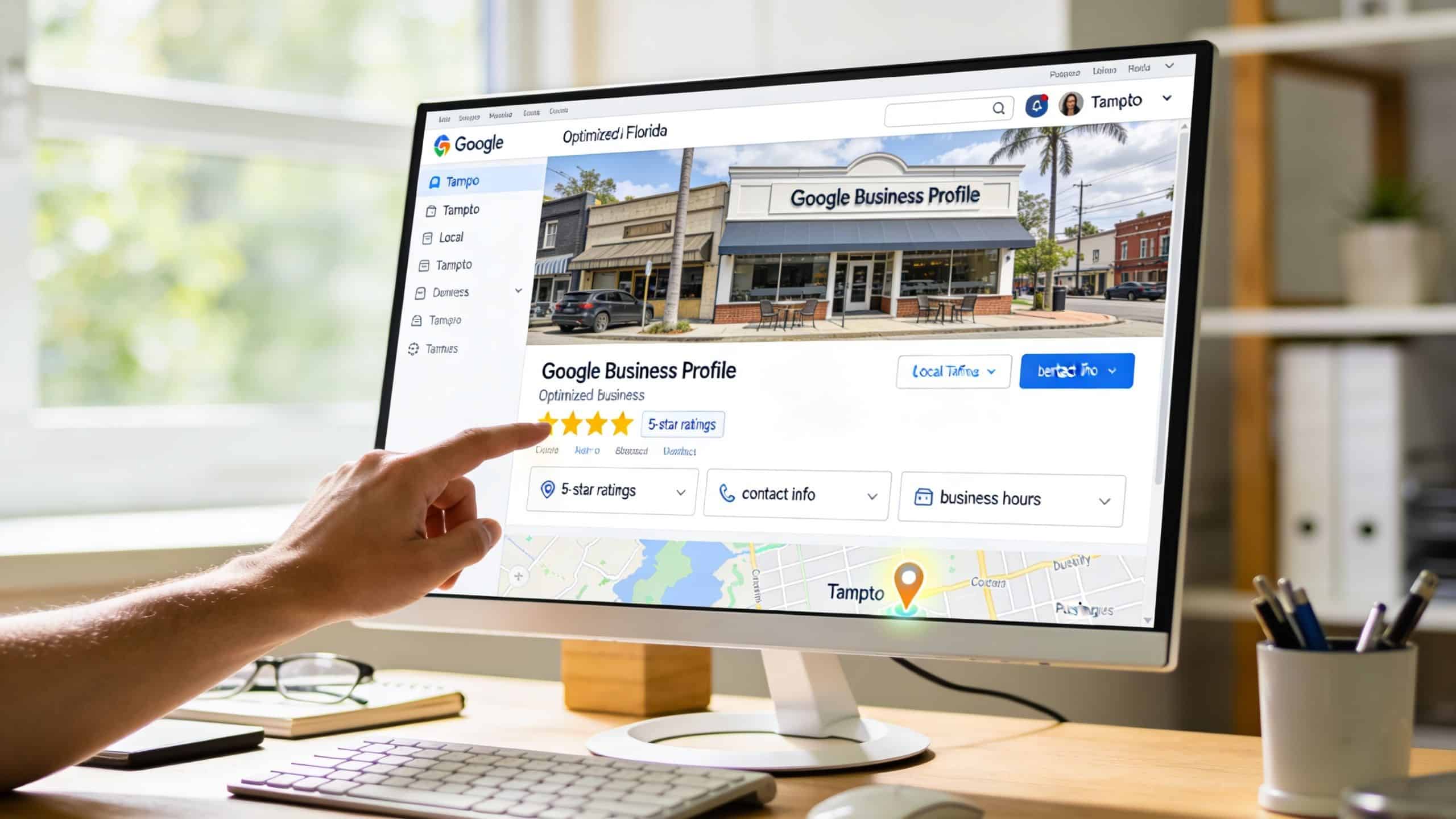
Your Google Business Profile is the center of local seo tampa. For many businesses, it's the first thing a prospect sees before they ever visit your website.
Treat it like a revenue asset, not a directory listing.
Pick the right categories and services
Most owners choose a broad primary category and stop there. That's rarely enough. Your primary category tells Google your main business type. Your secondary categories expand the kinds of searches where you can appear.
A Tampa med spa shouldn't rely on a vague category if it also offers treatments people search for directly. A law firm shouldn't assume one umbrella label covers every practice area. The wrong category choice limits visibility before any other optimization starts.
Use your categories, service list, and business description together.
- Primary category: Choose the closest match to your main revenue driver.
- Secondary categories: Add adjacent services only if you provide them.
- Service descriptions: Write them in plain language, with real local context.
- Business description: Mention Tampa service areas naturally, not as a keyword dump.
If you want a useful benchmark for what a more fully built profile looks like, Review Overhaul's Google Business Profile optimization shows the level of detail serious operators are aiming for.
Turn your profile into a conversion tool
A profile that only shows your name, phone number, and hours is underperforming. The stronger profiles give Google more context and give users more confidence.
Use every field that makes sense:
Services and products
Add real service names and short descriptions. A home services company can list drain cleaning, water heater repair, or emergency plumbing. A retailer can organize product categories clearly.Photos that prove you're active
Skip stock-looking images. Show your storefront, team, vehicles, interior, completed work, and branded details people would recognize.Posts with local relevance
Promote seasonal offers, community events, service updates, and time-sensitive specials. For Tampa, this can mean storm prep messaging, event-driven promos, or neighborhood-specific announcements.Q&A that removes friction
Seed common questions and answer them clearly. Parking. Service radius. Walk-ins. Insurance. Weekend appointments. Response time.
The businesses that get more calls often don't have the fanciest profile. They have the clearest one.
A strong local lead strategy also benefits from aligned paid channels. If you're running service-based campaigns, Local Services Ads support can complement your organic local presence when both are built around the same service areas and buyer intent.
Keep your profile active
Google pays attention to freshness. That doesn't mean posting every day for no reason. It means showing real signs of activity.
Here are the updates that matter:
- Hours and holiday changes: Keep them current so you don't frustrate searchers.
- New photos: Add them consistently, especially after completed jobs or improvements.
- Review responses: Reply promptly and professionally.
- Service updates: Adjust your services if your business focus changes.
Video can help if you're training a team member or reviewing the basics of profile management before deeper optimization work:
Common GBP mistakes in Tampa
| Mistake | Why it hurts |
|---|---|
| Stuffing the business name with keywords | Risks penalties and trust issues |
| Choosing too many irrelevant categories | Dilutes your core relevance |
| Ignoring neighborhood language | Misses real search intent |
| Leaving Q&A unmanaged | Lets confusion sit in public |
| Posting generic updates | Fails to match local demand |
In Tampa, the strongest profiles feel local, current, and credible. That's what drives map pack visibility and qualified actions.
Build Local Trust with Citations and Schema
Once your Google Business Profile is in good shape, the next job is verification. Google wants confirmation that your business is real, consistent, and clearly understood across the web.
That comes from two places. Citations and schema markup.

Clean citations before you build more
A citation is any listing of your business name, address, and phone number. Owners often think more listings automatically means better rankings. That's not how it works. Bad listings can create more damage than value.
If your website says one suite number, your profile shows another, and three directories still list an old phone number, you've sent mixed signals everywhere.
Start with a cleanup pass.
- Website first: Make sure your official name, address, phone, and hours are correct on the site.
- Major platforms next: Update the biggest listings that customers use.
- Industry directories: Claim profiles that matter in your category.
- Local directories: Focus on places with real visibility or local trust.
A Tampa attorney, clinic, contractor, or retailer doesn't need hundreds of random listings. It needs consistent ones.
Use schema to remove ambiguity
Schema markup is structured data added to your website so search engines can interpret your business details more precisely. Think of it as machine-readable context.
For local SEO, that usually means LocalBusiness schema and related markup for services, reviews, business hours, and organization details. When implemented correctly, it helps search engines connect your site to your location, offerings, and brand identity.
According to The Visual Realm's Tampa SEO blueprint, correctly implementing structured data and ensuring NAP consistency can lead to significant gains, including up to 70% surges in organic traffic, and law firms increasing leads by 65% through targeted keyword and schema expansion.
What matters most: schema doesn't replace strong content or strong local signals. It clarifies them.
If you're also thinking beyond classic search into AI-driven discovery, answer engine optimization strategies belong in the same conversation. Clean structured data makes your business easier to interpret across search experiences, not just traditional blue links.
What to mark up on a local site
You don't need to mark up everything. You need to mark up the right things accurately.
| Schema element | Why it matters |
|---|---|
| Business name and contact info | Confirms identity |
| Address and service area | Reinforces geography |
| Hours | Reduces confusion for users and platforms |
| Reviews | Supports richer business context |
| Services | Helps search engines understand offerings |
What works in practice
For a South Tampa home service company, schema should support the same story your site already tells. If your service pages mention neighborhoods, service radius, emergency availability, and core offerings, schema should mirror that structure. It shouldn't invent capabilities or locations you don't serve.
For a multi-location business, each location needs its own page, its own local details, and its own markup. Don't force one generic page to do all the work.
The technical side isn't glamorous, but it creates the trust layer that local rankings depend on. Businesses skip it because customers don't see it directly. Google does.
Create Content That Speaks Directly to Tampa
Generic content rarely earns local visibility. A page titled "Best Roofing Services" tells Google almost nothing about where you work, who you serve, or why a Tampa searcher should care.
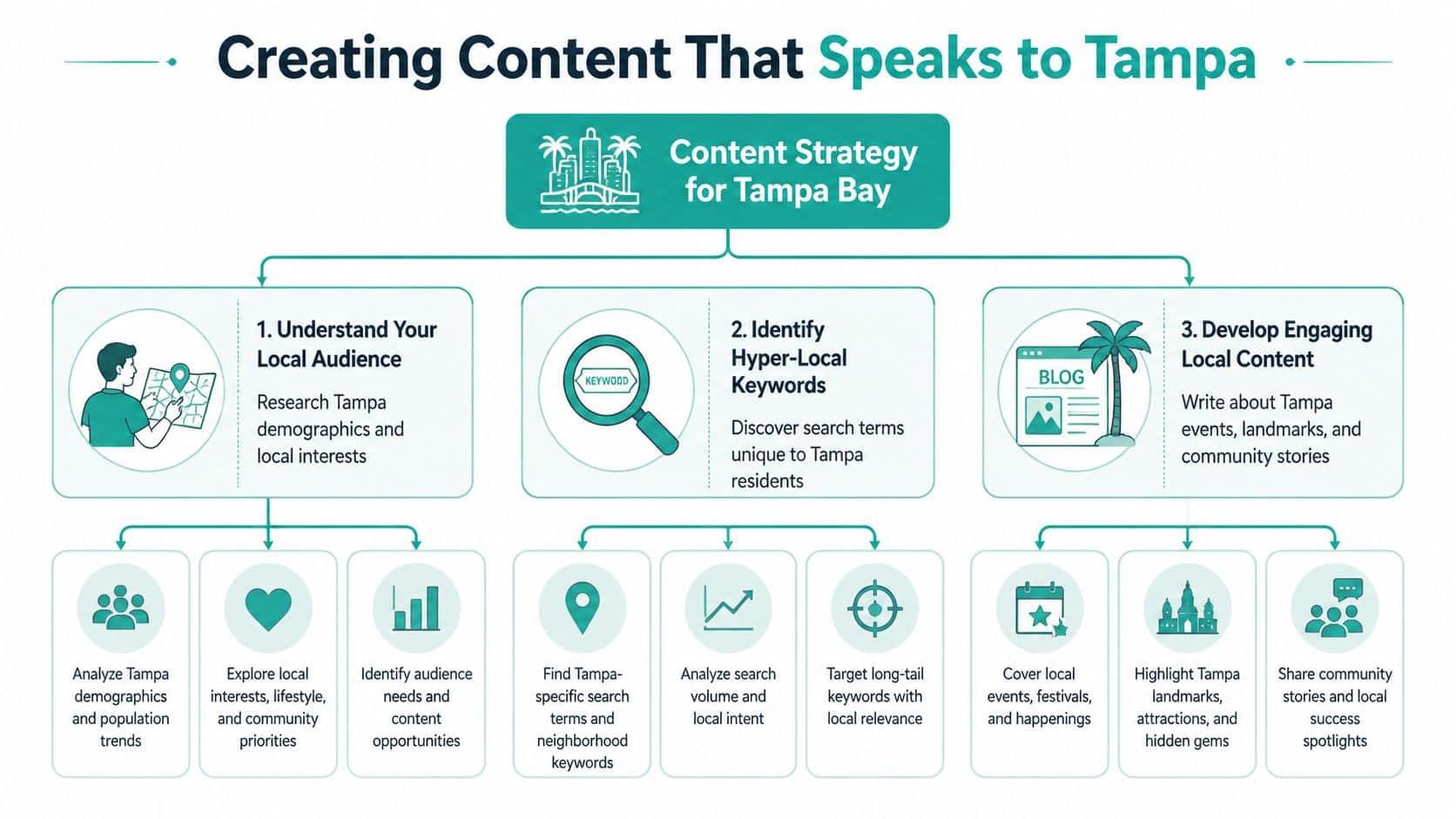
Hyper-local content fixes that.
Write for real neighborhoods and real intent
A Tampa business should sound like it operates in Tampa. That means speaking to neighborhoods, landmarks, weather patterns, traffic patterns, and event cycles your customers already live with.
A roofer can publish a page for South Tampa storm damage concerns. A restaurant near downtown can create a page about pre-event dining near Amalie Arena. A family law firm can build location pages that reference the communities it serves, not a pasted list of city names.
The difference is intent matching. Someone in Hyde Park doesn't always search the same way as someone in Westchase.
Here are the kinds of content that work:
- Neighborhood pages: Ybor City, South Tampa, Hyde Park, Seminole Heights, Carrollwood
- Service plus location pages: "AC repair South Tampa" or "estate planning attorney Ybor City"
- Event-tied content: seasonal, civic, or festival-related pages
- Problem-based local articles: topics tied to Tampa conditions and buyer concerns
Use Tampa's calendar to your advantage
Search demand in Tampa isn't static. Geography and local events influence what people search and when they search it.
According to SEO Tampa AI's local SEO guide for Tampa, the Gasparilla Festival can boost "Tampa Bay events catering" searches by 50% in January, while hurricane season drives 35% spikes in queries for emergency services. That's exactly why generic evergreen content leaves money on the table.
A content calendar built for Tampa should follow weather, neighborhoods, and events. Not just broad industry topics.
A few practical examples:
| Business type | Better Tampa content angle |
|---|---|
| Roofer | Hurricane prep for South Tampa homes |
| Caterer | Gasparilla party catering in Tampa Bay |
| Personal injury firm | What to do after a crash near busy Tampa corridors |
| HVAC company | AC issues during peak heat in older Tampa homes |
| Retailer | Event-ready products for local festival traffic |
If you need a sharper content foundation, expert keyword research tips for SEO strategy can help shape topic clusters around the services and locations that deserve their own pages.
Avoid the common local content trap
A lot of businesses hear "create local pages" and immediately publish thin pages with swapped city names. Google has seen that pattern for years. Users hate it too.
A useful Tampa page should include things like:
Specific service relevance
Explain why that service matters in that area. A flood-prone neighborhood has different concerns than a dense retail corridor.Operational proof
Mention service availability, response norms, parking, or local logistics only if they're true.Local references
Use landmarks, neighborhoods, and event patterns naturally. Don't cram them in.Clear next action
Make it easy to call, book, or request help from that page.
Think like the searcher, not the marketer
A Tampa resident usually isn't searching for your abstract brand message. They're searching around a problem, place, and timing.
Someone may search for a family dentist near work downtown. Another may search for an emergency electrician after a storm. Another may look for a restaurant before a festival or event. Your content should reflect those moments.
When local seo tampa is done well, content doesn't sound optimized first. It sounds useful first, local second, and strategically structured underneath.
Develop an Unbeatable Review and Reputation System
Reviews influence rankings, trust, and conversions at the same time. Most businesses treat them as a side effect of good service. That's too passive for a competitive market like Tampa.
The better approach is a system.

Build the review request into your workflow
Don't ask randomly. Ask at the right moment, with the right person, through the right channel.
For most businesses, that moment happens right after a successful outcome. The repair is complete. The patient had a smooth visit. The client got the result they wanted. The product arrived on time and works as expected.
Keep the request simple:
- In person: "We're glad we could help today. If you'd be open to it, a Google review would mean a lot."
- By text or email: thank them, keep it short, and send the direct review link.
- For teams: assign the ask to the staff member closest to the successful interaction.
Respond in a way that builds trust publicly
Owners often focus only on getting more reviews. Response quality matters too. A thoughtful response shows future customers how your business communicates.
Positive review responses should be personal enough to feel real. Negative review responses should be calm, concise, and solution-focused.
"Thanks for the feedback. We take this seriously and want to make it right. Please contact our team so we can look into the issue directly."
That kind of response doesn't argue in public. It shows professionalism in public.
If you're improving local visibility and conversion performance together, examples from local SEO results and proof points can help you think about reviews as part of a bigger search and lead-generation system rather than a standalone task.
Turn reviews into a reputation engine
A strong system connects three things:
| Part of the system | What it does |
|---|---|
| Review generation | Increases social proof |
| Review responses | Builds confidence and signals activity |
| Internal feedback loop | Improves service and messaging |
Use reviews beyond Google too. They reveal recurring customer language you can mirror on service pages, FAQ sections, and sales scripts. If customers repeatedly praise fast scheduling, friendly staff, or clear communication, that's market intelligence.
What doesn't work
- Buying reviews: risky, obvious, and short-sighted
- Mass generic replies: visible, robotic, and weak
- Only asking happy regulars: limits review flow
- Ignoring criticism: lets unresolved issues become your public story
The businesses with the strongest local reputations don't leave reviews to chance. They operationalize them.
Advanced Tactics and Measuring Your Success
Basic optimization gets you in the game. It doesn't always win the market. In Tampa, the stronger operators push beyond listing management and generic blog posting.
That means better local authority signals, smarter automation, and tighter measurement.
Local authority isn't built only on backlinks
A common assumption is that local SEO success comes down to ranking tricks. It doesn't. In competitive metros, authority often grows from visible local involvement paired with strong digital follow-through.
A few examples that create real local relevance:
- Community sponsorships: a local 5K, charity event, chamber activity, or neighborhood initiative
- Local partnerships: cross-promotion with Tampa businesses that serve the same audience without competing directly
- Local press and features: coverage tied to events, milestones, community work, or useful commentary
- On-site proof: publishing recaps, photos, and related landing pages so those efforts support search visibility
AI changes the scale of local execution
This is the part many Tampa SEO guides still underplay. Manual local SEO can only go so far, especially if you serve multiple neighborhoods or manage several service lines.
According to Local SEO Tampa's AI SEO service page, some services report reducing manual citation building by 60% and achieving a 40% increase in local pack rankings by automating hyper-local optimization and review responses. Used well, AI helps teams identify gaps faster, create localized support content more efficiently, and maintain consistency across a larger footprint.
That doesn't mean you hand strategy over to software. It means you use automation where machines are strong and human judgment where it matters most.
The pro-level advantage isn't using AI for everything. It's using AI where repetition slows your team down and using expert oversight where nuance affects revenue.
Track the signals that tie to business outcomes
Too many owners check rankings once in a while and call that SEO reporting. That misses the point. Local search performance should be judged by actions that move buyers closer to contact and purchase.
Track metrics like:
Google Business Profile actions
Calls, website clicks, and direction requestsLocation-based keyword visibility
Especially for your highest-value services and neighborhoodsLanding page performance
Which local pages generate calls, forms, or booked appointmentsLead quality by area
Not every ranking produces the same revenueReview velocity and sentiment
Watch reputation alongside search growth
For a solid framework, tracking marketing metrics and KPIs helps separate vanity reporting from numbers that effectively support decision-making.
What winning looks like
Winning in local seo tampa usually looks boring from the outside. Accurate data. Better pages. Faster updates. Strong reviews. Local relevance at the neighborhood level. Consistent monitoring. AI helping with scale. Humans guiding the strategy.
That's why many businesses stall. They do a few setup tasks, then stop. The businesses that keep climbing keep refining.
If your business is ready to turn Tampa search visibility into more calls, more qualified leads, and a stronger digital presence, Emulous Media Inc can help. We build performance-driven marketing systems that combine local SEO, website design, paid advertising, media production, and AI automation to help Central Florida businesses grow with precision. Book a free consultation, call 689-255-6327, or visit the contact page to start the conversation.