Some months your phone won’t stop ringing. Other months get uncomfortably quiet. That’s a common experience for a lot of owners trying to handle lead generation for small business by piecing together referrals, a few social posts, maybe some ads, and hope.
Hope isn’t a system.
If you want steady growth, you need a lead engine. Not a pile of disconnected tactics. Not random “marketing ideas” you saw on YouTube. A real system that brings in the right people, moves them toward a decision, and keeps working when you’re busy serving clients.
For Central Florida businesses, and for companies expanding into markets like Charlotte, that matters even more. Local competition is sharper, buyers compare options fast, and most small businesses waste money because they don’t connect strategy, website performance, traffic, and follow-up into one machine.
Table of Contents
- The Blueprint for Predictable Leads
- Your High-Conversion Digital Hub
- A Tale of Two Traffics Organic vs Paid
- From Interested Visitor to Paying Customer
- Your Essential Lead Generation Toolkit
- Start Your Growth Engine Today
The Blueprint for Predictable Leads
The businesses that struggle with lead generation usually have the same problem. They’re doing marketing without a blueprint. They run ads before defining the offer. They post content before deciding who it’s for. They judge success by clicks instead of qualified opportunities.
Start with three critical foundations. Clear goals, measurable KPIs, and a practical picture of your ideal customer. If those aren’t in place, your marketing budget will leak.
Start with business goals, not marketing activity
Your goal isn’t “get more leads.” That’s too vague to be useful. Your goal should tie directly to revenue, capacity, and the kind of clients you want.
Ask better questions:
- Revenue target: How much new business do you need this quarter?
- Service mix: Which services or products have the healthiest margins?
- Sales quality: Which types of leads turn into good customers, not just inquiries?
- Geography: Are you trying to win more business in Orlando, Lake Mary, Sanford, Winter Park, or another local market?
Then pick KPIs that show whether the engine is working. Track form fills, booked calls, qualified leads, close rates, cost per lead, and lead source. Stop obsessing over vanity metrics like random pageviews or low-quality social engagement.
Practical rule: If a metric doesn’t help you make a budget or sales decision, it’s probably a distraction.
Build your targeting around real buyer profiles
A useful buyer profile isn’t a fluffy persona with a fake first name. It’s an operating document. It tells you who buys, why they buy, what problem pushed them to act, and what objections stall them.
For a local service business, that profile might include:
- Urgent pain points: Broken AC, legal issue, outdated website, weak lead flow
- Buying triggers: Expansion, seasonality, staffing pressure, poor results from a previous vendor
- Trust factors: Reviews, case examples, response time, professional design, local credibility
- Preferred channels: Google search, maps, email, Facebook, LinkedIn, YouTube
Adobe notes that a structured lead generation process starts with actionable customer profiles, and that businesses using unified data and dynamic smart lists can see 2 to 3 times higher conversion rates compared with scattered tactics, according to Adobe’s lead generation framework.
That’s why smart targeting beats broad targeting. Every time.
If you want more ideas for audience visibility before you build campaigns, this roundup on strategies for boosting small business reach is worth a look. Then turn those ideas into a real funnel architecture with a focused lead generation funnel strategy built around search intent, landing pages, and follow-up.
Your High-Conversion Digital Hub
A weak website kills good marketing.
You can run solid SEO, pay for traffic, publish content, and send emails. If visitors land on a slow, confusing, outdated site, they leave. That’s it. Your website isn’t a brochure. It’s the central hub of your lead generation engine.
Your website should behave like a salesperson
Think about a physical storefront. If the entrance is hard to find, the lobby is messy, the staff ignores people, and checkout takes forever, customers walk out. Your website works the same way.
A conversion-focused site needs to do four things fast. It needs to explain what you do, who you help, why someone should trust you, and what they should do next.
That means:
- Fast loading: Visitors shouldn’t wait.
- Mobile usability: Your business will often be judged on a phone before a call is made.
- Clear messaging: Your homepage should speak to customer problems, not your internal company language.
- Strong calls to action: “Request a quote,” “Book a consultation,” and “Get pricing” work better than vague buttons.
Most small business websites ask visitors to think too much. High-converting websites remove decisions instead of adding them.
What every conversion-focused site needs
You don’t need more pages. You need better pages.
Here’s the short checklist I’d use over coffee if we were reviewing your site together:
| Site element | What it should do |
|---|---|
| Headline | Tell visitors exactly what problem you solve |
| Hero section CTA | Give one clear next step |
| Service pages | Match real search intent and answer buyer questions |
| Trust signals | Show testimonials, reviews, certifications, or proof of work |
| Contact paths | Make forms, phone, and scheduling easy to find |
| Landing pages | Focus on one offer for one audience |
Landing pages matter more than most owners realize. Sending paid traffic to a generic homepage is lazy marketing. A dedicated page with a single objective almost always gives you a cleaner path from click to conversion. If you want to see what that should look like in practice, study strong high-converting landing pages.
Experienced execution separates average results from profitable ones. Good design is not decoration. It’s sales infrastructure. The businesses that win online usually have cleaner messaging, tighter page structure, better page speed, and less friction between interest and action.
A Tale of Two Traffics Organic vs Paid
Most owners ask the wrong question. They ask whether they should invest in organic or paid traffic.
The better question is this. What should create demand now, and what should build durable demand later?
The answer for most businesses is both.
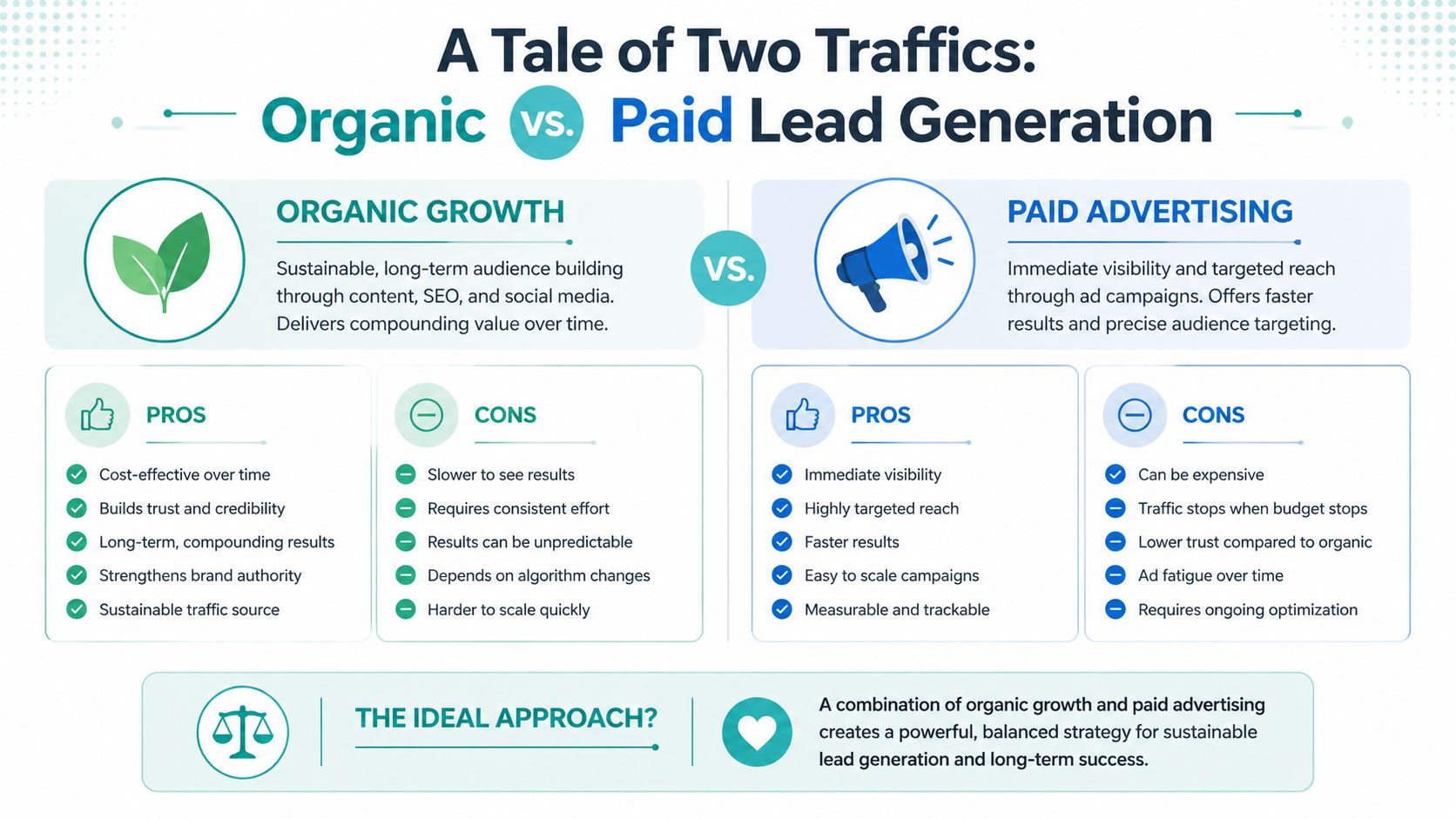
Organic growth
Organic traffic is slower to build, but it compounds. That’s the appeal. When you rank for the right searches, publish useful content, and optimize your Google Business Profile, you create a stream of people already looking for what you sell.
This matters because intent changes everything. According to Cirrus Insight’s lead generation statistics, SEO leads close at 14.6%, while outbound leads close at 1.7%. That gap tells you where the quality usually lives. People who search with intent are far more likely to buy than people interrupted by generic outreach.
Organic lead generation for small business usually comes from:
- Local SEO: Service pages targeting the cities and services you want to win
- Google Business Profile optimization: Reviews, categories, updates, and local relevance
- Content marketing: Pages and articles that answer buyer questions before they call
- Organic social support: Content distribution and reputation building
The upside is strong. Organic traffic can keep producing long after the work is published. The downside is patience. SEO doesn’t fix next month’s pipeline by itself.
If your business depends only on referrals and organic luck, you don’t have a pipeline. You have a streak.
For local businesses trying to dominate search in Central Florida or prepare for expansion into North Carolina, organic strategy should be part of the foundation. Done right, search engine optimization for local growth becomes one of the most durable assets in your marketing stack.
Paid advertising
Paid traffic is your accelerator. It gives you speed, control, and clear targeting. You can put an offer in front of buyers now instead of waiting for rankings to mature.
That makes paid media useful when:
- You need leads faster
- You’re launching a new service
- You want to test messaging
- You’re entering a new market
- You already know your best-converting offers
Google Ads works well when search intent is high. Facebook and Instagram can generate demand when creative and targeting are tight. LinkedIn is often more useful for professional services, B2B offers, and higher-value relationships than many small businesses think.
Paid has a tradeoff. You pay for visibility every day you want visibility. If the landing page is weak, the offer is generic, or the follow-up is slow, your budget disappears with very little to show for it.
That’s why I don’t like the “SEO vs PPC” debate. It’s shallow. A smarter mix looks like this:
- Use paid traffic for immediate testing and demand capture
- Use organic content and SEO to reduce dependency over time
- Retarget visitors who didn’t convert the first time
- Track lead quality by channel, not just lead volume
A healthy lead engine usually starts with one channel producing now and another compounding in the background. That balance gives you short-term traction without trapping you in permanent ad dependence.
From Interested Visitor to Paying Customer
A lead is not a win. It’s permission to continue the conversation.
That’s where most small businesses drop the ball. They spend time and money getting someone to fill out a form, then they respond late, send one generic email, or forget to follow up entirely.

Give people a reason to raise their hand
Not everyone is ready to buy the second they land on your website. Some are researching. Some are comparing. Some just want confidence that you know what you’re doing.
That’s why lead magnets work when they’re relevant. A strong lead magnet offers a practical next step tied to buyer intent. For service businesses, that might be a checklist, audit request, buyer guide, estimate tool, or a short problem-solving resource. For e-commerce, it might be a discount, buying guide, quiz, or product comparison.
The key is fit. Don’t offer a generic ebook because marketers told you to. Offer something your prospect would want before making a purchase decision.
Nurturing is where revenue is won
Most leads don’t convert because nobody nurtures them properly. The earlier data cited a harsh reality: 79% of marketing leads never turn into sales because of inadequate nurturing, based on Salesforce research referenced in that earlier source. That’s not a traffic problem. It’s a follow-up problem.
A solid nurturing flow usually includes:
- Immediate response: Confirmation email or text right after the form fill
- Useful follow-up: Helpful content tied to the original interest
- Sales context: A clear invitation to book, call, or reply
- Internal alerts: Someone on your team knows exactly when to step in
Here’s a practical example. If someone requests a roofing estimate, don’t just send “Thanks, we’ll be in touch.” Send a confirmation, explain the next step, answer common concerns, and give them a reason to trust your process before the sales call happens.
Video can help close that trust gap. This short explainer is a good companion to the follow-up conversation:
AI automation makes this practical for small teams. You don’t need a giant sales department to send timely, personalized messages anymore. You do need the right triggers, segmentation, and message logic. That’s where a good conversion rate optimization process earns its keep, because better nurturing and better page experience work together.
A fast follow-up with the right message beats a bigger ad budget with sloppy execution.
Your Essential Lead Generation Toolkit
Strategy without tools becomes guesswork. Tools without strategy become clutter. You need both, but keep the stack lean enough that your team will use it.
A lean stack that small teams can actually use
A practical lead generation for small business toolkit usually includes four categories.
- CRM system: HubSpot, Pipedrive, or Zoho CRM can track leads, pipeline stage, notes, and follow-up tasks.
- Analytics: Google Analytics helps you see where leads come from and which pages help or hurt conversion.
- Forms and capture: Typeform, Gravity Forms, Jotform, and similar tools make it easier to collect clean information.
- Automation: Platforms like Zapier or built-in CRM workflows can trigger emails, alerts, assignments, and segmentation.
AI belongs in this stack too, but only where it saves real labor. According to Join Valley’s guide to effective small business lead generation strategies, AI tools can automate personalized outbound outreach and reduce manual effort by as much as 70%. For a small team, that’s a serious advantage if the targeting and messaging are handled well.
If you want examples of form structures that reduce friction, review these successful lead forms and compare them against your current contact and landing page forms.
One option in this category is automated lead qualification systems, which can route leads, score intent, and speed up handoff after form submissions. That matters when you’re trying to avoid slow response times and overloaded inboxes.
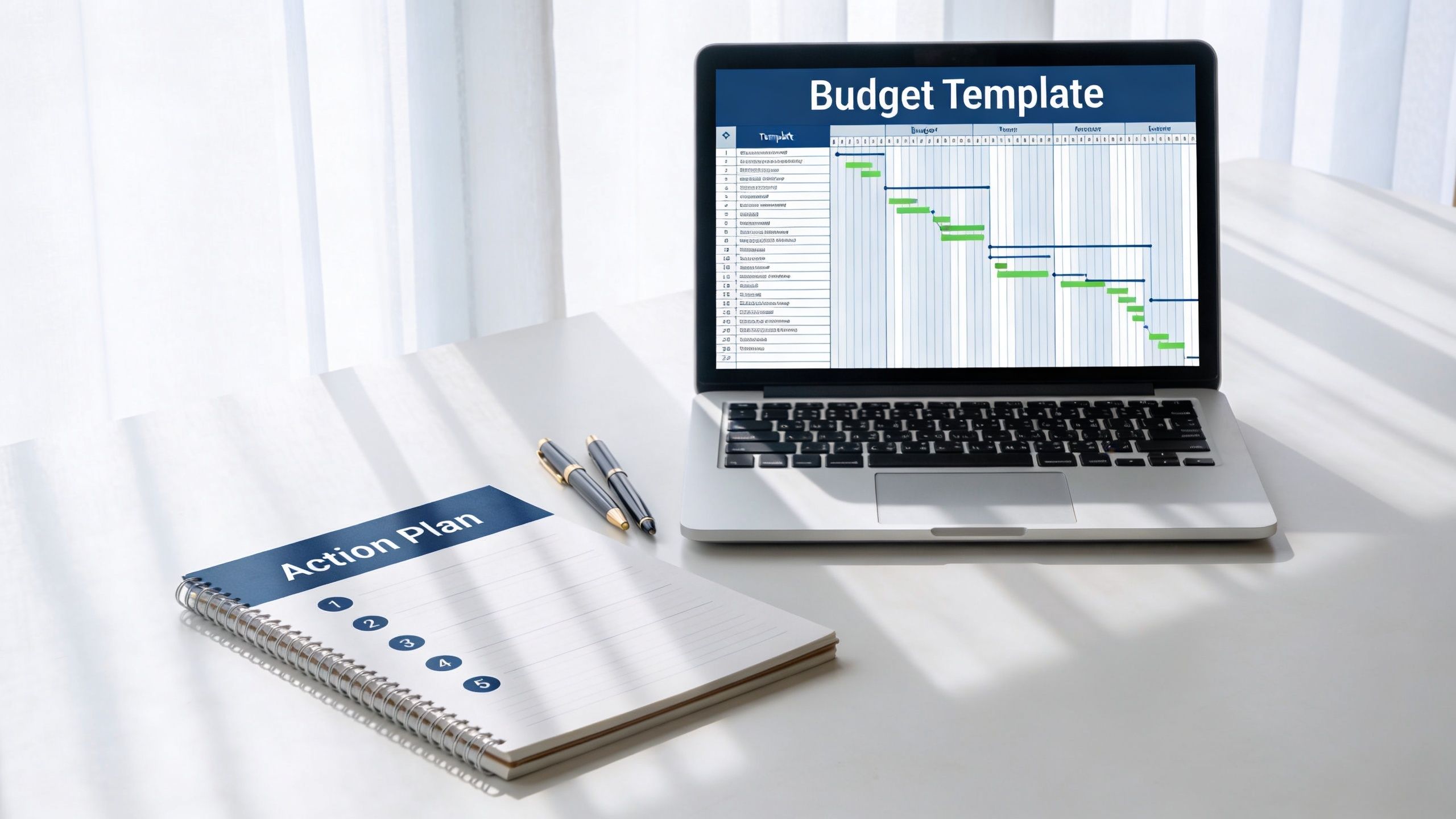
Simple planning tools that prevent chaos
You don’t need a fancy dashboard on day one. Start with simple operating documents.
Use a monthly budget sheet with line items for:
- SEO and content
- Paid ads
- Creative production
- Software
- Testing budget
Then use a basic content calendar with columns for:
- Target keyword
- Audience
- Offer
- CTA
- Publish date
- Distribution channels
Small business marketing gets messy when nobody knows what’s being published, what it’s supposed to do, or how leads are being tracked.
The right toolkit doesn’t just make marketing easier. It makes decisions clearer. You’ll know what’s working, what needs adjustment, and where your team is wasting time.
Start Your Growth Engine Today
The small businesses that grow consistently usually aren’t doing magic. They’ve just built a better system.
They know who they want to attract. Their website is built to convert. Their traffic strategy isn’t dependent on one channel. Their follow-up doesn’t rely on memory. Their tools support execution instead of creating more confusion.
That’s the core lesson in lead generation for small business. Predictable growth comes from a connected engine, not isolated tactics.
You can build that engine yourself. Many owners do. But execution is where things usually break down. Messaging gets watered down. Landing pages stay half-finished. Ads run without enough testing. CRM stages get ignored. Follow-up sequences never get completed. The strategy is fine. The implementation isn’t.
If you’re a business owner in Central Florida, or you’re growing into the Charlotte market, this is the moment to get serious about building a pipeline you can count on. Not one that depends on luck, referrals alone, or the occasional busy month.
A good lead system should make your business calmer. It should give you more control over demand, better visibility into performance, and a clearer path to revenue. That’s what mature marketing infrastructure does.
If you want help building a smarter growth system, book a free consultation with Emulous Media Inc, call 689-255-6327, or visit the contact page to talk through your goals.