You search one of your core services on Google and see a competitor sitting above you again. Same market. Same audience. Different result. The immediate questions are obvious. What keywords are they buying, how aggressive are they being, and are they winning business from it?
That’s where competitor adwords keywords research becomes useful. Not as a gimmick, and not as a copycat exercise. It’s a practical way to see where rivals are spending, which offers they push, and where your budget can work harder than theirs.
For a business owner in Central Florida, Charlotte, or any competitive local market, this matters because your real competition on Google often isn’t just the company across town. It’s whoever shows up first when a buyer searches with intent. The businesses capturing that attention are leaving clues in plain sight. If you know how to read them, you can turn raw ad data into better budget allocation, tighter funnel decisions, and more profitable campaigns.
Table of Contents
- Why You Need to Decode Your Competitors' Ads
- Identifying Your True Digital Competitors
- The Toolkit for Uncovering Competitor Keywords
- From Raw Data to Actionable Intelligence
- Launching Your Strategic Counter-Campaign
- Monitor, Automate, and Evolve Your Strategy
Why You Need to Decode Your Competitors' Ads
Most business owners assume competitor research means spying in a shady way. It doesn’t. You’re analyzing public signals: search ads, landing pages, auction overlap, and keyword patterns visible through research tools. That’s business intelligence, not anything unethical.
The reason it matters is simple. A competitor’s ad strategy reveals what they think is worth paying for. If they keep appearing on the same search terms, that usually means those terms matter to their pipeline. If they’ve stopped showing up on keywords you expected them to own, that can be just as revealing.
There’s also a second layer many companies miss. Your geographic competitors and your digital competitors aren’t always the same. A strong local company may barely advertise. Another business outside your immediate city may aggressively target your service area and absorb clicks that should have gone to you.
Practical rule: Don’t treat competitor adwords keywords as a list to copy. Treat them as evidence of how your market is being bought.
That mindset changes how you spend. Instead of guessing at keywords, you can prioritize based on business value, search volume, and user intent, which is the same core logic used in structured competitor keyword analysis workflows described by SE Ranking’s competitor keyword analysis guide.
This matters beyond Google Search, too. If you’re trying to understand how paid media scales across channels, a good companion resource is Sovran’s guide to analyzing Instagram ads for campaign scaling. The principle is similar: watch what competitors repeat, where they send traffic, and how they frame offers.
If you’re already investing in Google Ads, this gets even more important when paired with a strong search-intent strategy. That’s why many businesses also benefit from understanding how to capture buyers with Google Ads search intent marketing. Competitor research shows where rivals are visible. Search-intent work shows whether those clicks are worth buying.
Identifying Your True Digital Competitors
A lot of wasted analysis starts with the wrong list.
The HVAC company you think of first, the law firm across town, or the agency everyone knows locally might not be the advertiser taking your clicks. Google doesn’t care who has the biggest sign on the building. It cares who enters the auction for the search.
Your local rival may not be your paid search rival
The first useful distinction is this:
| Competitor type | What it means | Why it matters |
|---|---|---|
| Local business competitor | A company you compete with operationally in your market | They may matter offline but not bid heavily online |
| Paid search competitor | A company that appears repeatedly on your highest-intent searches | They directly affect your cost, visibility, and lead flow |
That difference becomes obvious fast when you search your own services. A plumbing company in Lake Mary may discover regional franchises and lead aggregators showing up for terms that local owners assumed belonged only to nearby shops. A Charlotte professional services firm may find niche specialists outranking larger generalists on high-intent queries.

A simple way to build your competitor list
You can build a clean starting list in one short session.
- Open an incognito browser window so your personal search history doesn’t skew what you see.
- Set your search location to the market you want, such as Orlando, Lake Mary, Sanford, Charlotte, or a specific service radius.
- Search your top service terms. Use phrases with buying intent, not broad industry language.
- Write down the advertisers that repeat across multiple searches.
- Click through carefully and note landing pages. The landing page usually tells you whether they’re targeting emergency buyers, price shoppers, commercial accounts, or branded comparison traffic.
Keep the list tight. You don’t need every business in the category. You need the domains that repeatedly show in the paid results for your most valuable searches.
Repetition matters more than one appearance. A competitor that shows up again and again is telling you where their money goes.
A good starting mix includes:
- Core service terms like emergency plumbing, personal injury lawyer, roofing contractor, med spa near me
- Long-tail local terms like water heater repair Lake Mary or estate planning attorney Charlotte
- Comparison searches where buyers are evaluating options
- Branded searches for your company and the leading rivals in your market
Once you’ve got those domains, the research becomes concrete. You’re no longer studying “the market” in the abstract. You’re examining the specific advertisers buying access to your buyers.
The Toolkit for Uncovering Competitor Keywords
Manual searching gives you the overview. Tools give you scale.
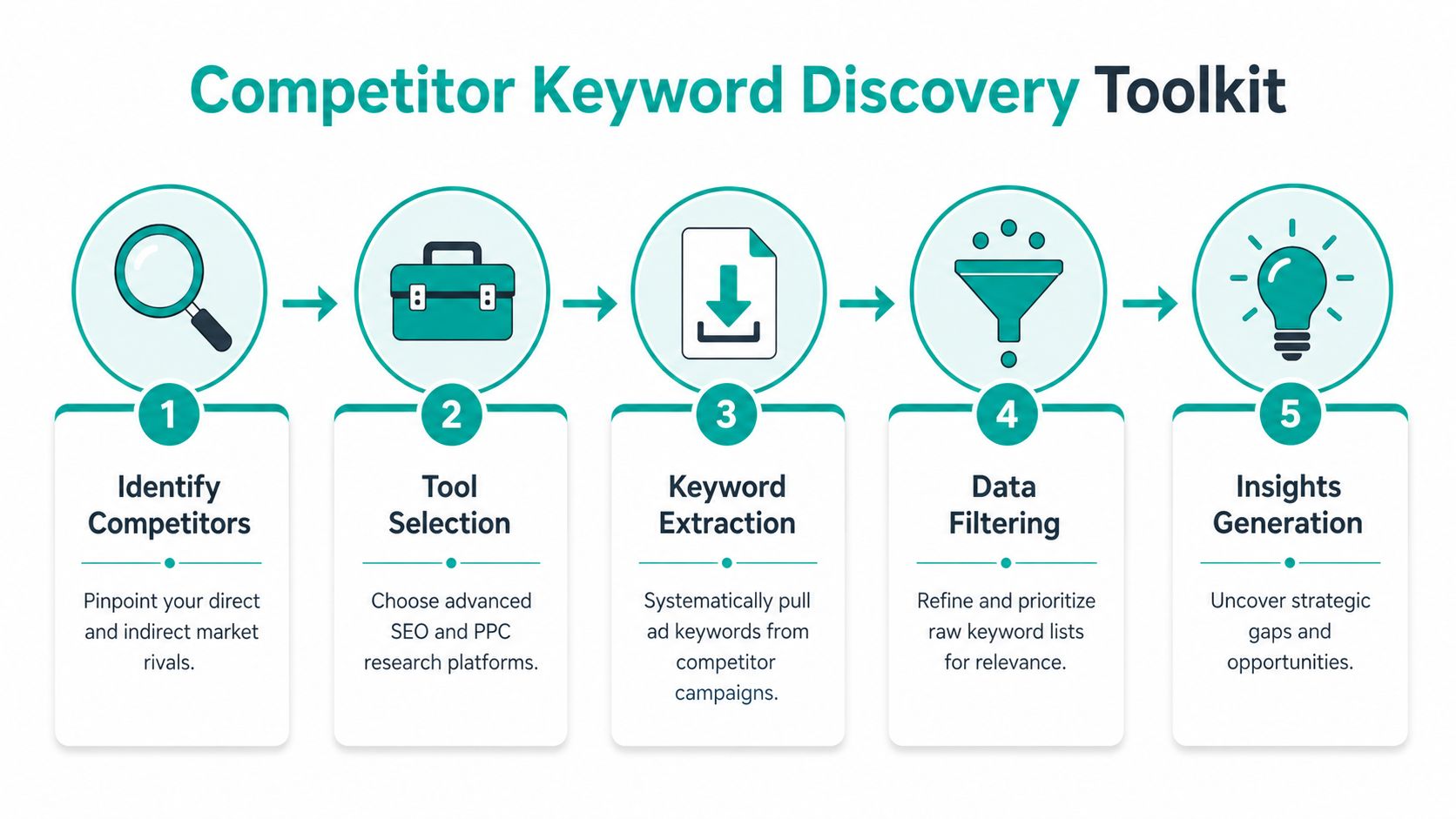
The useful workflow is straightforward: collect keywords from competitor domains, clean and organize the data, then assess ranking difficulty. Platforms such as SE Ranking, Ahrefs, and Semrush help extract estimated competitor keywords, average rankings, and landing pages, which makes it easier to spot high-volume opportunities where competitors are weaker, as described in this keyword research breakdown.
What free research can tell you
Free methods won’t replace paid tools, but they’re still useful.
Google’s Ad Preview and Diagnosis tool helps you inspect live ad behavior without repeatedly triggering impressions from your own searches. Competitor landing pages show keyword themes fast. If a rival has separate pages for emergency service, financing, same-day appointments, and city-specific variants, you’ve already learned a lot about how they segment intent.
Manual review is especially good for:
- Message patterns such as speed, guarantees, price framing, or trust signals
- Offer positioning like free consultation, same-day booking, or quote requests
- Funnel structure including whether traffic goes to a homepage, location page, or dedicated lead page
That’s enough to spot obvious strengths and weak spots. It’s not enough to map a whole keyword portfolio.
Where paid tools earn their keep
Third-party tools are what make competitor adwords keywords research operational.
SpyFu is often the fastest way to inspect paid search overlap. Competitor research tools in this category can reveal the keywords rivals bid on, show ad copy variations, estimate click volumes and cost-per-keyword data, and identify keyword gaps where your domain doesn’t appear but theirs does, as outlined in Ryze’s competitor research guide. SpyFu’s overlap views are especially useful when you need to see where competitors and your own domain collide.
Semrush is strong when you want a broad paid and organic view in one place. It’s helpful for tracing keyword themes back to landing pages and understanding how a competitor balances search visibility across channels.
Ahrefs is valuable when you want cleaner insight into keyword and landing-page relationships. It’s also useful for connecting paid opportunities with organic content opportunities, especially when you’re planning to turn PPC learning into SEO pages later.
SE Ranking is a practical option for agencies and in-house teams that want structured extraction and analysis without overcomplicating the workflow.
A quick comparison looks like this:
| Tool | Best use | What you’re looking for |
|---|---|---|
| SpyFu | Paid competitor overlap | Ad copy patterns, PPC gaps, estimated paid terms |
| Semrush | Broader market view | Paid and organic visibility across domains |
| Ahrefs | Keyword to page analysis | Which landing pages align with which terms |
| SE Ranking | Structured keyword extraction | Competitor domain exports and difficulty review |
What matters most isn’t the logo on the platform. It’s the output. You want:
- A downloadable keyword set
- The landing pages connected to those terms
- Search volume context
- A sense of keyword difficulty
- Evidence of where a competitor is active and where they’re absent
The absence matters. A competitor ranking high on a small-volume term may be less interesting than their weaker position on a larger-volume phrase. Traffic share tells you where the true opportunity sits, not just where they appear.
From Raw Data to Actionable Intelligence
A spreadsheet full of keywords isn’t strategy. It’s clutter until you classify it.
The fastest way to make competitor adwords keywords useful is to group them into themes. The most practical four-bucket model is Brand, NonBrand, Competitive, and Content. That framework turns a raw export into a map of where a competitor is protecting, prospecting, or staying silent.

Turn exports into themes
Here’s what each bucket tells you:
- Brand means searches that include the competitor’s own name. This is defensive spend. They’re trying to keep branded traffic from leaking.
- NonBrand covers generic commercial terms like family dentist Orlando or managed IT services Charlotte. New customer acquisition usually happens here.
- Competitive includes keywords tied to rival brands. If they’re active here, they’re deliberately trying to intercept comparison shoppers.
- Content points to informational or research intent. These terms can support top-of-funnel traffic, remarketing pools, and future SEO expansion.
This classification model is valuable because it helps infer budget allocation. AdConversion’s competitor analysis article notes that a keyword mix can show patterns such as an 87% NonBrand focus and 0% Competitive focus, which signals heavy investment in generic acquisition and avoidance of direct rival bidding due to cost.
That kind of pattern changes how you respond. If a competitor is all-in on NonBrand and absent on Competitive, you may have room to attack comparison intent selectively. If they’re heavily branded but light on Content, they may be relying on demand they already own rather than building new demand efficiently.
Raw exports become useful only after classification. Until then, you’re looking at ingredients, not the meal.
A lot of business owners underestimate the operational side of this work. Even good tools export messy CSV files, and teams still need a repeatable way to classify, sort, and review them. If you’re evaluating software costs for broader market monitoring, this overview of competitive intelligence solution pricing helps frame what different levels of tooling usually cover.
What the patterns actually mean
After you classify the list, study the ratio between categories and the landing pages attached to them.
Ask practical questions:
- Are they sending NonBrand traffic to a generic homepage or to focused service pages?
- Are branded keywords protected with strong ad copy, or are they leaking easy clicks?
- Are they avoiding local long-tail variants that matter in your area?
- Are they treating informational terms as throwaway traffic instead of funnel entry points?
That’s where reporting discipline matters. A useful dashboard doesn’t just count keywords. It shows theme share, landing page alignment, and which buckets tie to business goals. Strong teams build that visibility into recurring reporting, not one-time audits. If you want a better framework for that side of the process, this guide on data reporting for marketing strategies is worth reviewing.
For a quick visual walkthrough of how this analysis mindset applies in practice, this video adds helpful context before you build campaigns from the data:
The main takeaway is simple. Keyword lists tell you what exists. Theme analysis tells you what the competitor is trying to do.
Launching Your Strategic Counter-Campaign
A common pattern shows up right after competitor research. A business sees a rival everywhere in search, gets frustrated, and starts bidding broadly on the competitor’s brand terms. Spend climbs fast, lead quality gets muddy, and the core campaigns that produce revenue lose budget.
The better move is to turn competitor keyword data into a budget plan.
Most accounts should split response strategy into two lanes. Put the larger share of spend into under-defended, high-intent gaps that can convert efficiently. Reserve a smaller, tightly controlled test budget for competitor brand terms, where CPC pressure and lower click-through rates are part of the trade-off.

Prioritize the gaps with the best buying intent
Gap campaigns usually create the fastest wins because they let you compete where intent is clear and resistance is lower.
In practice, that often means building campaigns around service-specific modifiers, geo terms, urgent problem queries, niche product variants, and audience qualifiers your competitors have not covered well. These searches may have lower volume than headline terms, but they often sit closer to conversion and give you cleaner traffic.
Budget allocation matters here. Give more room to gap themes that map to mid-funnel and bottom-funnel intent, where the searcher already knows the problem and is comparing providers. Keep top-funnel themes on a shorter leash unless you have remarketing, email capture, or sales follow-up in place to turn that traffic into pipeline.
Strong gap campaigns usually include:
- One clear intent per ad group or asset group
- Landing pages built for that exact service or pain point
- Negative keywords that protect budget from broad-match drift
- Bid strategies based on conversion value, not competitor anxiety
I see too many accounts put all competitor-driven opportunities into one broad campaign. That makes reporting harder, hides which themes deserve more budget, and creates landing page mismatch that hurts conversion rate.
Use competitor brand bidding as a controlled test, not a default strategy
Bidding on a competitor’s brand can produce useful incremental traffic, but only if the business can afford expensive clicks and has a credible alternative to present.
The economics are rarely forgiving. Analysts at SpyFu found that advertiser CTRs on competitor terms can run 10 to 20% lower, strong campaigns can still contribute a 5 to 15% market share lift, weak Quality Scores can push CPCs to double or triple normal levels, and longer competitor-related variants can account for a large share of missed qualified traffic opportunities. Their guidance is covered in SpyFu’s competitor keyword analysis.
That is why I treat competitor bidding as a separate budget decision, not an extension of core search.
A disciplined setup usually includes:
- Standalone campaigns by competitor or competitor cluster
- Hard budget caps so branded and non-brand campaigns keep priority
- Custom landing pages that explain your difference clearly
- Negative keyword controls to avoid cannibalizing your own traffic
- Pause rules tied to CPL, lead quality, or sales acceptance rate
Send those clicks to a comparison page, offer page, or problem-solution page. Homepage traffic is usually wasted traffic.
If you need a model for that kind of account structure, the same segmentation principles show up in experienced Google Ads PPC management services. The win comes from intent matching, budget discipline, and funnel alignment.
Match the campaign to the funnel
Raw competitor keyword data becomes useful when it changes where you spend and what page the click reaches.
If a competitor dominates high-funnel informational terms, you do not have to outspend them there. You can let them pay to educate the market while you put more budget into comparison, solution, local, and urgency terms where buyers are closer to action. If they are weak on those terms, that weakness is your opening.
If you do target their branded searches, build the landing page for decision-stage visitors. Answer the question they are already asking. Why choose you instead? Faster onboarding, better support, simpler pricing, stronger local coverage, a more specialized service. Make the contrast explicit and truthful.
That is the ethical line as well. Bid on the query if it fits your strategy. Do not imitate the competitor, mislead the searcher, or blur your brand identity. Clear positioning wins more often than clever imitation.
Monitor, Automate, and Evolve Your Strategy
Competitor research loses value fast if you treat it like a one-time project.
Search auctions move. Competitors change copy, cut spend, expand markets, and test new landing pages. The only way to stay ahead is to build a loop: monitor, adjust, measure, repeat.
Use Auction Insights as your control panel
Google Ads Auction Insights is one of the most practical places to monitor what happens after launch. It helps you see who overlaps with your campaigns, where your impression share is slipping, and which rivals are becoming more active.
That matters because your pre-launch assumptions won’t stay perfect. A competitor that looked aggressive in manual research may turn out to be inconsistent. Another may subtly dominate only a narrow slice of terms that matter most to your business.
A disciplined review rhythm should include:
- Weekly checks on overlap and impression trends
- Search term reviews to tighten negatives
- Landing page reviews tied to conversion quality, not just click volume
- Bid strategy checks when market conditions shift
Advanced competitor bidding can improve meaningfully when you layer Remarketing Lists for Search Ads onto these campaigns. Practical Ecommerce’s guidance notes that RLSA can lift CTR by 20-30%, which makes sense because you’re speaking to searchers who already know your brand.
The same source reports that structured campaigns in service sectors can achieve 1.2-1.8 ROAS, versus 0.8-1.1 for unoptimized efforts, and that USP-focused landing pages can improve conversions by 15% when the experience is tighter and more relevant. It also warns that neglecting negative keywords can cause 25% cannibalization of generic traffic. Those are exactly the kinds of performance gaps that separate serious management from casual setup.
Add automation only where it improves control
Automation should sharpen judgment, not replace it.
Scripts and AI-driven rules are useful when they help you react faster to CPC movement, budget pacing, or impression share changes. They’re especially helpful in competitor campaigns because those auctions can swing quickly and punish slow accounts.
Good automation tasks include:
- Monitoring weekly CPC fluctuations
- Adjusting bids within guardrails
- Flagging impression-share drops
- Routing budget toward the best-performing segments
Bad automation is anything that hides the economics. If you can’t explain why a competitor campaign is spending, where it’s showing, and what kind of lead it produces, the automation isn’t helping.
That’s why more mature advertisers combine manual auction review with systems that respond faster than a human can. For businesses building this into a broader optimization stack, AI-powered bid management can be useful when it’s tied to clear campaign logic and clean conversion data.
The businesses that win with competitor adwords keywords aren’t the ones with the biggest spreadsheet. They’re the ones that turn research into campaign structure, structure into disciplined testing, and testing into a tighter funnel over time.
If you want help turning competitor research into a working Google Ads strategy, Emulous Media Inc can help. We build and manage data-driven advertising systems for Central Florida businesses and growing brands that need smarter PPC, stronger websites, and better lead generation. Book a free consultation, call 689-255-6327, or visit the contact page to talk through your market, your competitors, and where your next campaign should go.