You’re probably doing more marketing than ever and trusting it less than ever.
The website got redesigned. Google Ads are running. Someone is posting on social. Maybe SEO is “in progress.” Email campaigns go out when there’s time. Every vendor says their channel is working, but when you ask a simple business question, “What’s driving qualified leads and sales?” the answer gets fuzzy fast.
That’s the problem integrated marketing solutions solve.
For many small and mid-sized businesses in Central Florida and Charlotte, the issue isn’t effort. It’s fragmentation. One system is generating clicks, another is collecting leads, another is supposed to nurture them, and none of them are speaking the same language. You’re not running a growth engine. You’re managing a pile of disconnected tactics.
Table of Contents
- The Hidden Cost of Disconnected Marketing
- What Are Integrated Marketing Solutions Really
- The Blueprint of an Integrated Growth Engine
- Integrated Marketing in Action for Local Businesses
- How Emulous Media's Five Pillars Deliver Results
- Your Next Step Toward Unified Growth
The Hidden Cost of Disconnected Marketing
A business owner in Orlando hires an SEO freelancer, a paid ads specialist, and a social media contractor. Each one sends reports. Each one shows activity. Traffic is up in one place, impressions are up somewhere else, and lead quality is still inconsistent.
That setup is common because it feels responsible. You’re covering your bases. But in practice, disconnected marketing behaves like separate departments inside a company that never meet. The ad team promises speed. The website talks about trust. Social posts sound casual. Emails push offers that don’t match the landing page. Buyers notice that friction even if they never say it out loud.
A useful reality check comes from a 2025 HubSpot study summarized by IMS on fragmented SMB marketing stacks, which says 67% of SMBs in tier-2 cities struggle with fragmented marketing stacks, yet only 15% use AI for integrated local search. That gap matters for markets like Central Florida and Charlotte, where local competition is serious but many businesses still run marketing as isolated tasks.
Where the leak usually happens
The money leak rarely starts with one catastrophic mistake. It starts with small disconnects that compound:
- Paid traffic lands on weak pages that weren’t built for the keyword or offer behind the ad.
- SEO content attracts interest but no one built a follow-up system to turn that interest into a lead.
- Social media creates awareness but doesn’t connect to search, remarketing, or email.
- Reporting stays channel-specific so nobody can explain the full customer path.
Practical rule: If each vendor can only prove the value of their own lane, nobody is managing business outcome accountability.
That’s why attribution matters. If you’ve never looked closely at how channels assist one another, marketing attribution modeling is where the fog starts to clear. It helps you stop asking, “Which single channel gets credit?” and start asking, “How did the whole journey create the sale?”
What disconnected marketing feels like to the buyer
From the customer side, fragmented marketing is simple. It feels confusing.
They search for one service, click an ad, land on a page that doesn’t answer the question they had, leave, see a retargeting ad with different language, then get an email that assumes they’re ready to buy. Businesses often interpret that as poor lead quality. More often, it’s poor orchestration.
Integrated marketing solutions fix that by making every touchpoint act like part of one system instead of a collection of separate campaigns.
What Are Integrated Marketing Solutions Really

A better way to define it
The easiest way to understand integrated marketing solutions is to stop thinking about channels and start thinking about coordination.
A fragmented marketing setup is like putting talented solo musicians in one room and asking them to play whatever they want. You’ll hear sound. You may even hear moments of brilliance. But you won’t hear a song anyone can follow.
An integrated system works like an orchestra. The website, Google Ads, SEO, social media, email, video, and automation each play different parts, but they follow the same score. The buyer hears one clear message, not six competing versions of your business.
That’s why many companies trying to unify your marketing channels eventually realize the issue isn’t adding more tools. It’s deciding what each channel should do, when it should do it, and how it should hand the prospect to the next step.
A good integrated setup usually includes these essential elements:
- One core message carried across ads, pages, emails, and sales follow-up
- One source of truth for lead and performance data
- One buyer journey that maps awareness, consideration, and conversion
- One operating rhythm so campaigns launch together instead of randomly
Businesses that need help building that structure usually aren’t missing tactics. They’re missing orchestration. That’s where a broad service model becomes valuable, especially when digital marketing and growth services live under one strategic roof instead of being split across scattered specialists.
What integration changes for the buyer
Integrated marketing doesn’t just help the business report better. It helps the buyer decide faster.
A prospect might first find you through search, watch a short video on a landing page, leave, see a retargeting ad later, come back through a branded search, and fill out a form after reading reviews. In a disconnected setup, each touchpoint feels unrelated. In an integrated one, every touchpoint reinforces the same promise.
That consistency builds trust because the buyer doesn’t have to re-learn who you are every time they meet you.
A short explainer helps bring that to life:
Buyers rarely convert because one channel “won.” They convert because multiple touchpoints reduced uncertainty at the right time.
The Blueprint of an Integrated Growth Engine
Integrated marketing solutions work best when you build them like a machine, not a checklist. Each part should feed the next part. If one gear spins without transferring power, you’re paying for motion instead of growth.
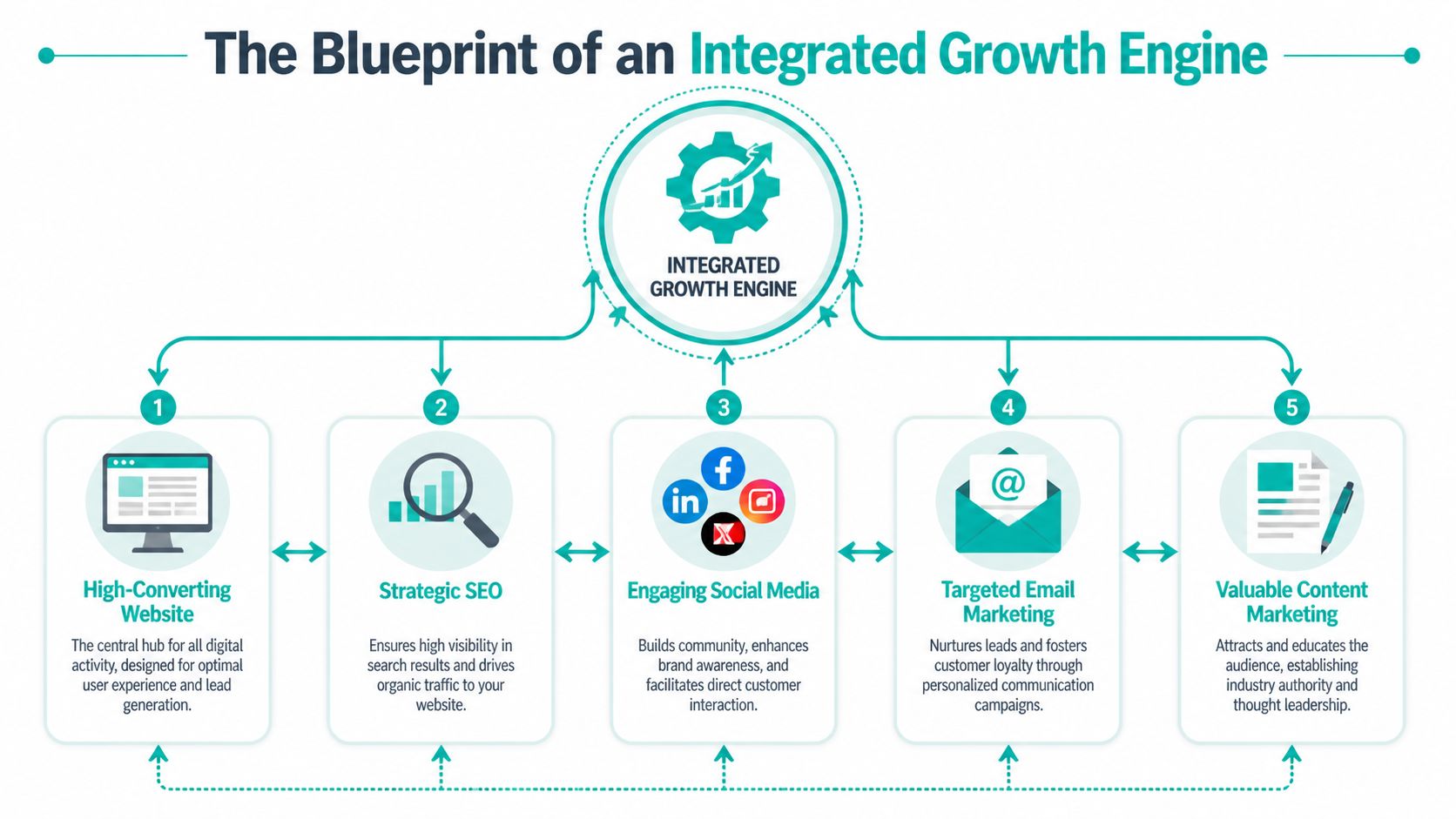
One reason this matters so much is retention. Companies that excel in omnichannel customer engagement retain 89% of customers compared with 33% for companies with weak strategies, according to New Digital Noise on omnichannel engagement and retention. That’s not a branding vanity metric. It’s a direct signal that connected experiences outperform scattered ones.
Your website is the hub
Your website is not a brochure. It’s the central operating system.
Every campaign eventually asks the website to do one of four jobs: validate trust, answer objections, capture the lead, or close the sale. If the site is slow, unclear, hard to use, or inconsistent with the ad that brought the user there, everything upstream gets weaker.
For service businesses, that means pages built around intent. “Emergency AC repair,” “family law consultation,” and “pediatric care” should not all funnel into a vague homepage. For e-commerce, it means product pages, category pages, and cart flow have to match the promise made in the ad and the search term.
SEO and PPC should inform each other
Too many businesses run SEO and Google Ads like separate bets. That wastes information.
SEO tells you how people search, what language they use, and which topics earn attention over time. PPC tells you which offers and terms produce immediate action. When those teams talk, the business gets sharper fast. Organic search data can shape ad groups. Paid search data can reveal which service pages deserve deeper SEO investment.
If you’re trying to build pipeline instead of just traffic, this kind of alignment fits closely with a broader AI SEO Tracker guide on demand generation, especially the idea that channels should create and capture demand together rather than compete for credit.
A functional loop looks like this:
| Component | Primary job | What it feeds next |
|---|---|---|
| Website | Convert attention into action | Better audience data and stronger conversion signals |
| SEO | Capture existing demand | Content themes, landing page priorities, remarketing audiences |
| PPC | Create immediate visibility | Fast testing for keywords, offers, and audience intent |
| Media production | Build trust quickly | Better ad creative, stronger pages, more persuasive follow-up |
| AI automation | Respond and nurture at scale | Faster lead handling and cleaner handoff to sales |
Creative and automation close the loop
Most local businesses underuse creative and overestimate software.
Creative matters because buyers judge quality before they read details. A polished video, strong photography, clear copy, and a clean interface tell people your business is credible. Weak creative creates friction before the sales process even begins.
Automation matters because speed and consistency win deals. A lead from PPC should trigger the right thank-you page, the right CRM tag, the right text or email follow-up, and the right reminder for your team. AI can help route, qualify, and personalize those interactions, but only if the structure is already sound.
For teams that want visibility across all of it, a marketing dashboard built for cross-channel decision-making becomes less of a reporting tool and more of a control panel.
Integrated Marketing in Action for Local Businesses
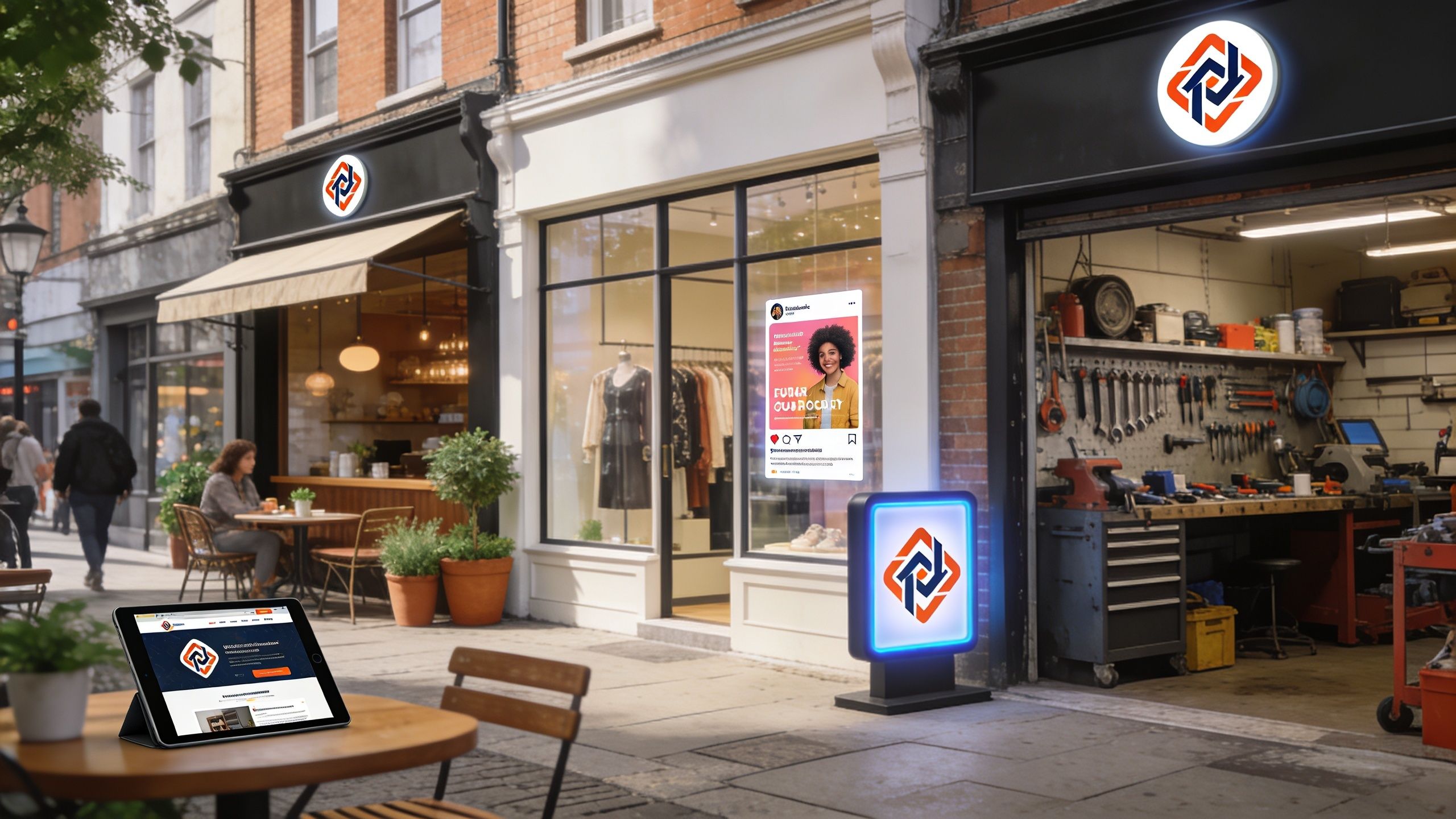
Theory is useful. Local execution is what pays the bills.
E-commerce stores that want smarter follow-up
A shopper clicks a Google Shopping ad, views a product, and leaves. In a weak setup, that visit disappears into analytics and nothing meaningful happens next.
In an integrated setup, the viewed product informs retargeting creative, email capture offers, and follow-up messaging. If the visitor comes back through branded search, the landing experience stays consistent. If they add to cart and stop, automation can trigger a reminder flow that reflects the same product and positioning they already saw.
That’s where smaller retailers in secondary markets can compete. They may not have enterprise budgets, but they can still coordinate product feeds, landing pages, retargeting, and email so the buying path feels deliberate instead of accidental.
Home services companies competing in local search
For a home services company in Orlando or the Charlotte area, the goal isn’t broad awareness. It’s to show up when intent is urgent and local.
That means local SEO should support Google Business Profile visibility, service pages should match search intent, and paid ads should target the same service geography with clear calls to action. A “plumber near me” search should lead to a page that confirms location, services, credibility, and contact options immediately.
Paid search and local signals work best when they reinforce each other. A business that wants to dominate its immediate service area should study how hyper-local Google Ads can strengthen backyard visibility, especially when paired with strong landing pages and review-focused trust signals.
Local lead generation breaks when the ad, map listing, landing page, and follow-up process each make a different promise.
Healthcare practices serving mixed and underserved communities
Healthcare marketing has another layer of difficulty. Trust, accessibility, clarity, and follow-up all matter more because the decision often carries stress and urgency.
A clinic might publish condition-specific content for search visibility, offer a downloadable guide for patients or caregivers, and use automation to route inquiries based on service need. But those systems have to respect the realities of the audience. Diverse populations don’t all access healthcare the same way, and underserved areas often face digital access barriers that standard funnels ignore.
For service-based companies in diverse regions, integrating AI that is aware of Social Determinants of Health can boost engagement by 51% in underserved zip codes compared with 29% in urban areas, according to Healthcare IT Today on equitable digital engagement. The practical takeaway is straightforward. Better automation isn’t just faster. It can be more relevant, more accessible, and more respectful of how real patients engage.
Law firms building authority before the first call
Legal marketing works when authority shows up before the consultation.
A Charlotte law firm might run search ads for high-intent terms, but that alone won’t carry the whole decision. Strong video testimonials, attorney profile content, FAQ pages, and remarketing can reduce hesitation before someone ever picks up the phone. LinkedIn can support practice-area visibility for certain firms, while branded search and direct visits often increase when authority content is doing its job.
Here, media production isn’t decoration. It’s proof. A well-produced testimonial or attorney explainer helps a prospect decide whether your firm feels credible, experienced, and worth contacting.
How Emulous Media's Five Pillars Deliver Results
Integrated marketing is hard to pull off when five different vendors each protect their own lane.
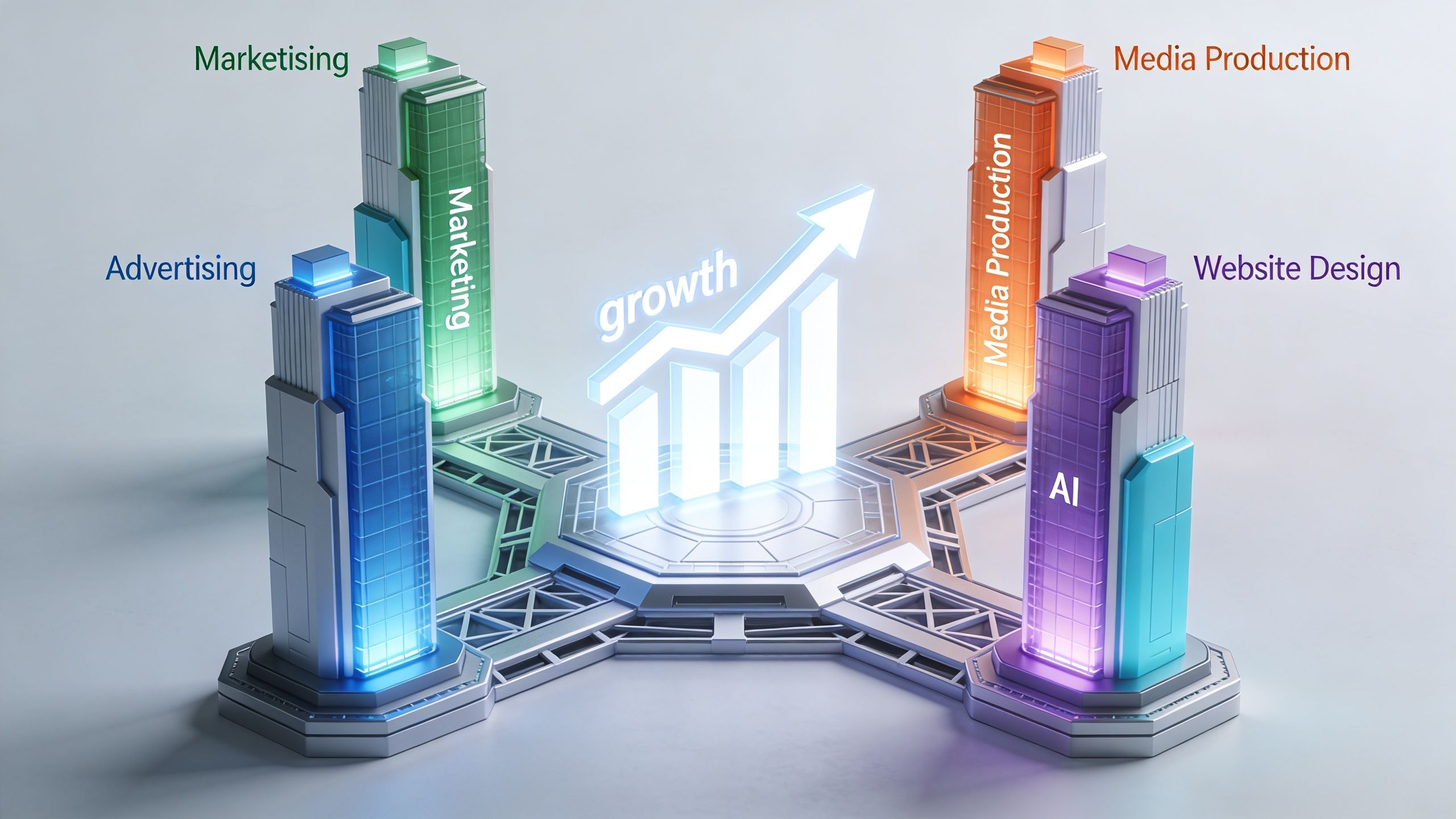
That’s why the strongest agency models don’t just offer more services. They connect strategy, creative, media, website performance, and automation inside one operating framework. The business owner gets one plan instead of five opinions.
There’s a hard business case for that. C-Suite Strategy on integrated marketing performance notes that an integrated approach yields 50% higher ROI on average, and B2B firms that implement it achieve a 24% rise in market share.
Why one orchestrated team beats five separate vendors
When different providers own ads, website changes, SEO, creative, and automation, simple tasks become slow and political.
The ad manager says conversions are weak because the landing page needs work. The web team says they need better messaging. The SEO team wants more content. The CRM person says lead routing is the primary issue. Sometimes they’re all right, but nobody is accountable for the system.
An integrated model solves that by changing the unit of work. Instead of optimizing channels in isolation, the team optimizes the full path from click to customer.
That shift usually improves four things fast:
- Speed of execution because creative, copy, tracking, and web updates don’t wait on separate vendors
- Message consistency because the same strategy informs ads, pages, video, and follow-up
- Data quality because tracking decisions are made across systems, not inside one platform
- Decision clarity because reporting reflects business outcomes, not channel self-defense
The five pillars in practice
Emulous Media’s framework is effective because each pillar solves a specific bottleneck while supporting the others.
Advertising
Paid media creates immediate visibility where intent already exists or where attention can be earned. Google Ads, Local Services Ads, Meta campaigns, YouTube placements, and targeted regional campaigns all belong here. The point isn’t “more ads.” It’s sharper offers, tighter targeting, and cleaner conversion paths.
Marketing
This is the strategic layer. Positioning, SEO, content planning, campaign structure, audience segmentation, and funnel design all sit here. Without this layer, advertising becomes expensive traffic buying and content becomes random publishing.
Media production
Good creative shortens the trust gap. Brand videos, testimonials, short-form clips, photography, and campaign visuals help buyers decide whether your business looks credible before they compare details. In crowded markets, that first impression matters more than many owners think.
Website design
A site should do more than look modern. It should load well, work on mobile, answer the right questions, structure information clearly, and guide action without confusion. The website is where many campaigns either cash out or collapse.
AI automation
This pillar turns response time and follow-up into a competitive advantage. AI-supported workflows can qualify leads, route inquiries, support nurturing, and reduce manual delays. Used correctly, automation doesn’t make a business feel robotic. It makes the experience feel responsive.
Operational truth: Tools don’t create integration. Shared strategy, shared data, and shared accountability create integration.
If you want proof that your current setup is working, the cleanest place to start is your reporting stack. A strong marketing analytics and reporting system should show how traffic, leads, conversion quality, and follow-up connect. If it can’t, the system is still fragmented.
Your Next Step Toward Unified Growth
Disconnected marketing feels busy because it is busy. It also hides waste well.
When SEO, PPC, website design, creative, and automation operate separately, you end up paying for attention you can’t convert, leads you can’t track, and traffic you can’t explain. That’s why integrated marketing solutions matter so much for SMBs in markets like Central Florida and Charlotte. They turn isolated activity into a coordinated system.
The practical standard is simple. Your ads should match your landing pages. Your content should support your search strategy. Your CRM should know where leads came from. Your automation should respond based on real behavior, not generic timing. And your reporting should tell the story of the whole customer journey, not just one vendor’s slice of it.
If that’s not how your current setup works, the fix probably isn’t another tool. It’s a unified strategy and a team that knows how to build it.
Take a hard look at your current stack. Count how many handoffs it takes to launch one campaign, update one landing page, change one offer, and trace one lead back to revenue. If the answer is messy, you’ve already found the growth constraint.
If you want a clearer plan for building integrated marketing solutions that drive leads and sales, talk with Emulous Media Inc. You can book a free consultation, call 689-255-6327, or reach out through the contact page.