Your business may be growing while your brand still looks and sounds like the company you were years ago. That gap shows up in subtle ways first. Sales conversations take longer. Better-fit prospects hesitate. Your website gets traffic but doesn't convert like it should. Referral partners understand your old offer better than your current one.
This is usually when owners start asking the underlying question behind the design question. Not “do we need a new logo?” but why do companies rebrand when the business itself is already working?
Because brand isn't decoration. It's infrastructure. It shapes how buyers interpret your pricing, your expertise, your category, and your credibility before your team gets a chance to explain any of it.
That pressure has intensified. Since 2020, 75% of companies have rebranded, and an additional 51% updated their branding strategies post-pandemic to match changing markets and customer expectations, according to Chief. For many companies, the issue isn't visibility alone. It's whether every touchpoint still communicates the same value. If you're reviewing your positioning, this guide on brand consistency is a useful companion because consistency is often the first thing to break when a business outgrows its original identity.
A strategic rebrand fixes misalignment. Done right, it helps a company earn attention, support higher pricing, expand into new markets, and improve digital performance across search, paid media, social, and web conversion.
Table of Contents
- Is Your Brand Still Working as Hard as You Are?
- Core Reasons Driving a Strategic Rebrand
- Modern Triggers for a Digital-First Brand
- When to Seriously Consider a Rebrand
- The Rebranding Process What to Expect
- Measuring Rebrand Success and Avoiding Pitfalls
- Your Partner for a Growth-Focused Rebrand
Is Your Brand Still Working as Hard as You Are?
A lot of owners hit the same wall. The company has matured, the offer is stronger, the team is better, and the customer experience has improved. But the brand still signals “small local provider,” “budget option,” or “single-service shop.”
That mismatch costs money.
Buyers don't experience your business in the order you do. They don't first meet your team, understand your vision, and then evaluate your brand. They see your name, website, ad creative, social presence, proposal deck, and search results first. Those assets create the first filter. If the filter is outdated, the rest of your marketing has to work harder to overcome it.
The hidden drag on growth
An underperforming brand usually creates operational drag before anyone calls it a branding problem.
- Sales drag: Reps spend too much time re-explaining what the company does today.
- Pricing drag: Prospects compare you to cheaper competitors because your presentation doesn't support premium positioning.
- Hiring drag: Strong candidates overlook the business because the public-facing image feels behind the times.
- Marketing drag: Paid traffic lands on a website that doesn't reinforce trust fast enough.
Practical rule: If your team has to repeatedly “clarify who we are now,” your brand is no longer doing its job.
Why this issue is urgent now
Market shifts since 2020 forced companies to adapt faster than their identities could keep up. That's why rebranding moved from occasional initiative to standard business response. The companies that rebrand strategically aren't chasing novelty. They're correcting market perception so the business can keep scaling without friction.
For a Central Florida company moving from local growth into regional campaigns, or a firm preparing to compete in Charlotte while still serving Florida, this becomes even more important. Your old brand may have been accurate when you were smaller. Accuracy changes when the business changes.
A rebrand is worth considering when the current brand makes the business look less capable, less relevant, or less differentiated than it really is.
Core Reasons Driving a Strategic Rebrand
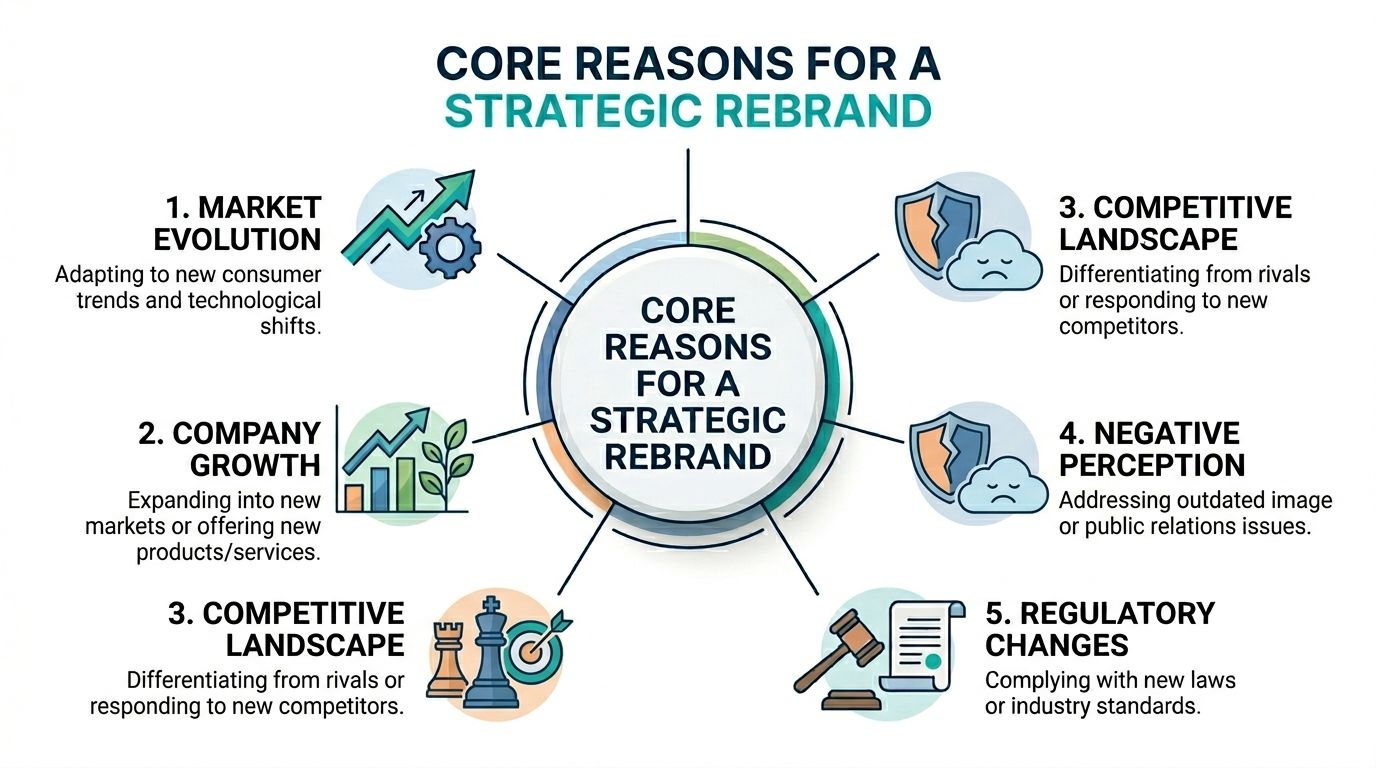
A strategic rebrand starts when the brand no longer helps the business win the right deals. The issue is rarely design alone. Revenue goals changed. The offer changed. The buyer changed. Sometimes all three changed at once.
Growth changes what the brand needs to do
Early-stage positioning is usually narrow on purpose. It helps a company get traction, explain a core offer fast, and build initial demand in one market or category. The problem comes later, when that same positioning starts limiting what buyers believe you can do.
A company that began with one flagship service may now sell integrated solutions. A founder-led local business may now be competing for regional accounts. A firm that once relied on referrals may now need the brand to carry paid traffic, support outbound, and convert search demand into qualified leads. If the market still sees the old version of the business, conversion rates suffer before leadership sees the brand as the cause.
This shows up in practical ways. Sales conversations start with correction instead of momentum. The website pulls in traffic for lower-value work. Prospects who could afford a larger engagement assume the company is too small, too narrow, or too tactical.
At that point, the brand is capping growth.
Mergers and acquisitions create expensive confusion
M&A changes the story buyers hear. It also changes the system behind the story.
Now there are multiple names, service lines that overlap, visual identities that conflict, and teams using different language in proposals, sales decks, and web pages. Customers have to work harder to understand what belongs together. That extra effort costs trust, and trust affects deal velocity.
BrandExtract points to Landor research showing how often acquired brands are reworked after a deal. That pattern makes sense. Companies consolidate brands because fragmented brand architecture creates duplicate marketing spend, weaker recall, and confusion in the market.
For businesses preparing for expansion, portfolio cleanup, or a more mature go-to-market strategy, brand strategy and identity work becomes a practical requirement, not a creative luxury.
A house of brands can work. An endorsed brand can work too. The right choice depends on customer overlap, reputation transfer, cross-sell potential, and whether the parent brand helps or hurts demand generation. What does not work is ambiguity. If buyers cannot tell how your offers connect, every channel performs worse.
Market perception can fall behind business reality
Some companies outgrow the reputation they built years ago. Others inherit a position they never meant to keep. The business may be stronger, broader, or more specialized than the public-facing brand suggests.
That gap has real consequences. Better-fit prospects do not inquire. Recruiters hear interest from candidates who are a poor match. Paid campaigns attract clicks but not the right leads. In competitive markets like Central Florida and Charlotte, where buyers compare options quickly across search, review platforms, social proof, and websites, weak positioning gets punished fast.
A rebrand is often justified when:
- The company appears smaller or less established than it is
- The name is tied to an offer, geography, or audience the business has outgrown
- Competitors look more credible even when their capabilities are weaker
- The category has become crowded, and buyers cannot tell the difference
- Leadership has made a real strategic shift that the market has not recognized
The fix is not a fresh logo by itself. The fix is a clearer market position, stronger messaging, and an identity system that supports higher-value acquisition across every channel the business depends on.
Rebranding can support a deliberate move upmarket
One of the most common reasons to rebrand is a pricing and positioning shift. Companies that want larger accounts, better margins, or more selective client fit often discover that their current brand still signals accessibility when they need authority, or familiarity when they need specialization.
That mismatch creates friction at the exact moment the business is trying to move upmarket. Enterprise buyers expect polish, consistency, and a clear point of view. Mid-market buyers want confidence that your team has done this before. If the brand looks generic, dated, or disconnected from the actual buying process, those prospects hesitate.
I have seen this happen with professional services, healthcare, legal, home services, and multi-location businesses. The company has already improved operations and expanded capabilities, but the market still reads the old identity and assigns the old value. A strategic rebrand corrects that signal so marketing can attract better-fit demand and sales can defend stronger pricing.
Modern Triggers for a Digital-First Brand
A modern rebrand isn't just about what looks good on signage or business cards. It has to function inside search results, mobile layouts, ad creative, social avatars, video intros, landing pages, and platform interfaces.

A logo now has to work like a system
Many older brands were built for a simpler environment. A desktop website, some print collateral, maybe local sponsorships. That's not the operating reality now.
Today, your brand has to survive these conditions:
- Tiny spaces: favicon, app icon, social profile image
- Fast scanning: paid social, local search, YouTube thumbnail, email preview
- Motion: short-form video, animated logo stings, digital ads
- Consistency across devices: desktop, tablet, phone, smart display
That changes the design brief. The question isn't “does this logo look modern?” It’s “does this brand system hold together across every sales and marketing touchpoint?”
For companies planning a broader digital overhaul, website redesign and modernization is often where branding weaknesses become impossible to ignore. The site exposes the cracks fast. Inconsistent typography, unclear hierarchy, vague messaging, weak mobile presentation, and a visual identity that doesn't support conversion.
Simpler is not always better
A lot of executives see the current wave of stripped-down logos and assume simplification is the answer. Sometimes it is. Sometimes it removes the very distinctiveness that made the brand memorable.
The challenge was framed well by Bolt Group, which noted the “blanding” trend driven by the need for logos to perform everywhere from app icons to smartwatches. The issue isn't simplicity itself. It's whether simplification improves omnichannel performance without flattening the brand into something generic.
A digital-first brand should be easier to deploy, not easier to ignore.
Here's a useful framing:
| Brand choice | Helps when | Hurts when |
|---|---|---|
| Simplified mark | You need clarity at small sizes and cleaner mobile presentation | It makes you visually interchangeable with competitors |
| Expanded brand system | You run campaigns across paid, web, social, and email | The system becomes so loose that teams create inconsistent assets |
| More expressive design | Your market is crowded and buyers need a reason to remember you | The style overpowers usability or confuses the core offer |
This short video gives a useful outside perspective on modern rebranding decisions.
For e-commerce brands and service businesses, the key trade-off is straightforward. Distinctive design can improve recognition, but only if the experience still converts. If visitors can't understand the offer, move around the page, or trust the business, the rebrand becomes expensive theater.
When to Seriously Consider a Rebrand
Most companies don't need to rebrand the moment they feel a little tired of their look. Fatigue is not a business case. Friction is.
The right time is usually when your current identity starts limiting growth, confusing buyers, or constraining the next version of the company.
Questions worth asking now
Run through these with your leadership team. The pattern matters more than any single yes.
- Market perception: Does your brand accurately reflect the quality, price point, and sophistication of your offer today?
- Sales alignment: Do prospects regularly misunderstand what you do before speaking with your team?
- Competitive separation: Do you look and sound too similar to your top competitors?
- Expansion readiness: Is your current name, positioning, or identity too tied to one service, one city, or one legacy audience?
- Digital performance: Does your website look disconnected from the level of trust required to convert colder traffic?
- Internal alignment: Can your team explain the company clearly and consistently without rewriting the story every time?
A useful founder example is Snoopforms became Formbricks, where the company explains the reasoning behind changing a name that no longer matched the broader direction of the business. That kind of move is rarely about aesthetics alone. It's about removing a constraint.
If your answer is yes to several of the questions above, the next step usually isn't to redesign a logo. It's to examine positioning, user experience, and message hierarchy together. That's where UI and UX design strategy becomes part of the rebrand conversation.
Rebrand decision matrix
| Rebranding Trigger | Business Symptom | Potential Outcome |
|---|---|---|
| Business model changed | Brand still describes the old offer | Clearer market understanding and stronger fit with current buyers |
| Regional or national expansion | Current identity feels too local or narrow | Better support for broader campaigns and market entry |
| Crowded competitive space | Prospects struggle to tell you apart | Stronger differentiation and more memorable positioning |
| Outdated digital presence | Website and ads don't reflect current credibility | Better alignment between traffic generation and conversion |
| M&A or brand portfolio complexity | Customers see disconnected names and messages | Cleaner brand architecture and more coherent communication |
| Reputation reset after real operational change | Old perception keeps following the company | Opportunity to reintroduce the business with a stronger narrative |
If the problem is temporary boredom, don't rebrand. If the problem is sustained market confusion, take it seriously.
The Rebranding Process What to Expect
A strategic rebrand is not a quick design project. It affects positioning, website structure, ad creative, content, social profiles, sales assets, email templates, signage, and often internal operations. Companies that underestimate the scope usually create inconsistency on launch.

Strategy comes first
The first phase is diagnosis. Leadership needs clarity on what is changing.
That usually includes:
Positioning review
What market are you claiming now? What do you want buyers to understand faster?Audience and message alignment
Which buyers matter most today? What objections, assumptions, and expectations need to be addressed earlier?Competitive audit
Where do rivals look and sound interchangeable? Where is there room to own a more specific message?Brand architecture
If you have multiple services, divisions, or acquired entities, how should they relate?
Without this work, design becomes guesswork.
Execution is where many rebrands fail
Once strategy is set, identity development starts. That includes naming issues if needed, visual direction, voice and messaging rules, website planning, creative templates, and rollout sequencing.
The implementation phase is heavier than many teams expect. Typical deliverables include:
- Website updates: navigation, copy, page layouts, mobile UX, conversion paths
- Sales tools: pitch decks, proposals, one-pagers, follow-up assets
- Campaign assets: paid ads, organic social graphics, video intros, landing pages
- Operational items: email signatures, forms, PDFs, directories, listings, profile images
This is also where content work becomes critical. A new identity without a clear message still underperforms. Strong content marketing strategy helps translate the new brand into pages, campaigns, and buyer-facing assets that move people toward action.
The cleanest rebrands are rarely the fastest. They're the ones that align strategy, assets, and rollout before the public sees the change.
A smart launch also answers the customer question directly: what changed, why it changed, and why it benefits them. If the launch only celebrates the company’s new visuals, it misses the point.
Measuring Rebrand Success and Avoiding Pitfalls
A CEO approves a rebrand, the new site goes live, sales says the company looks sharper, and six months later pipeline quality has not improved. That is a branding failure, even if the internal reaction was positive.
If leadership cannot define what success looks like before launch, the company is spending on appearance instead of performance.

Track business outcomes not internal opinions
A rebrand should be measured against the business problem it was built to fix. If the goal was to attract larger accounts in Charlotte, shorten sales cycles in Central Florida, or improve conversion rates from paid traffic, those are the metrics that matter.
Good measurement usually includes a mix of revenue indicators and buyer behavior signals:
- Lead quality: Are more qualified prospects filling out forms, booking calls, or replying to outreach?
- Conversion behavior: Are service pages, landing pages, and contact flows producing more inquiries from the right buyers?
- Sales efficiency: Do prospects understand the offer, pricing range, or differentiation earlier in the process?
- Brand search and recall: Are more buyers searching for your company by name and connecting you to the right category?
- Message consistency: Do the website, ads, proposals, email follow-up, and social content communicate the same position?
The strongest rebrands support a clear commercial shift. That could mean entering a new market, moving upmarket, consolidating multiple services under one offer, or replacing a generic story that was depressing conversion rates. Success is not the applause on launch day. Success is better-fit demand, stronger close rates, and less friction across the buyer journey.
If your team needs a practical way to define that scoreboard, use this guide to tracking marketing metrics and KPIs to set the right baselines before and after launch.
Common ways companies waste the investment
Rebrands usually fail in predictable ways.
They change visuals but not positioning
The company looks newer, but the message is still vague, interchangeable, or aimed at the wrong audience.They launch the website and stop there
Paid campaigns, sales decks, nurture emails, listings, and proposal templates still carry the old language, which weakens trust and hurts conversion.They erase useful brand equity
Existing customers lose familiar signals without a clear explanation of what changed and why it benefits them.They let internal taste override buyer clarity
Leadership spends weeks debating colors and homepage style while prospects still cannot tell who the company serves or why it is different.They skip baseline measurement
Without pre-launch numbers, the team cannot prove whether the rebrand improved lead quality, search behavior, or sales performance.
One hard truth: a rebrand can create temporary confusion before it creates momentum. That trade-off is manageable when the rollout is planned, the message is clear, and the team tracks the right indicators early.
A rebrand should make it easier for buyers to understand, trust, and choose your company. If sales and account teams have to explain the new brand repeatedly, the market-facing strategy was not finished.
The companies that get strong returns from a rebrand treat it like a growth initiative. They measure pipeline impact, channel performance, and market clarity, then adjust quickly if the new brand is not producing the response it was designed to get.
Your Partner for a Growth-Focused Rebrand
A rebrand can reset how the market sees your company for years. It can also waste time and budget if it's treated like a style update instead of a business decision.
The companies that get this right usually make three disciplined choices. They rebrand for a real strategic reason. They build for digital performance, not just visual polish. And they measure success through leads, conversions, sales quality, and market clarity.
That requires more than a designer and a launch post. It takes coordinated thinking across positioning, website design, paid media, content, video, analytics, and automation. That is exactly where many businesses benefit from a partner with deeper execution across the full marketing system.
If you're evaluating whether your current brand is helping growth or subtly limiting it, the smartest next move is a candid strategic review before any design work begins.
If you want a rebrand that supports lead generation, stronger digital performance, and scalable growth, talk with Emulous Media Inc. Their team combines advertising, marketing, media production, website design, and AI automation to turn outdated brands into conversion-focused digital systems. To start the conversation, book a free consultation through the contact page or call 689-255-6327.