Google Local Service Ads are pay-per-lead ads that place verified service businesses at the very top of Google, above traditional ads and organic results. They became a major force in local search as user preference grew from 20.5% in early 2021 to 29.43% by mid-2022, a 43.56% increase, and by 2026 updates they were projected to capture over 50% of total leads for eligible service industries.
If you're a service business owner in Orlando, Lake Mary, Winter Park, or Charlotte, you've probably felt the same frustration. You pay for clicks, traffic comes in, phones ring unevenly, and too many inquiries go nowhere. That isn't a lead generation system. That's a budget leak.
Local Service Ads solve a different problem than standard PPC. They aren't built to send casual browsers to a landing page. They're built to put a trusted, pre-screened business in front of someone who wants to call now. For plumbers, HVAC companies, attorneys, medical practices, and other local service providers, that's a big distinction.
For sharp operators, the key question isn't just what are google local service ads. It's whether they're the right tool for fixing poor lead quality, weak trust signals, and unpredictable local acquisition costs. In most eligible service categories, the answer is yes.
Table of Contents
- Stop Paying for Clicks and Start Getting Customers
- The Google Guaranteed Trust Engine Explained
- Choosing Your Weapon for Local Search Dominance
- Are You Eligible and How to Get Google Guaranteed
- How LSA Pricing and Lead Management Works
- Winning with LSAs The Emulous Media Playbook
- Your Next Step to Dominate Local Search
Stop Paying for Clicks and Start Getting Customers
A lot of local businesses are running the wrong ad model for the job.
If you sell a service in a defined area, you don't need more vague traffic. You need booked jobs, qualified phone calls, and fewer junk inquiries. Traditional Google Ads can absolutely work, but plenty of businesses in Central Florida and Charlotte end up paying for curiosity clicks from people who aren't ready, aren't local enough, or aren't serious.

Google Local Service Ads flip that model. Instead of paying when someone taps an ad, you pay when a potential customer contacts you through the listing. That's why the format gets so much attention from service businesses that are tired of funding low-intent traffic.
What LSAs are in plain English
Think of LSAs as Google's built-in contractor referral shelf at the top of the search page. A customer searches for a service, Google shows a short list of screened providers, and the user can call or message directly without detouring through a website first.
That matters because intent is different at this stage. The person isn't browsing blog posts. They're trying to hire someone.
Practical rule: If your business closes work over the phone and serves a local area, LSAs deserve serious attention.
LSAs are especially strong for businesses that win on trust and speed. If you answer fast, maintain a solid profile, and keep reviews healthy, you're giving Google the exact signals it wants to promote.
Why business owners like this model
Here’s why many service pros prefer LSAs over standard PPC:
- You pay for contact, not curiosity. The ad is built around direct calls and messages.
- Trust shows up before the click. The verification process and badge reduce hesitation.
- The search page does the heavy lifting. Customers can act immediately instead of bouncing around tabs.
- The fit is local by design. This isn't broad awareness media. It's intent capture.
If you want a deeper look at how this structure changes ROI, this guide on pay-per-lead marketing and LSA ROI is worth reading.
Most business owners don't need another definition of local ads. They need a system that sends better opportunities and wastes less spend. That's the primary value of LSAs.
The Google Guaranteed Trust Engine Explained
LSAs work because Google built them like a screened marketplace, not like a normal ad auction.
A standard search ad says, "We paid to be here." A Local Service Ad says, "Google checked us first." That difference is huge when someone needs a roofer, lawyer, chiropractor, or locksmith and wants confidence fast.
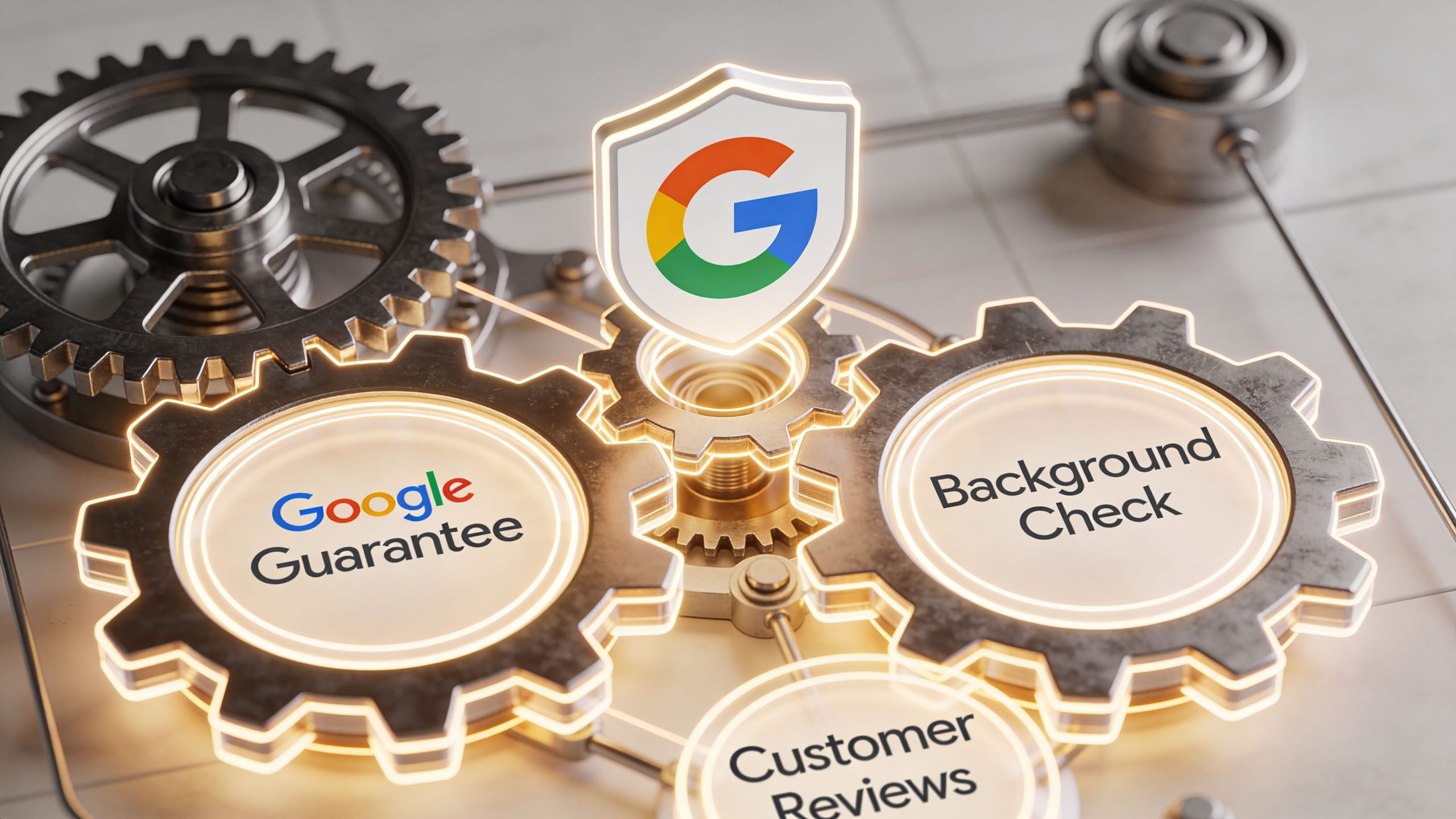
By 2026 updates, LSAs were projected to capture over 50% of total leads for eligible service industries like home services, legal, and healthcare, even when businesses ranked highly in the local pack, largely because of their top-of-page placement and trust badges tied to background checks and license verification, according to this analysis of Google Local Service Ads growth.
Why the badge changes buyer behavior
Google's badge system is the first thing most business owners notice, and it should be. It's the visual shortcut that tells a customer your business passed screening steps that many competitors either haven't completed or can't complete.
That badge isn't decorative. It's tied to verification.
For many categories, the process includes background checks, license validation, and insurance review where required. That means Google is trying to reduce buyer risk before the lead happens. In local service markets, that's powerful because trust is often the deciding factor between two similar businesses.
If you want a detailed breakdown of how that badge fits into local acquisition strategy, review this resource on the Google Guaranteed badge process.
The badge is doing the first part of the sales call before your team ever picks up the phone.
Why pay per lead feels different from pay per click
This is the mechanic most business owners care about. In PPC, you pay for the visit. In LSAs, you pay for the contact. That makes LSAs feel less like renting traffic and more like buying shots on goal.
Here’s the simple analogy. PPC is paying for foot traffic to walk past your storefront. LSA is paying when someone opens the door and asks for service.
That doesn't mean every lead is perfect. It means the pricing model is closer to how service businesses make money.
LSAs also sit above the normal search ad stack and organic results, which means they intercept demand at the highest-visibility point of the page. For urgent services, that position changes everything.
A quick walkthrough helps if you want to see the interface and flow in action.
For the right business, this is less of an ad platform and more of a trust-and-response machine. If your operation is disciplined, LSAs can become one of the cleanest lead channels in your mix.
Choosing Your Weapon for Local Search Dominance
Not every local visibility tool does the same job. That's where a lot of businesses get confused.
LSAs, Google Ads, and organic local SEO can all drive leads. But they do it with different economics, different speed, and different levels of control. If you treat them like interchangeable channels, you'll misallocate budget.
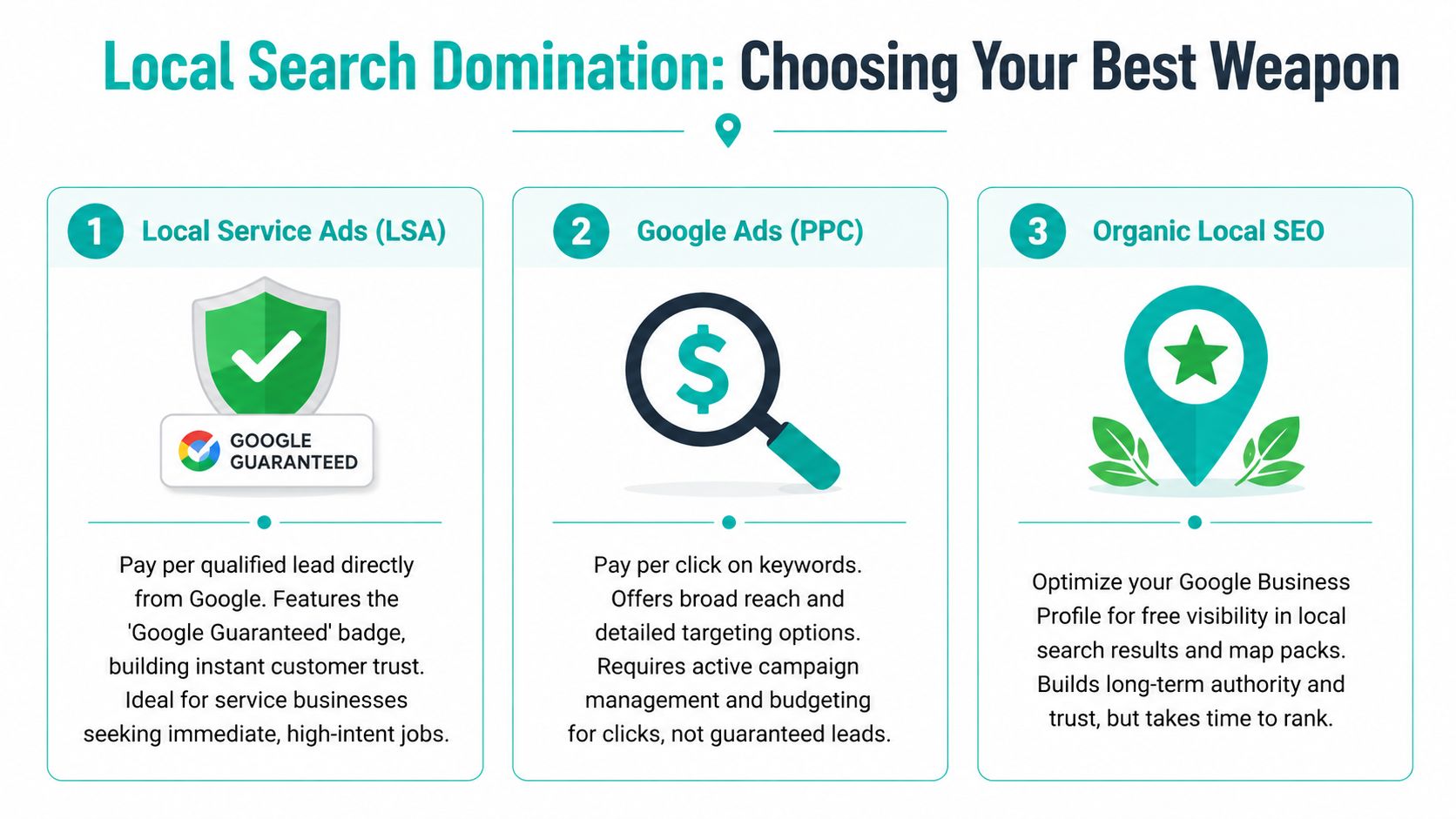
A straight comparison that business owners can actually use
| Channel | Best use | Payment model | Main strength | Main limitation |
|---|---|---|---|---|
| Local Service Ads | Immediate local lead capture | Pay per lead | Trust badge and top placement | Less creative control |
| Google Ads PPC | Keyword targeting and broader campaign control | Pay per click | Flexibility and scale | You pay before a contact happens |
| Organic Local SEO | Long-term visibility and map authority | Indirect investment | Durable presence and trust | Takes time |
If your primary need is direct local inquiries, LSAs usually deserve first priority in eligible categories. According to WordStream's writeup on Google Local Services Ads, LSAs generate 3-5x higher CTR, with 15-25% vs. 2-5% for standard ads, and outperform PPC by 40% in lead cost efficiency for service firms.
That's not subtle. It means the format is structurally stronger when the goal is high-intent local lead generation.
When LSAs win and when PPC or SEO still matter
LSAs win when the buyer wants a provider now. Emergency plumbing, legal help, HVAC repair, urgent dental searches, and similar categories fit that pattern well. The user wants a trusted local option, not an extended research journey.
PPC still matters when you need tighter message control, broader keyword coverage, or support for services that don't fit the LSA setup cleanly. SEO still matters because authority compounds. Your Google Business Profile, reviews, and website all strengthen your overall local position.
A smart local acquisition strategy doesn't force one channel to do every job. It gives each channel a role.
A practical way to understand this:
- Use LSAs for demand that's already hot.
- Use PPC for service expansion, branded protection, and controlled messaging.
- Use SEO to build long-term visibility that lowers dependence on paid media.
If you're in a niche like cleaning services and want a practical PPC reference point, Mastering Google Ads for your cleaning business is a useful outside read because it shows how keyword-driven campaigns differ from lead-first LSA setups.
For businesses that need both channels working together, professional Google Ads and PPC management becomes less about launching ads and more about assigning the right job to the right platform.
Are You Eligible and How to Get Google Guaranteed
LSAs aren't open to everyone. That's good news if you're eligible and bad news if you're unprepared.
Google uses eligibility and screening as a gate. That's why the format carries more trust than standard ads. It also means some businesses get stalled before launch because they assume setup is quick and informal. It isn't.
Who should seriously consider LSAs
LSAs are designed for service businesses with local intent and direct customer contact. Home services are the obvious fit, but legal, healthcare, and other professional categories can also qualify depending on market and category rules.
Central Florida businesses often have a strong opportunity here because local search demand is active and service competition is intense. Charlotte is promising too, but newer entrants can hit more friction. Approval hurdles such as mandatory background checks, license verification, and geographic eligibility often block new entrants in secondary markets like Charlotte, and non-home-service categories can face stricter verification, as explained in this overview of Google Local Services Ads eligibility and setup.
Your approval checklist
Before you apply, get your house in order.
- Business details must match. Your legal business information, service area, and public profile need to line up cleanly.
- Licenses need to be current. If your category requires licensing, expired or mismatched records can slow approval.
- Insurance documents should be ready. Some categories require proof before your ad can run.
- Owners and staff may need screening. Don't treat background checks like a minor formality.
- Your Google Business Profile should be complete. Missing categories, weak descriptions, or inconsistent business info can create friction.
Approval isn't paperwork for paperwork's sake. It's part of the product. Google is selling trust before you're allowed to sell the service.
A lot of businesses make the same mistake. They wait until they're in the application flow to gather documents. That's backwards. Prepare first, then apply.
What to expect during setup
The verification process can feel tedious, especially if you operate in a regulated category or a newer market. That's normal. Google wants evidence that the business is legitimate, active, and properly documented.
Once approved, your LSA profile should reflect the services you want to offer. Be specific. Broad, sloppy profiles tend to attract weak-fit inquiries. Tight service definitions and accurate service areas usually create better lead quality.
This is also where many operators realize they need operational discipline, not just ad access. If your records are messy or your profile is incomplete, LSAs won't fix that. They'll expose it.
How LSA Pricing and Lead Management Works
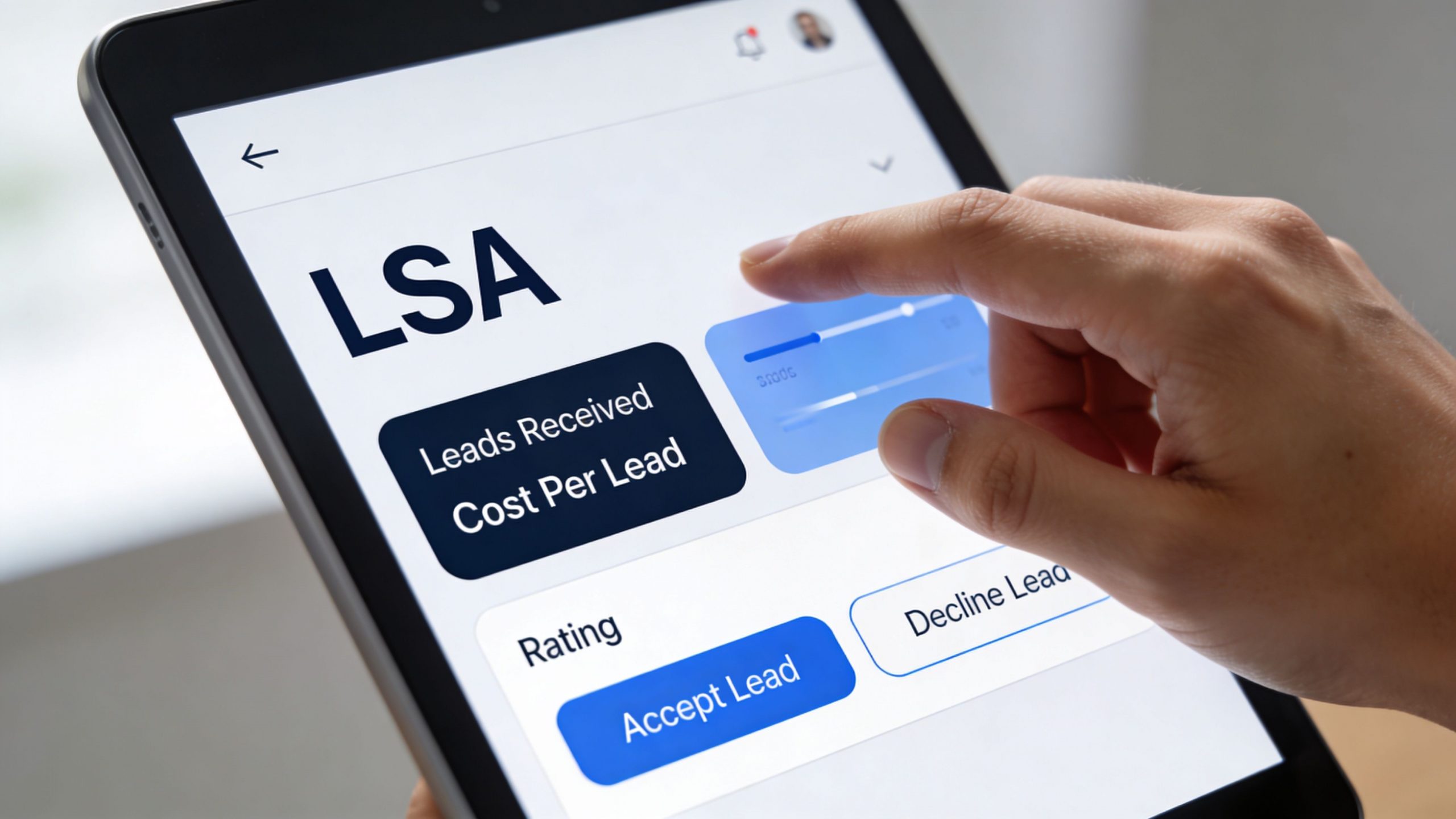
LSA pricing solves one of the biggest frustrations in local advertising. You are not paying for random clicks from people who were never going to call. You are paying for leads tied to a real service inquiry. For plumbers in Orlando, HVAC companies in Charlotte, and other local service businesses, that changes the math fast.
Google lets you set a weekly budget, then uses that target to pace lead delivery over the month. The right budget is the one your team can answer, book, and service well. If your office misses calls at 2 p.m. or lets weekend voicemails sit until Monday, raising the budget just buys more waste.
How budgeting and bidding work
Start with capacity, not ambition.
If your team can reliably handle 15 solid inquiries a week, budget for that level first. Then increase spend only after your response process is tight. LSAs are less like buying billboard space and more like buying appointments. If the front desk drops the ball, the ad account cannot save you.
Google also gives you bidding controls such as Maximize Leads and options that aim for tighter cost efficiency, but bid strategy is only part of the equation. Your visibility depends on trust and performance signals too. A business with strong reviews, fast response times, accurate service settings, and consistent lead handling will usually beat a sloppy competitor with a bigger wallet.
That is the part many owners miss. LSAs reward operators, not just advertisers.
How to handle leads without burning money
Lead management decides whether LSAs become a profit channel or another line item you resent.
Use a simple standard:
- Respond fast. Speed affects both close rate and future visibility.
- Screen every lead. Wrong job type, wrong area, spam, and duplicate inquiries should not sit in the same bucket as qualified calls.
- Log outcomes. Booked, quoted, lost, unqualified. Track it all.
- Dispute bad leads on schedule. Google does not refund ignored mistakes.
If you want a useful primer on the broader economics behind pay-per-lead models, that resource helps explain why LSAs feel so different from click-based campaigns.
A bad lead is not just an annoyance. It distorts your numbers, hides real cost per booked job, and can trick you into cutting a channel that is working better than you think. That is why disciplined teams review lead quality every week and submit disputes consistently. If you need a tighter process, LSA dispute management for bad leads and refunds lays out how to document and recover value from unqualified contacts.
Treat LSAs like a revenue system. Google delivers a trust-based lead source with more cost control than traditional search ads. Your job is to answer fast, qualify hard, and protect budget from junk. That is how service businesses turn LSAs from a nice idea into booked jobs.
Winning with LSAs The Emulous Media Playbook
LSAs reward disciplined operations. That is the part many owners miss.
A plumber in Orlando or an HVAC company in Charlotte can have the same budget, the same service category, and the same city coverage as a competitor, yet get worse results because the business treats LSAs like a listing instead of a lead system. Google is not grading your brand story. It is grading whether your business looks ready to answer, qualify, and book real local jobs.
As noted in Near Media's discussion of LSA ranking signals, responsiveness, review activity, and lead handling play a major role in how these ads perform. That matches what service businesses see in practice. The operators who win tend to run tighter intake, tighter service definitions, and tighter follow-up.
What strong operators do differently
The best LSA accounts are usually built around a simple idea. Make it easy for Google to trust you, and easy for prospects to reach you.
That shows up in a few consistent habits:
- They keep reviews coming in steadily. A healthy review flow signals that the business is active and still delivering good service.
- They treat the phone like the front desk for revenue. If calls go unanswered, booked jobs drop and account performance usually follows.
- They define services with precision. Narrow targeting often produces better leads than trying to show for everything.
- They set business hours accurately. If you cannot serve certain time blocks well, stop advertising as if you can.
For companies that miss calls after hours or need better filtering before a rep steps in, automated lead qualification for service businesses can clean up routing and help protect lead quality.
Mistakes that kill LSA performance
Poor LSA results rarely come from one dramatic failure. They usually come from a pile of small operational mistakes.
A sloppy intake process eventually turns into weaker visibility, weaker lead quality, and higher cost per booked job.
Watch for the common offenders:
- Set-and-forget management. Service categories, hours, and coverage areas change, but the profile never gets updated.
- Mismatched business details. Inconsistent information creates friction for Google and doubt for prospects.
- Loose service targeting. Broad settings often bring in more calls you do not want.
- Slow call handling. In LSAs, delay is expensive.
- Review stagnation. A profile that looks inactive loses ground to sharper competitors.
At that stage, many operators realize LSAs are not a magic switch. They are a trust-and-intake machine. Run that machine well and you get better leads, more control over spend, and a stronger position in local search than traditional click-based campaigns usually deliver.
Emulous Media Inc is one option for businesses that want help managing that system. The company handles LSA setup, verification support, campaign management, website design, media production, and AI automation so marketing and lead operations work as one program instead of separate parts.
Your Next Step to Dominate Local Search
Google Local Service Ads are not just another ad unit. For eligible service businesses, they're one of the clearest paths to trusted local leads because they combine top-page placement, built-in verification, and pay-per-lead economics.
If you're still asking what are google local service ads, the practical answer is simple. They're a tool built for businesses that need more calls, better lead quality, and tighter cost control than traditional click-based advertising often provides.
You can set up the basics yourself. Plenty of owners do. But the businesses that usually get the most from LSAs treat them like a managed revenue channel. They tighten verification, sharpen service definitions, improve response workflows, monitor disputes, and connect the whole system to strong websites, CRM follow-up, and automation.
That’s the strategic decision in front of you. DIY is possible. Professional execution is faster.
If you want help building a smarter local lead engine, talk with Emulous Media Inc. We help Central Florida and Charlotte-area businesses turn LSAs, PPC, web design, media production, and AI automation into one coordinated growth system. Book a free consultation, call 689-255-6327, or visit the contact page to discuss your goals.