Your crews can install great systems and still have a weak pipeline. That’s the trap a lot of solar companies are in right now. One month the phone rings nonstop. The next month your sales team is chasing cold leads, price shoppers, and old inquiries that should’ve been followed up better the first time.
That feast-or-famine cycle usually isn’t a sales problem. It’s a system problem. Most solar businesses don’t need more random marketing activity. They need solar power marketing built like an engine, where audience, message, channel, website, and follow-up all work together.
If you’re a business owner in Central Florida, or anywhere in a competitive U.S. market, this matters more than ever. Solar demand is real. So is the noise. The companies that win aren’t always the cheapest or the oldest. They’re the ones that make it easy for the right buyer to trust them, contact them, and keep moving forward.
Table of Contents
- The Solar Boom Is Here But Are You Ready
- Define Your Battlefield and Ideal Customer
- Crafting a Message That Sells More Than Panels
- The Solar Marketing Channels That Drive Growth
- Your Website A 24/7 Solar Sales Consultant
- Unlocking Growth Through Referrals and Partnerships
- Automating Your Follow-Up with Lead Nurturing and AI
- The Simple KPIs That Measure Marketing Success
- From Plan to Profit Your Path Forward
The Solar Boom Is Here But Are You Ready
The market has already made its decision about solar. Buyers want it. Investors back it. Utilities have to respond to it. The question isn’t whether demand exists. The question is whether your company is built to capture it consistently.
The proof is hard to ignore. The U.S. passed 1 million solar installations in 2016 after 40 years, then added the next million in just three years. By 2023, solar accounted for over 50% of all new U.S. grid capacity additions, according to this solar industry timeline. That kind of growth creates opportunity, but it also attracts more competitors, more ad spend, and more sameness.
A lot of owners still market like it’s 2014. They buy leads, boost a few Facebook posts, ask for referrals when they remember, and hope branded trucks do the rest. That approach doesn’t hold up when buyers compare five installers before lunch.
Practical rule: If your lead flow depends on luck, seasonality, or one salesperson’s personal network, you do not have a marketing system.
Serious solar power marketing does three things at once. It finds the right audience, gives them a reason to believe you, and moves them through a process that feels clear and low-friction. Miss one of those and the whole machine gets expensive.
That’s why siloed advice doesn’t help much. SEO alone won’t save weak messaging. PPC won’t rescue a slow website. A beautiful website won’t fix sloppy follow-up. The businesses that grow predictably connect the dots.
Define Your Battlefield and Ideal Customer
Most solar companies say they target homeowners. That’s not a strategy. That’s a category.
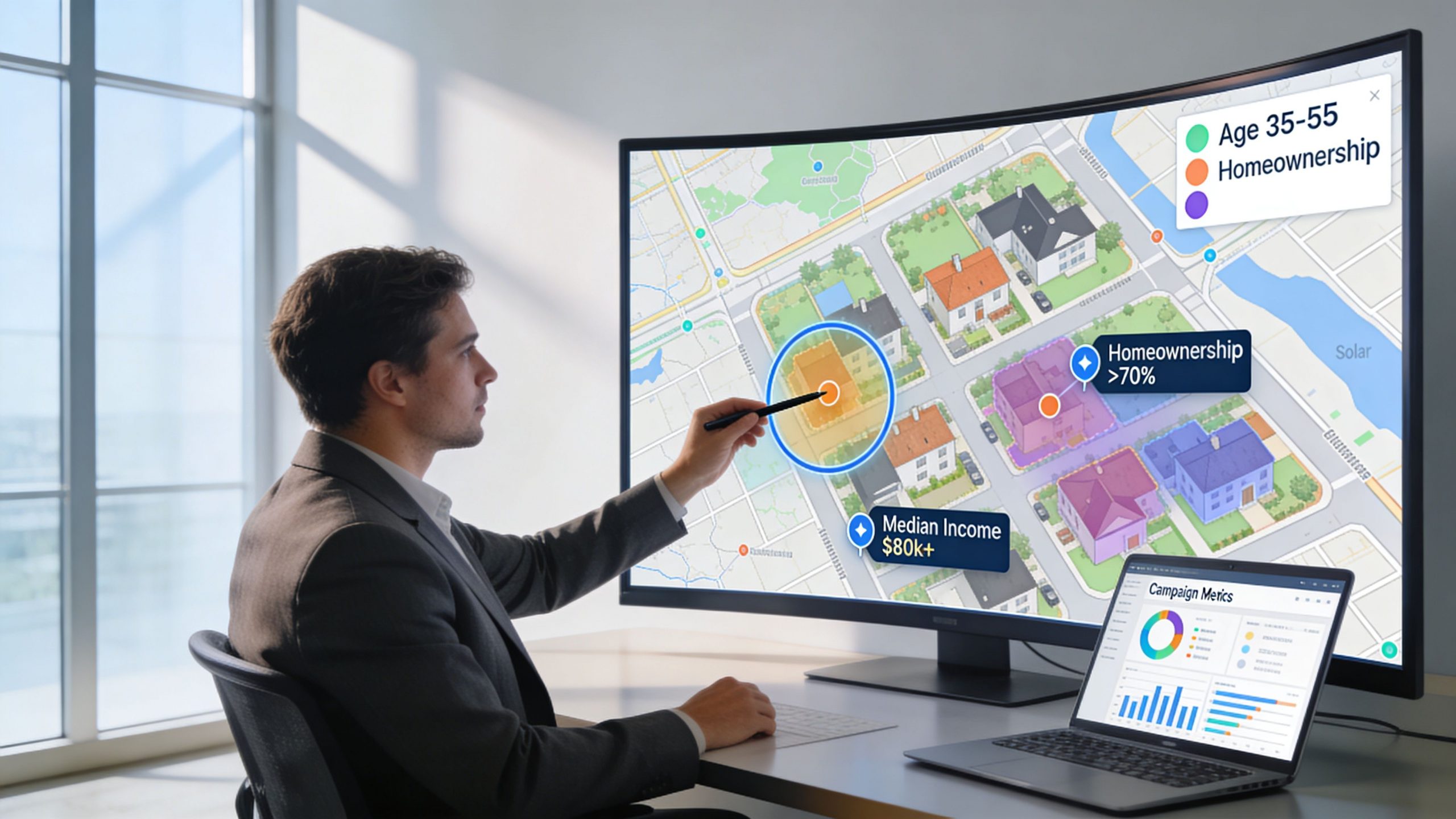
If you try to market to everyone with a roof, your ads get vague, your website gets generic, and your sales team wastes time talking to people who were never a fit. Precision lowers waste. It also makes your brand sound smarter.
Stop marketing to a generic homeowner
The biggest mistake in solar power marketing is using one message for every prospect. A retiree in Seminole County, a warehouse owner in Orlando, and a church board in the Charlotte area do not buy for the same reasons.
One of the clearest blind spots is small commercial solar in the 50-600 kW range. Industry analysis points out that this “overlooked middle” gets hit with residential-style messaging even though those buyers care about ROI calculators, operational stability, and rate-hedge benefits, not sustainability slogans. You can see that argument in this small commercial solar analysis.
That should change how you segment fast.
- Residential premium buyers: They often respond to trust, install quality, warranty confidence, and a smooth buying experience.
- Cash-flow focused households: They want predictability and plain-English financial impact, not a lecture on energy policy.
- Small commercial operators: They need operating-budget clarity, service expectations, and a business case.
- Community and underserved segments: They require trust-first outreach and often need local context before they’ll engage.
For local operators, this gets even sharper when you combine geography with behavior. A company serving Lake Mary, Orlando, Winter Park, Sanford, and nearby areas shouldn’t treat all neighborhoods the same. The same goes for firms expanding toward Charlotte. Service area intelligence matters, which is why tools and methods such as predictive audience modeling are valuable. They help you focus budget where buyer intent and fit are strongest.
Build segments based on buying logic
A useful buyer profile isn’t “male, homeowner, age 45-64.” That’s lazy. Build around decisions.
Ask better questions:
What triggers the conversation
Rising utility bills, roof replacement timing, new construction, business overhead pressure, or long-term ownership plans.What stops the sale
Financing confusion, trust issues, uncertainty about maintenance, spouse or partner hesitation, HOA concerns, or fear of choosing the wrong installer.What proof moves them
Warranty details, local project examples, side-by-side cost comparisons, production transparency, or service responsiveness.
The best target audience is not the largest group. It’s the group you can persuade most efficiently.
When you define your battlefield this way, your campaigns become easier to build. Your sales calls get shorter. Your close rates improve because the prospect feels understood before your rep ever picks up the phone.
Crafting a Message That Sells More Than Panels
A homeowner lands on your site after opening another painful utility bill. A facility manager clicks your ad because operating costs keep climbing. Neither one cares about module specs in the first five seconds. They care about whether you can solve an expensive problem without creating a new one.
That is where solar messaging usually breaks down. Installers jump to equipment, financing menus, and technical features before they earn trust. Prospects are still asking a simpler question. "Why should I believe your company is the right choice for a decision this expensive?"
Start with the outcome. Then support it with proof.
People buy solar for control, predictability, property value, resilience, and lower long-term energy costs. Panels are the delivery mechanism. They are not the message. If your copy leads with hardware, you sound like every other installer quoting the same commodity.
Your message needs to answer four questions fast:
- Why act now: What cost, risk, or missed savings grows if they wait.
- Why your company: What makes your process, service, or expertise different in a crowded local market.
- Why believe you: What proof reduces skepticism, such as warranties, project examples, reviews, or production transparency.
- Why take the next step: Why a consultation feels useful and low pressure instead of a trap.
This is not just copywriting. It is positioning. And positioning has to carry through your website, ads, sales conversations, estimate emails, and follow-up sequences. If those pieces say different things, your marketing leaks trust at every handoff.
Weak solar messaging sounds familiar. "Affordable solar solutions for your home." "Quality panels at competitive prices." That copy is wallpaper. Any installer can claim it, so it does nothing to separate you.
A stronger value proposition makes a clear promise and gives the buyer a reason to believe it. Say what improves, for whom, and why your company can deliver it.
Build one message architecture and use it everywhere
Serious growth comes from connection, not isolated tactics. Your audience definition should shape your promise. Your promise should shape your landing pages. Your landing pages should match your ad language and your sales pitch. That is how you build a lead-generation system instead of a pile of disconnected campaigns.
A practical messaging guide should define:
| Messaging element | What to clarify |
|---|---|
| Core promise | The main result buyers want from choosing you |
| Proof points | Warranty terms, install quality, local experience, service process |
| Objection handling | Price, financing confusion, timeline, maintenance, trust |
| Voice | Direct, professional, plain-English, confident |
A real brand strategy and identity process helps you set this up correctly. Your brand is not a logo file and a color palette. It is the set of promises, proof, and language your team repeats so consistently that prospects remember you for something specific.
That consistency matters. It shortens sales conversations, improves conversion rates, and keeps your marketing from sounding improvised. If you want predictable lead flow, stop treating messaging as decoration. Treat it like system design.
The Solar Marketing Channels That Drive Growth
A homeowner searches “solar installer near me” on Tuesday, clicks an ad, skims your site, leaves, sees one of your completed projects on Facebook that night, reads your Google reviews on Wednesday, then fills out a form on Thursday. That is how real buying decisions happen. Serious solar marketing connects those touchpoints on purpose. If your channels operate in isolation, your pipeline becomes inconsistent and expensive.
Treat channel strategy like route planning. SEO captures demand that already exists. PPC buys speed and testing power. Social builds familiarity and keeps you in front of people who are not ready on day one. Content supports all three by answering the questions that stall deals. Used together, these channels create a lead system you can measure and improve.
Local SEO for buyers already in the market
Local SEO goes after the people closest to action. They are searching for installers, comparing service areas, checking reviews, and looking for proof that you work in their city. If your company does not appear there, a competitor gets the call.
Focus your effort on a few assets that move rankings and leads:
- Service-area pages: Build pages for real cities and towns you actively serve. Each page should reflect local conditions, local proof, and a clear next step.
- Google Business Profile management: Keep categories, services, photos, Q&A, and reviews current. An outdated profile signals an inattentive business.
- Location-specific content: Publish pages that answer local questions about permits, utility rules, roof types, financing, and installation timelines.
- Clear conversion paths: Every local page should point to one action, book a consultation, request a quote, or use a calculator.
SEO takes time. It also keeps paying after the click. That makes it one of the best channels for lowering dependence on paid leads over time.
PPC for immediate demand and faster learning
Paid search gives you speed. It also punishes lazy campaign structure.
According to this solar marketing benchmark article, customer acquisition costs in solar can reach $10,000, while data-driven marketing can reduce CAC by 70%. Analysts in the same article report $5-15 CPCs for solar keywords, more than 2% click-through rate on optimized campaigns, 3-5% landing page conversion rates, and stronger lead volume when CRM data is connected to campaign optimization.
The lesson is simple. PPC works when you control the match between keyword, ad, page, and follow-up. It fails when every click lands on the same generic page.
Build campaigns around intent and audience. A homeowner searching for savings should see a different ad and landing page than a commercial property manager evaluating system size, incentives, and payback period. That structure improves conversion rates and gives you cleaner data about which offers sell.
Social media and content for trust, retargeting, and sales support
Social media does not need to close the deal by itself. Its job is to keep your company visible, credible, and familiar while prospects compare options.
Use social content to prove you are real and competent:
- Completed installations: Show actual homes and buildings in your market
- Process education: Explain what happens before, during, and after install
- Team visibility: Put real people in front of the camera, not just branded graphics
- Objection handling: Answer questions about cost, financing, timelines, warranties, and maintenance
Paid social is especially useful for retargeting site visitors and warming up cold audiences before they ever search your brand name. A specialist in social media advertising for lead generation can tighten audience targeting, creative testing, and attribution so your campaigns support revenue instead of producing vanity metrics.
Here’s the practical channel mix:
| Channel | Primary Goal | Average Cost | Time to Results |
|---|---|---|---|
| Local SEO | Capture high-intent organic searches | Variable | Slower |
| PPC | Generate immediate demand and test offers | As noted earlier, solar keyword costs are often high | Faster |
| Social Media | Build trust, awareness, and retarget interest | Variable | Moderate |
| Content Marketing | Educate prospects and support SEO and sales | Variable | Slower but compounding |
Stop asking which channel is best. Build a system where each channel does a specific job, shares data with the others, and moves prospects one step closer to a sales conversation.
Your Website A 24/7 Solar Sales Consultant
A homeowner clicks your ad while standing in the driveway, phone in hand, comparing you to two other installers. If your site is slow, confusing, or vague, you do not get a second chance. The prospect leaves, fills out someone else’s form, and your ad budget just paid for a competitor’s lead.
Your website has one job. Turn interest into action.
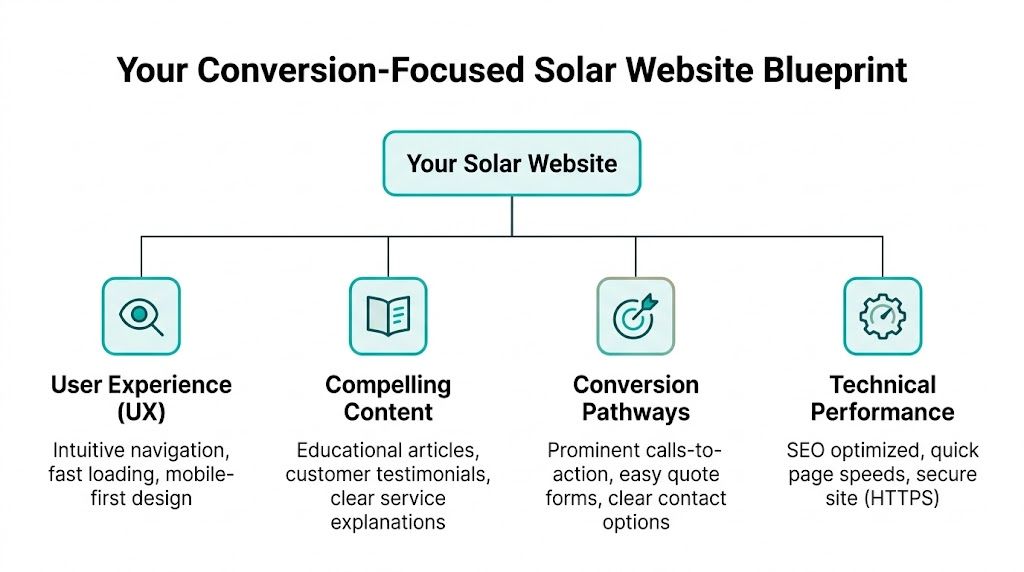
Too many solar companies treat their site like a digital brochure. Pretty photos, generic claims, buried forms, and no clear path forward. A serious growth system needs more than that. Your website should connect your message, proof, audience segments, and follow-up path so every click has somewhere useful to go.
A solar website should guide the sale
People researching solar want fast answers. They are checking savings potential, financing options, installer credibility, service area, and what happens next. A good site handles that buying behavior in the right order. It clarifies the offer, proves you are credible, and asks for the next step before attention fades.
Speed and mobile usability matter because that is how prospects shop. If the page stalls, buttons are hard to tap, or the form feels like paperwork, lead volume drops and lead quality usually gets worse too. You do not need more traffic if your site leaks intent.
A strong site makes three things obvious within seconds:
- What you offer
- Why your company is trustworthy
- What the visitor should do next
A slow website works like a rep who shows up late to the appointment. The prospect does not wait around.
The page elements that improve lead quality
Start above the fold. The first screen should tell a homeowner or business buyer exactly who you help, what outcome you deliver, and how to take the next step. Skip the cinematic fluff unless it supports a clear offer.
Use this checklist on your homepage and key service pages:
Clear headline
Lead with the result. Lower bills, backup power, predictable energy costs, or a guided solar installation process in a specific market.Strong primary CTA
Put one main action near the top of the page. Quote request, consultation, or savings assessment. Do not make visitors hunt for it.Proof close to the CTA
Reviews, local project photos, financing options, warranty details, certifications, and utility-specific experience should sit near the action point, not buried halfway down the page.Short forms
Ask for the information your sales team needs to qualify and follow up. Nothing more.Separate paths by audience
Homeowners and commercial buyers have different questions, timelines, and economics. Build pages that reflect that reality.
Campaign traffic needs the same discipline. If you send paid clicks to a generic page, you force visitors to sort through irrelevant information and guess what to do next. Dedicated high-converting landing pages work better because they match the ad, the audience, and the offer in one straight line.
The best solar websites do not try to impress. They reduce doubt, answer buying questions, and make the next step easy. That is what a real sales consultant does, and your site should do it all day, every day.
Unlocking Growth Through Referrals and Partnerships
A homeowner sees your ad and gets curious. A friend says, “They did ours. Smooth process.” That second interaction usually matters more.
Solar is a trust-heavy purchase. Buyers worry about the installer, the process, the warranty, and whether anyone will pick up the phone later. Referrals work because they borrow trust that’s already been earned.

Referrals work because trust transfers
Most companies say they rely on referrals. Very few run a referral system.
The simple version works best:
- Ask at the right time: Right after installation satisfaction is highest, and again after the customer sees the system in action.
- Make the ask specific: Don’t say “send us referrals.” Ask if they know a neighbor, family member, or local business owner who’s been asking questions about solar.
- Remove friction: Give them a short text template, email intro, or referral form.
- Close the loop: Thank them quickly and keep them informed.
A referral program should feel organized, not awkward. If your team only remembers to ask when they’re desperate for leads, it won’t scale.
Partnerships open doors ads can’t
The strongest local partnerships are with businesses that already speak to your future buyers. Roofers, electricians, general contractors, real estate agents, mortgage professionals, and even community organizations can all become lead sources when the relationship is structured well.
This matters even more for underserved segments. Research highlighted in Aurora Solar’s discussion of low-to-moderate-income outreach shows that LMI households often respond better to community-based marketing, including local newsletters, town leaders, and nonprofit partnerships, than to digital-only campaigns.
That insight changes the playbook. In those markets, community trust beats ad targeting.
A short educational video can support those local relationships well when it’s used as a follow-up tool, not a replacement for real outreach.
For Central Florida companies, that can mean showing up at local events, partnering with municipal or nonprofit initiatives, and building referral lanes through people the audience already trusts. That’s harder work than buying clicks. It’s also harder for competitors to copy.
Automating Your Follow-Up with Lead Nurturing and AI
Most leads aren’t bad. They’re early.
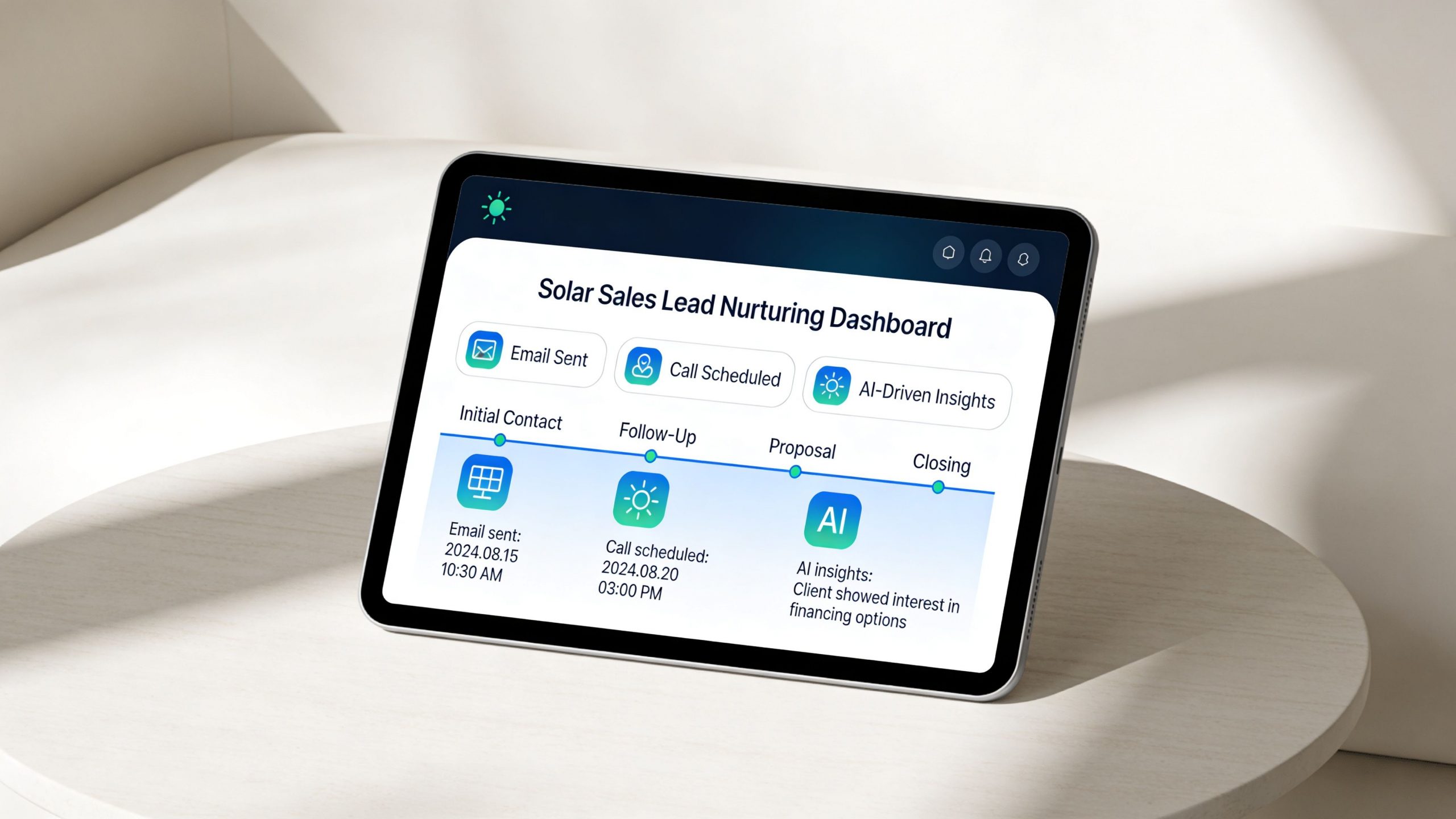
A prospect downloads a guide, requests a quote, or clicks an ad because they’re interested. That doesn’t mean they’re ready to buy today. Solar has questions attached to it. Cost, timing, roof fit, financing, warranties, maintenance, family input. If your follow-up only consists of one call and two emails, you’re letting warm interest cool off.
Most leads need education before they need a quote
Lead nurturing is just structured follow-up. It should answer questions in the order buyers naturally ask them.
A practical sequence might include:
- Immediate response: Confirm the inquiry and set expectations.
- Early education: Send plain-English content that explains process, timelines, and common concerns.
- Proof layer: Share project examples, testimonials, and warranty confidence.
- Decision support: Offer a consultation, site review, or next-step checklist.
The point is simple. Don’t force every lead straight into a close. Help them move.
If you want a useful outside primer on the workflow side, this guide to marketing automation for small business gives a solid overview of how automated sequences reduce manual follow-up gaps.
AI should sort and prioritize not replace people
A lot of business owners hear “AI” and think chatbot gimmicks. That’s the wrong frame. In solar marketing, AI is most useful when it helps your team decide who needs attention first and what message fits best.
Use it for:
- Lead scoring: Identify who is actively engaging versus casually browsing.
- Segmentation: Separate residential from commercial, hot leads from research-stage leads, and short-cycle buyers from long-cycle ones.
- Personalized follow-up: Trigger different emails or texts based on actions taken.
- Sales efficiency: Push the best leads to reps first.
A process such as automated lead qualification becomes powerful. It helps you stop treating every form fill the same. That matters because your sales team’s time is expensive. The rep who spends an hour chasing weak inquiries isn’t spending that hour closing a qualified opportunity.
Automation should handle repetition. Your team should handle trust, nuance, and closing.
The right setup makes your business feel responsive without becoming robotic. Prospects get timely answers. Your staff gets cleaner priorities. Revenue becomes less dependent on memory and manual effort.
The Simple KPIs That Measure Marketing Success
A lot of owners look at dashboards full of impressions, clicks, and traffic graphs and still can’t answer one question. Is this marketing making money?
You don’t need more metrics. You need the right ones.
Track the numbers that affect decisions
Start with the small set that changes action:
Customer Acquisition Cost
What you spend to win one new customer. If this drifts up, you need to inspect audience quality, conversion rates, and close rates.Cost Per Lead
Useful, but only when paired with lead quality. Cheap junk leads are still expensive.Lead-to-sale conversion rate
This tells you whether the issue is lead generation, website conversion, or sales execution.Return on Marketing Investment
The clearest executive view. If a channel costs money but doesn’t produce profitable customers, sentiment doesn’t matter. Cut it or fix it.
For owners who want a practical framework beyond vanity metrics, this article on how to measure advertising effectiveness is worth reviewing because it pushes the conversation toward outcomes instead of surface-level platform stats.
Build a dashboard a business owner can actually use
You don’t need a complicated BI stack to run smarter marketing. A clean spreadsheet or CRM dashboard is enough if your inputs are disciplined.
Keep the dashboard readable with these fields:
| KPI | Why it matters |
|---|---|
| Leads by channel | Shows where opportunity is entering the pipeline |
| Qualified leads by channel | Filters out channels that generate noise |
| Appointments set | Reveals follow-up effectiveness |
| Sales closed | Connects marketing to revenue |
| CAC and ROMI | Tells you whether growth is efficient |
Review it on a fixed cadence. Don’t wait until a slow month to care. The purpose of KPIs is early correction.
If paid search is generating leads but not appointments, your landing page or lead quality may be off. If SEO traffic is growing but consultations aren’t, your content may attract researchers rather than buyers. Good measurement turns guesswork into diagnosis.
From Plan to Profit Your Path Forward
The companies that win with solar power marketing don’t rely on isolated tactics. They build a connected system. They know exactly who they want, what those buyers care about, where to reach them, how to convert them, and how to follow up without gaps.
That’s the playbook. Define the right segments. Speak to the primary buying motive. Use channels for the jobs they’re best at. Build a website that sells. Turn referrals into a process. Automate follow-up so opportunities don’t go cold. Measure the few KPIs that matter.
You can implement parts of this yourself. A lot of owners do. But execution is where most pipelines break down. Strategy without implementation is just a notebook full of good intentions.
If you want a predictable lead-generation engine instead of another cycle of random tactics, get expert help and build it right the first time.
If you're ready to turn your website, ads, content, and automation into one coordinated growth system, talk with Emulous Media Inc. Book a free consultation, visit the contact page, or call 689-255-6327 to map out a smarter solar marketing strategy for Central Florida, Charlotte, or your broader service area.