Your sales team still gets leads from trade shows, referrals, and the occasional distributor introduction. But the pattern has changed. Fewer prospects arrive ready to talk, more of them disappear for months, and the buyers who do reach out often know your product line almost as well as your reps do.
That’s the reality of manufacturer inbound marketing today. Engineers compare specs before they ever fill out a form. Procurement teams build vendor shortlists independently. Plant leaders look for proof that a solution will work inside their actual operating environment, not just in a polished brochure. If your marketing still depends on booth traffic, generic line cards, and a website that functions like a digital catalog, you’re making the sales process harder than it needs to be.
A strong inbound system changes that. It helps the right buyers find you earlier, gives each stakeholder the information they need, and creates a trackable path from first visit to serious opportunity. For manufacturers with long sales cycles and layered buying committees, that shift matters more than any single campaign.
Table of Contents
- The End of the Trade Show Era
- Map Your Buying Committee Not Just a Persona
- Build a Content Machine for Technical Experts
- Transform Your Website into a Lead Generation Engine
- Automate Trust Across a Long Sales Cycle
- Amplify Your Reach and Measure What Matters
- From Outbound Cost to Inbound Investment
The End of the Trade Show Era
A lot of manufacturers are still running a marketing model built for a different buying environment. The annual trade show gets the biggest budget line. Sales collateral gets refreshed. Someone buys a list. Then leadership wonders why pipeline quality feels inconsistent and why follow-up takes so much effort for so little movement.
Trade shows still have a place. So do distributor relationships and targeted outbound outreach. But they no longer carry the full load. Buyers now spend more time researching on their own, comparing suppliers privately, and narrowing options before anyone on your team gets a chance to present.
That’s why manufacturer inbound marketing has moved from “nice to have” to operational necessity. Inbound marketing tactics generate 54% more leads than outbound marketing approaches, while costing 62% less per lead, according to HubSpot data highlighted in 2025 analyses shared by Munro Agency’s inbound marketing statistics roundup.
What old-school marketing gets wrong
The problem isn’t just cost. It’s timing.
Traditional outbound methods often interrupt buyers before they’ve defined the problem internally. In manufacturing, that creates low-intent conversations and long stretches of silence. Inbound works differently. It lets buyers engage when they’re actively looking for answers, whether that’s a material comparison, a tolerance question, or a production capability check.
Practical rule: If a prospect can’t learn something useful from your website without talking to sales, your marketing is creating friction instead of demand.
A stronger approach looks more like an integrated system than a campaign:
- Search-driven discovery: Buyers find answers through technical pages, not just your homepage.
- Offer-specific conversion paths: A visitor reading about a machining capability should see a relevant next step, not a generic contact form.
- Lead routing and follow-up: Marketing has to connect with a real process, not dump names into a spreadsheet.
That’s why many manufacturers need purpose-built lead generation funnels for complex sales, not another batch of disconnected tactics.
What actually replaces the old model
The replacement for outdated outbound isn’t “post more on LinkedIn” or “write a few blogs.” It’s a digital system built around buyer intent. The companies winning with inbound are the ones answering real technical questions, capturing demand early, and giving sales context before the first call.
That’s the shift. Stop renting attention and start building assets that keep working after the event hall empties.
Map Your Buying Committee Not Just a Persona

Most buyer persona templates are too shallow for manufacturing. “Operations Manager, age 45 to 60, values efficiency” doesn’t help you write a better application page or build a stronger campaign. It doesn’t tell you what an engineer needs to validate. It doesn’t tell you what procurement will challenge. It doesn’t tell you why a plant leader stalls the deal late in the process.
That gap matters because up to 58% of the B2B customer journey in manufacturing is now completed without salesperson interaction, which makes early-stage content and digital positioning essential for anonymous researchers, as noted in Salesgenie’s inbound marketing statistics overview.
Why single personas fail in manufacturing
You’re rarely selling to one person. You’re selling into a group with different risks, different incentives, and different definitions of success.
An engineer may care about fit, tolerances, durability, and integration. Procurement may focus on vendor reliability, price structure, lead times, and total cost over time. Leadership may only get involved when risk, scale, or strategic value changes.
If you market to all of them the same way, the message gets watered down. The site sounds generic. The campaigns attract curiosity instead of intent. The sales team gets inquiries, but not enough context to move them efficiently.
The better model is simple. Stop asking, “Who is our buyer?” Start asking, “Who has to say yes, and what proof does each person require?”
A practical buying committee map
A useful buying committee map isn’t fancy. It’s a working document your marketing and sales teams can both use. Build it around these questions:
| Stakeholder | What they need | What usually slows them down |
|---|---|---|
| Engineer or technical evaluator | Specs, tolerances, compatibility, materials, performance detail | Missing technical depth |
| Procurement | Pricing structure, supply reliability, comparison points, risk reduction | Unclear commercial terms |
| Plant or operations leader | Implementation confidence, uptime impact, support clarity | Fear of disruption |
| Executive approver | Strategic fit, supplier trust, business case | Weak differentiation |
Then go one level deeper.
- Document search behavior: List the questions each stakeholder types into Google, asks distributors, or raises on calls.
- Capture objections from sales calls: Your reps already know where deals get stuck. Use that language.
- Map content by decision stage: Early-stage educational content should not sound like late-stage proposal copy.
- Segment audiences cleanly: Strong predictive audience modeling for industrial buyers helps separate general interest from genuine fit.
One of the fastest ways to improve manufacturer inbound marketing is to interview your own team. Ask sales what questions come up in first calls. Ask applications engineers where prospects misunderstand the product. Ask customer service what issues appear after the sale. Those answers usually reveal the actual content roadmap.
Build a Content Machine for Technical Experts
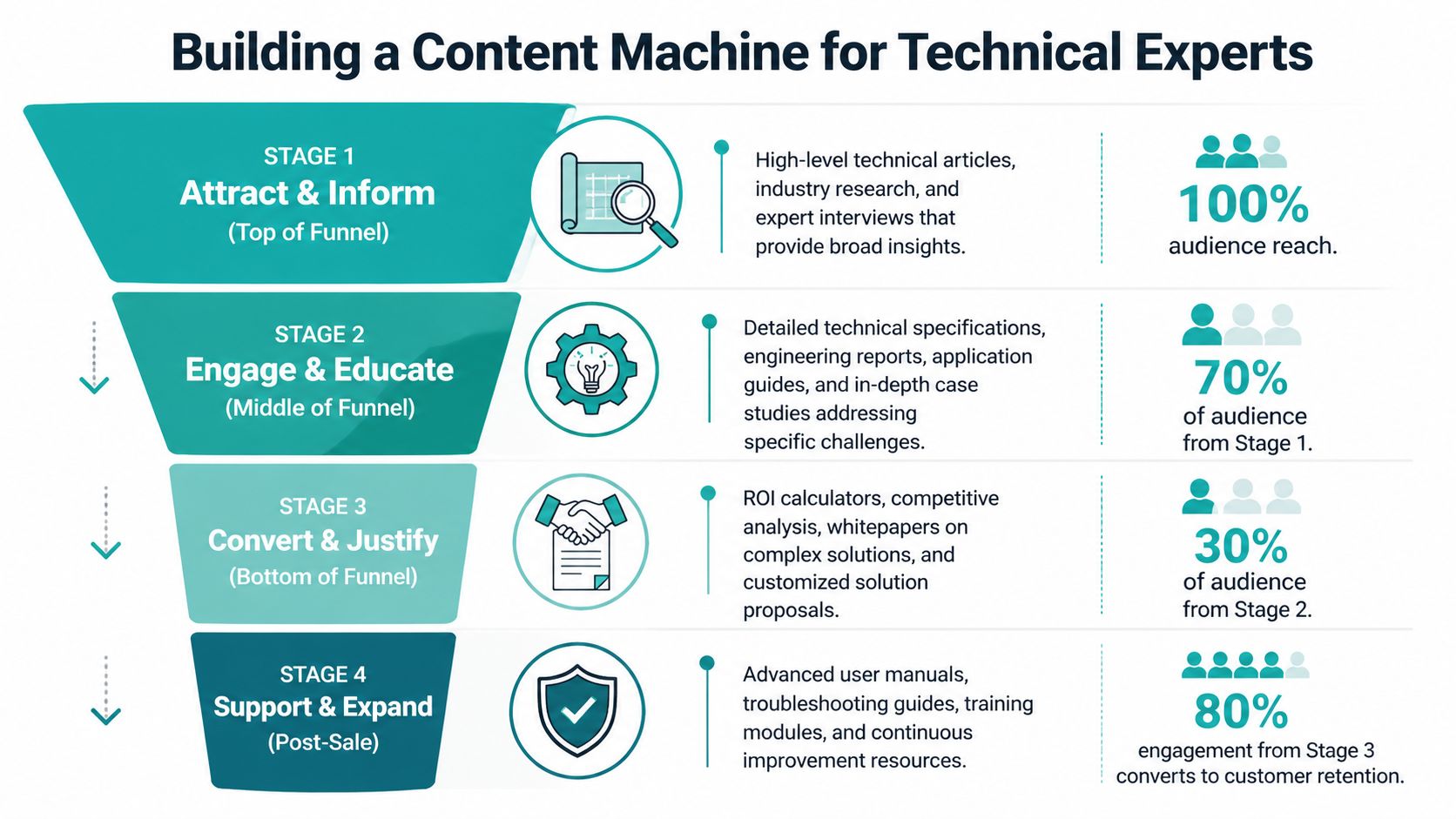
Generic content performs poorly in manufacturing because technical buyers can smell fluff immediately. They don’t need another article summarizing industry headlines. They need material that helps them evaluate a process, compare options, or reduce risk inside a real project.
That’s where content earns its keep. Content marketing costs 62% less than traditional marketing while generating 3x more leads, and is the preferred inbound tactic globally with over 20% adoption rate, according to MarketingLTB’s inbound marketing statistics. For manufacturers, that advantage only shows up when the content is useful enough to support a buying decision.
Start with the questions your engineers already answer
Most manufacturers already have the raw material for strong content. It’s trapped in inboxes, on sales calls, and inside the heads of engineers and product specialists.
Pull from questions like these:
- Application fit: Will this material hold up under heat, corrosion, vibration, or repeated washdown?
- Specification detail: What tolerances can you hold, and where do limitations begin?
- Process comparison: When should a buyer choose one method, substrate, or configuration over another?
- Implementation concerns: What changes on the line, in maintenance, or in integration?
Those questions can become practical assets instead of one-off answers.
Build assets that reduce sales friction
Not every piece of content needs to be a blog post. In fact, some of the highest-value manufacturing content barely looks like marketing.
Create assets such as:
- Application notes: Short documents that explain where a solution works best, where it doesn’t, and what variables matter.
- Material or product comparison guides: Useful for engineers and procurement teams trying to justify a choice internally.
- Technical white papers: Best for more complex buying decisions where deeper education matters.
- CAD files and drawings: Critical when buyers need to evaluate fit before they talk to sales.
- FAQ pages built from real objections: Strong for search and even better for reducing repetitive sales friction.
- Industry-specific case narratives: Not hype. Show the problem, the operating environment, and the decision criteria.
Field observation: The strongest manufacturing content usually starts life as internal documentation, not marketing brainstorming.
If your internal team struggles to produce consistently, this is where a structured editorial workflow matters. Manufacturers that want to scale B2B content output usually do better when they repurpose expert interviews, webinars, call transcripts, and technical Q&A instead of expecting subject matter experts to write polished drafts from scratch.
Turn expertise into an operating system
The mistake is treating content like a side project. It needs process.
A simple operating system looks like this:
- Choose one product line or market segment. Don’t start broad.
- Collect recurring sales and engineering questions.
- Group them by decision stage. Awareness, evaluation, justification, post-sale.
- Assign one content owner and one technical reviewer.
- Publish to a structured hub on your site.
- Connect every asset to a next step.
That final point matters. A technical guide should lead to something relevant, such as a drawing request, quote request, capability review, or consultation. A good content marketing strategy for lead generation doesn’t stop at publishing. It turns expertise into movement.
Manufacturer inbound marketing works best when content isn’t ornamental. It should shorten explanations, improve qualification, and help buyers defend the purchase internally.
Transform Your Website into a Lead Generation Engine
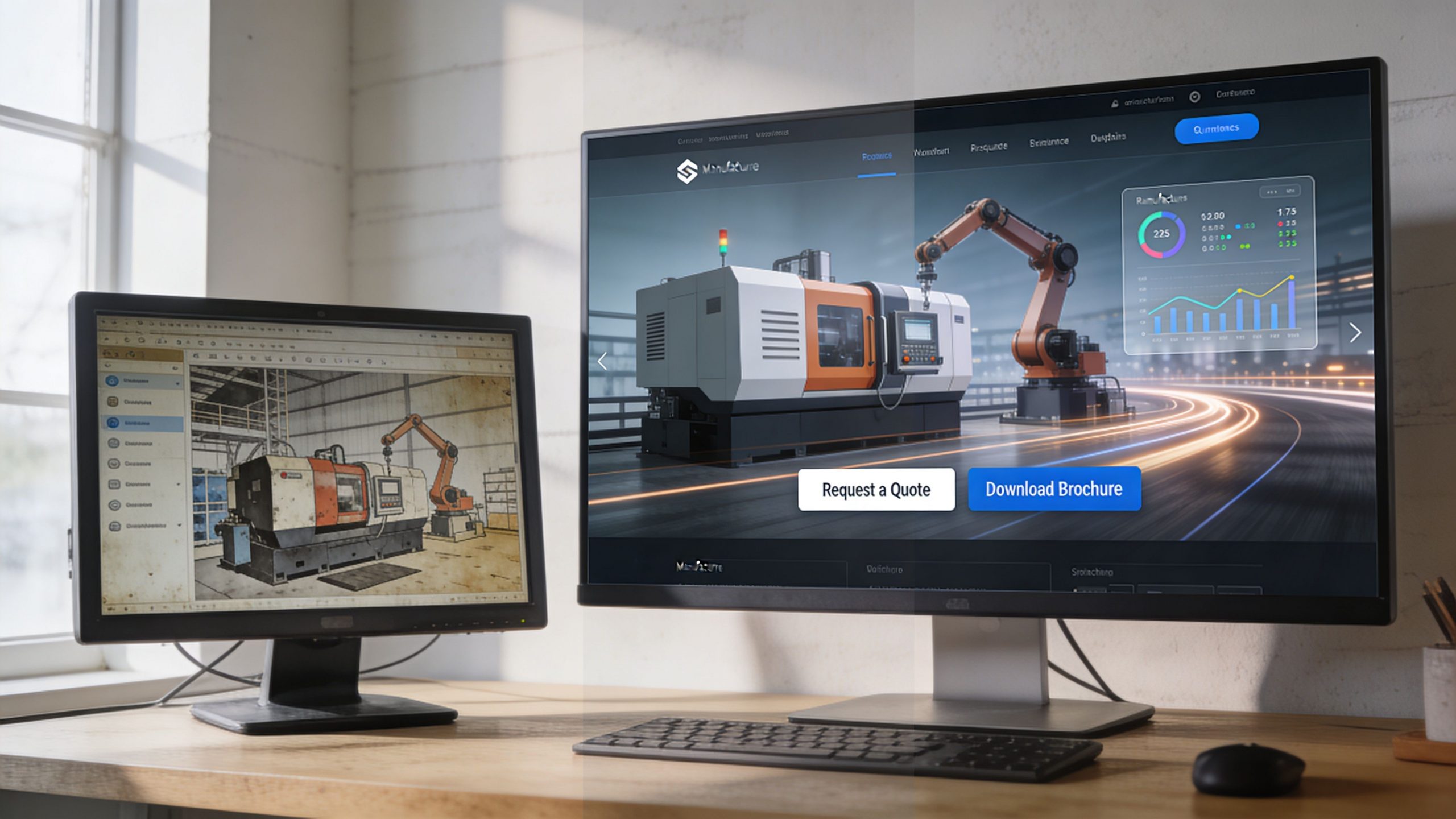
A surprising number of manufacturing websites still behave like archived brochures. They list capabilities, show a few facility photos, add a generic “Contact Us” page, and leave the rest to sales. That setup doesn’t support how industrial buyers evaluate vendors online.
Your website has to do more than describe the company. It has to help a technical visitor find the right information quickly, build confidence, and take the next step without friction. That means structure, speed, clarity, and conversion paths all matter.
Your site should guide the next step
A strong manufacturing site doesn’t dump every visitor onto the same path. It routes people based on intent.
Someone reading about a specific machining tolerance shouldn’t have to dig through a navigation maze to find relevant capabilities. A procurement manager comparing suppliers should be able to locate documentation, certifications, and commercial reassurance. A plant manager looking for implementation confidence should find support content, process detail, and signs that your team understands operational reality.
That’s why high-performing sites often rely on focused high-converting landing pages for industrial campaigns, not just a broad homepage and a few service pages.
A practical enhancement is conversational intake. When done well, chat doesn’t replace sales. It improves routing and captures context. Tools like a SupportGPT lead generation solution show how chatbot workflows can qualify inquiries, answer common questions, and direct buyers toward the right resource or form.
What a conversion path looks like on a manufacturing site
Here’s a better model than the standard brochure layout:
- Entry point: Organic search lands a visitor on a technical article, product page, or application page.
- Proof layer: The page links to specifications, a use-case page, or a closely related resource.
- Action point: The visitor sees a relevant CTA such as “Request a Quote,” “Talk to an Engineer,” or “Get Technical Documentation.”
- Follow-up routing: The form sends context with the inquiry, not just a name and email.
That middle layer is where most manufacturing sites fail. They jump from information straight to contact, with nothing in between to build confidence.
A quick example helps. If a visitor lands on a page about corrosion-resistant components for harsh environments, the page should also offer related material guidance, compatibility notes, and a customized inquiry form. That path feels natural. It respects how technical buyers think.
A short walkthrough of conversion-focused site strategy is worth reviewing:
A manufacturing website should answer the buyer’s first questions before asking for the meeting.
That’s the standard. If the site can’t educate, qualify, and direct, it’s not a sales tool. It’s overhead.
Automate Trust Across a Long Sales Cycle
In manufacturing, a form fill rarely means someone is ready to buy. More often, it means a buyer has started evaluating options, collecting internal input, or pressure-testing suppliers. If your only follow-up is one sales email and a voicemail, you’ll lose opportunities that were never dead, just early.
That’s why nurture matters. Organizations that use automated nurture cycles see a 451% increase in qualified leads, according to MarketVeep’s analysis of inbound ROI for manufacturing companies. For long-cycle industrial sales, structured follow-up isn’t a convenience. It’s part of qualification.
Nurture should feel helpful not robotic
Bad automation spams. Good automation educates.
A useful nurture sequence sends information that matches what the buyer already showed interest in. If someone downloaded a technical guide, the next touch might be a related application note. If they requested a quote, the next message might clarify implementation steps, documentation, or timeline expectations.
Use automation to deliver things like:
- Relevant technical resources: Not generic newsletters.
- Use-case content by industry: Help prospects see themselves in the solution.
- Process videos or facility walkthroughs: Strong for trust when buyers haven’t visited in person.
- Sales alerts tied to engagement: Let reps know when a lead returns, clicks, or revisits key pages.
What to automate and what to leave human
The best manufacturer inbound marketing systems split the work correctly.
| Automate this | Keep this human |
|---|---|
| Immediate follow-up email | Complex technical discussions |
| Resource delivery | Pricing negotiation |
| Lead scoring and routing | Late-stage objection handling |
| Re-engagement sequences | Executive relationship building |
This division matters because industrial buyers don’t want a robot pretending to be an engineer. They do want fast answers, useful documentation, and consistent communication while their internal review keeps moving.
Operational note: If sales and marketing don’t agree on what counts as a qualified lead, automation will only make the confusion happen faster.
A practical workflow starts with source and interest. Did the lead come from a spec page, a webinar, or a quote form? What product line did they engage with? Which stakeholder group are they likely in? Those inputs should determine the sequence.
Trust compounds when follow-up feels informed. That’s what automation should do. It should make your company easier to buy from, not louder.
Amplify Your Reach and Measure What Matters
Creating strong content is only half the job. Distribution decides whether that content influences real opportunities or just sits on your website waiting to be discovered. In manufacturer inbound marketing, amplification has to be selective. Broad reach is less important than relevant reach.
That’s where many teams waste budget. They publish solid technical material, then push it through the same channels they’d use for a consumer brand. The result is attention from the wrong audience and weak signals inside reporting.
Put technical content where buyers already pay attention
One of the biggest gaps in manufacturer marketing guidance is channel nuance. As noted by Retailist Mag’s discussion of underserved market channel strategy, advice often lacks specificity around emerging platforms like LinkedIn video, industry Discord communities, and technical webinars where decision-makers increasingly gather.
That matters because channel fit changes by segment.
- LinkedIn works well when your content has a clear business and technical angle, especially for reaching managers, procurement, and leadership.
- Technical webinars work well when buyers need education before they’re ready for a sales conversation.
- Industry forums and niche communities work well when engineers want peer discussion, troubleshooting insight, or implementation detail.
- Email still matters when segmented by product interest, vertical, or stage instead of blasted to the entire database.
Paid amplification also has a role. Promoting a high-value guide or webinar to a tightly defined audience can help content reach target accounts. But the targeting has to be disciplined, and the offer has to justify the click.
Track revenue signals not vanity metrics
Manufacturers run into a reporting problem fast. Traffic looks healthy. Content downloads happen. Form submissions increase. Then leadership asks the only question that matters: which activities are driving revenue?
That answer won’t come from surface-level dashboards. It comes from closed-loop tracking that connects the first touch to sales progression.
Focus on measures like these:
- Lead source quality: Which channels create qualified conversations, not just inquiries.
- Content-to-opportunity influence: Which assets show up repeatedly before real pipeline movement.
- Sales cycle visibility: Where leads stall, recycle, or accelerate.
- Stage conversion by segment: Product line, industry, and stakeholder type all matter.
A stronger reporting model uses your CRM, analytics, forms, and automation platform together. It also requires shared definitions. Marketing can’t call a lead “good” if sales treats it as noise.
For teams trying to build that reporting discipline, this guide to tracking marketing metrics and KPIs across channels is a useful framework.
Don’t optimize for visibility alone. Optimize for traceable buying intent.
That’s the difference between activity and accountability.
From Outbound Cost to Inbound Investment
The fundamental shift in manufacturer inbound marketing isn’t tactical. It’s financial and operational. You stop treating marketing like a recurring expense tied to events, collateral, and isolated campaigns. You start treating it like an asset that compounds.
A technical article can keep attracting qualified search traffic. A conversion-focused landing page can keep producing inquiries. A nurture sequence can keep advancing leads while your sales team focuses on live opportunities. Over time, the system gets smarter because the data gets better.
That’s why the strongest manufacturers don’t ask whether inbound replaces every outbound effort. They ask which parts of the old model still deserve investment, and which ones should be rebuilt into a digital engine that keeps working between sales calls, plant visits, and industry events.
Execution is the hard part. It takes strategy, technical SEO, website design, media production, paid distribution, CRM logic, and AI-enabled automation working together. That combination is difficult to build in-house, especially for teams already stretched across operations and sales support.
If you're ready to turn your website, content, and automation into a real growth system, Emulous Media Inc can help. We build conversion-focused digital infrastructure for businesses that need more than generic marketing, including website design, digital advertising, media production, SEO, and AI automation. For Central Florida manufacturers and growth-minded companies across the U.S., the next step is simple. Book a free consultation, call 689-255-6327, or visit the contact page to start the conversation.