How to Build a Lead Generation System for Your Small Business — A Step-by-Step Guide to Predictable Growth
A lead generation system is a repeatable set of tools, processes, and channels that captures, qualifies, and routes prospects into your sales pipeline so you can forecast growth with confidence. This guide walks you through designing an owned lead-capture engine that cuts acquisition volatility, raises conversion quality, and produces measurable, repeatable outcomes for small businesses. You’ll learn why owning the system matters, the six steps to build an in-house engine, hands-on capture tactics (forms, chatbots, landing pages), how to create lead magnets that convert, and which traffic channels typically give the best ROI. We’ll also map the KPIs you should watch—CPL, conversion rate, lead-to-sale—and share tables and checklists you can use immediately. By the end, you’ll have a practical blueprint to move from ad-hoc leads to a structured, data-driven funnel that supports predictable growth.
Why Does Your Small Business Need an Owned Lead Generation System?
Owning your lead generation system means you control the assets—landing pages, lead magnets, CRM records, and scoring rules—that drive customer acquisition, and you can iterate quickly when something isn’t working. When you own the data, you know who converts, which channels deliver quality, and which messages land—so your CAC falls and lifetime value rises. An owned approach replaces reliance on third-party platforms and agency black boxes with clear metrics and internal capability. Below we highlight the common risks of outsourcing and explain how an in-house system makes growth measurable and predictable.
What Are the Risks of Relying on External Marketing Agencies?
Relying only on outside agencies or third-party platforms introduces operational and financial risks that reduce predictability. Agencies can end up controlling creative assets, campaign setups, and targeting knowledge—leaving you without transferable systems if the relationship ends. Costs and ROI may swing when agencies focus on short-term acquisition instead of long-term owner value, and limited data access slows troubleshooting and iteration. Those risks make internal knowledge transfer and owning your assets essential so your team can sustain growth without vendor-driven volatility.
How Can In-House Lead Generation Create Predictable and Measurable Growth?
Bringing lead generation in-house creates predictability by aligning data capture, CRM workflows, and measurement in one place, enabling continuous A/B testing and faster optimization. Data ownership lets you attribute leads to specific content, channels, and campaigns and set KPIs like CPL, lead-quality score, and conversion velocity to guide decisions. Connecting your CRM to capture and scoring rules smooths sales handoffs and makes lead-to-sale conversion measurable, forming a feedback loop of learning. With this foundation you can scale winners, stop what underperforms quickly, and forecast acquisition needs with greater accuracy.
For small businesses that want control over marketing outcomes, the practical path is sensible tooling plus repeatable processes—this reduces risk and builds institutional capability. Our goal is to help small teams win more customers by showing measurable results and creating clear next steps for booking appointments.
What Are the 6 Essential Steps to Building Your Lead Generation Engine?
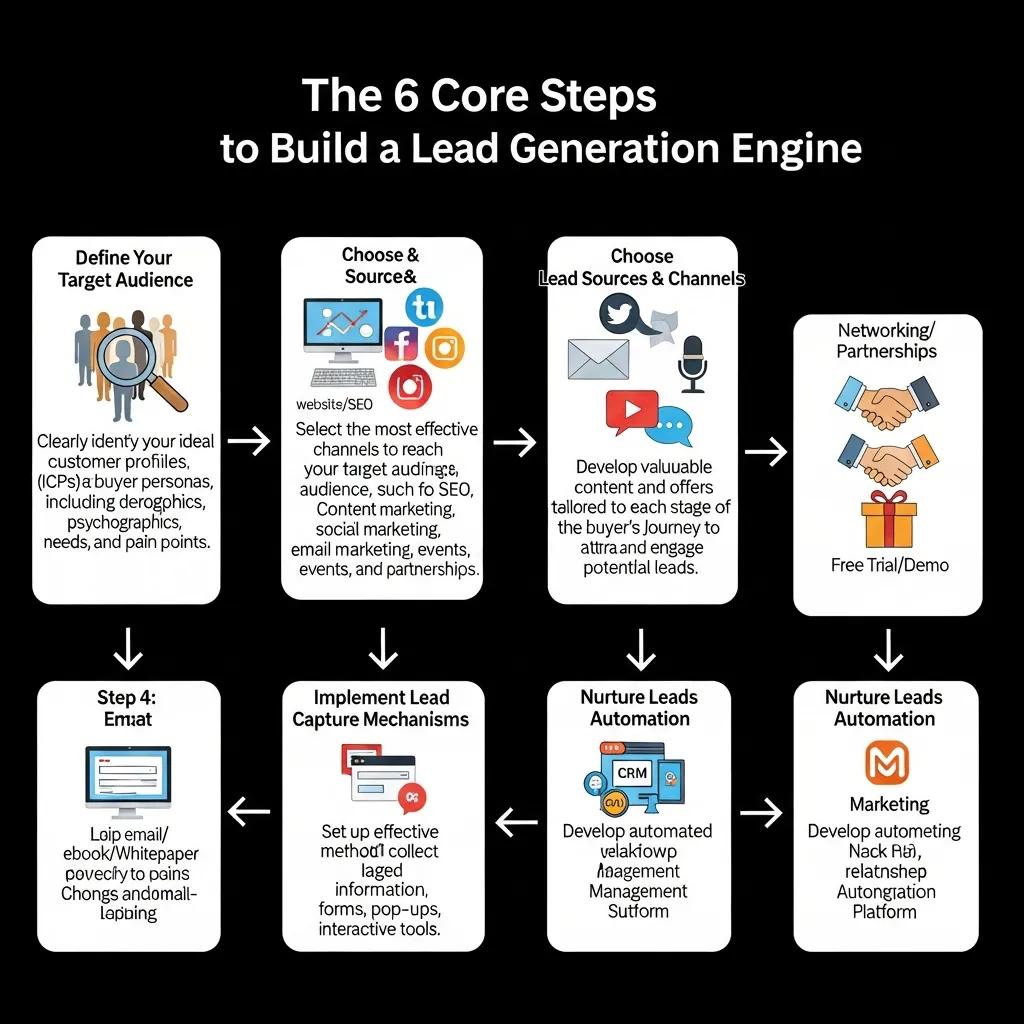
A reliable lead generation engine follows six practical steps that turn strangers into qualified opportunities. Each step is an operational layer you can build, measure, and optimize to create steady lead flow: define your target persona, create high-value lead magnets, implement high-converting capture, drive targeted traffic, nurture and score leads, then analyze and scale the winners. Below is a concise checklist you can use to implement the system.
- Define your target persona and decision triggers so messaging and channels match buyer intent.
- Create lead magnets matched to buyer stage—estimators, checklists, and guides that solve immediate problems.
- Build optimized landing pages and focused capture forms with trust signals and progressive profiling.
- Drive traffic with a blended mix of SEO, search ads, and local referrals tuned to intent.
- Nurture and qualify leads with CRM scoring, segmented email flows, and clear sales handoffs.
- Analyze multi-touch attribution, run A/B tests, and scale the highest-performing campaigns.
Those steps tie directly to measurable outcomes—landing-page conversion, CPL by channel, average lead score, and lead-to-sale ratio—and create a continuous improvement loop driven by data. One way teams accelerate this build is structured training: Emulous Media Inc. runs a focused 6-week program that helps small businesses build and manage their own lead systems. If you want a guided path to implement these steps and prioritize the highest-impact actions, schedule a strategy session to turn the framework into a tactical roadmap.
Introductory comparison of the six steps with expected outcomes:
| Phase | Includes | Expected KPI |
|---|---|---|
| Persona Definition | Buyer attributes, pain points, channels | Improved conversion relevance |
| Lead Magnet Creation | Checklists, estimators, guides | Higher lead-to-MQL rate |
| Capture & Landing Pages | Forms, CTAs, trust elements | Increased landing conversion rate |
| Traffic Acquisition | SEO, PPC, referrals | Lower CPL over time |
| Nurture & Scoring | Drip flows, CRM rules | Faster lead-to-opportunity rate |
| Analyze & Scale | A/B tests, attribution | Scalable ROI and predictability |
This framework shows which tasks give quick lifts and which build lasting advantage; the following H3s break each step into actionable subtasks and templates you can apply right away.
How Do You Define Your Ideal Client Persona for Targeted Lead Generation?
Defining an ideal client persona means capturing actionable fields: demographic or firmographic data, project needs, budget range, decision timeline, and top objections. Start by interviewing past customers and reviewing closed-won deals to find recurring pain points, channels, and triggers. Use a one-page persona template that lists the top three pain points, preferred communication method, average budget, and typical decision timeline so messaging and lead magnets align with buyer intent. Personas inform ad targeting, site copy, and the magnets most likely to convert—improving qualification and conversion quickly.
What Are Effective Lead Magnet Ideas to Attract Qualified Leads?
Good lead magnets for service firms solve a specific problem and deliver usable value—examples: project estimators, renovation checklists, and short how-to videos. Match format to buyer stage: local guides for early awareness; calculators and estimators for buyers evaluating costs and timelines. Keep delivery simple (PDFs, email-triggered downloads, or short gated videos) and pair every magnet with a clear CTA and tracking so you can measure magnet-to-opportunity conversion. Prioritizing magnets that answer common pre-sales questions improves lead quality and speeds sales conversations.
How Do You Implement High-Converting Lead Capture Forms and Landing Pages?
High-converting capture starts with one clear offer and a minimal form that asks only what you need to qualify prospects at that stage. Use progressive profiling to gather deeper info over time, add trust indicators like local reviews or portfolio images, and design mobile-first to reduce friction. Test headline, CTA copy, and form fields to find the right balance between volume and quality. Instrument pages with conversion tracking and CRM integration so leads flow automatically into nurture sequences and sales workflows for timely follow-up.
Which Traffic Generation Channels Drive Qualified Leads?
Each channel brings a different mix of intent, cost, and speed—pick a mix that balances immediate leads with long-term growth. Search ads capture high intent and deliver quick leads but at higher CPL; SEO and local content take longer to ramp but lower CPL and increase sustainable volume; referrals and partnerships yield high-quality, lower-cost leads when nurtured. Align channels with persona behavior—if buyers search “remodel cost estimator,” prioritize search and well-structured service pages. Track CPL, conversion rate, and lead quality by channel to decide what to scale or pause.
| Channel | Cost Profile | Lead Quality | Timeline to Results |
|---|---|---|---|
| SEO (Local) | Low to medium | Medium-high | 3–9 months |
| Google Ads (Search) | Medium-high | High | Immediate |
| Paid Social | Medium | Medium | 2–6 weeks |
| Referrals/Partnerships | Low | High | Depends on partner setup |
This channel comparison helps you allocate budget and set realistic expectations based on business goals and the buyer’s journey.
How Do You Nurture and Qualify Leads Using Lead Scoring and CRM?
Lead scoring assigns points to behaviors and attributes—form fields, page visits, email engagement—so sales can prioritize the warmest prospects. Keep rules simple: for example, +30 for an estimator request, +10 for a pricing-page view, -20 for no engagement in 30 days; then map score thresholds to CRM stages and automated nurture cadences. Use segmented email flows with content matched to persona and score, and route qualified leads to sales for human follow-up. Tracking lead velocity, MQL→SQL conversion, and lead-to-sale rate closes the loop between marketing activity and revenue.
How Can You Analyze, Optimize, and Scale Your Lead Generation Results?
Analyzing lead generation means keeping a dashboard of core KPIs—CPL, conversion rate, lead-score distribution, and lead-to-sale conversion—updated regularly to spot trends and run tests. Run structured A/B tests on landing pages, lead magnets, and ad creative, and use an analysis window that matches each channel’s timeline. When a test delivers a reliable win, scale budget and replicate in adjacent audiences or geos; when results fall, revert and retest. A disciplined test-and-scale loop turns one-off wins into predictable growth because analysis shows where investment brings the best incremental return.
What Are the Best Lead Capture Strategies for Small Businesses?
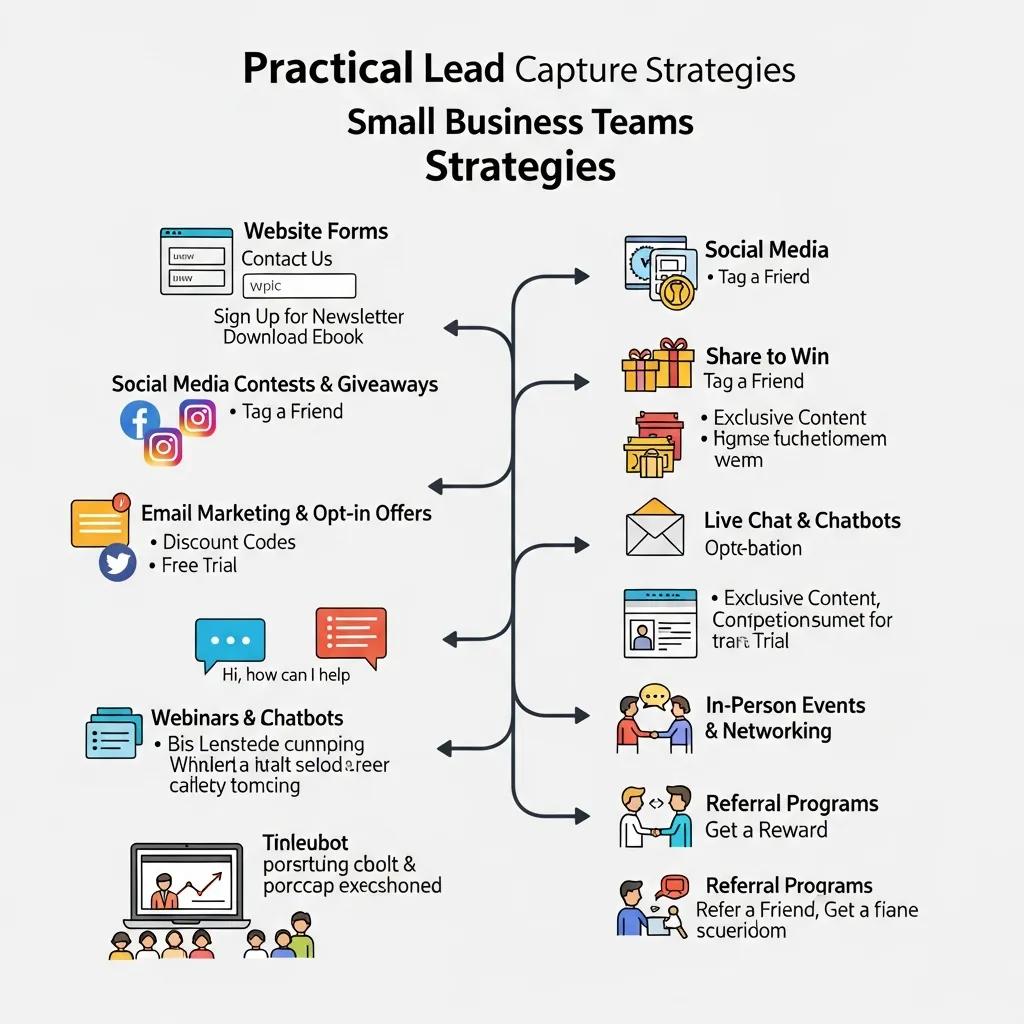
For small teams, lead capture should be low-friction and trust-focused to match limited resources and project-based sales cycles. A simple, effective mix is a focused landing page offer, a short qualification form, and automated routing into a CRM with immediate follow-up. Prioritize a single booking or estimator CTA, visible trust signals, and a lightweight chatbot for after-hours qualification instead of multiple competing conversion points. The sections below explain form design and how chatbots can help capture and qualify leads.
How Do You Design High-Converting Lead Capture Forms?
Design forms to reduce friction and increase signal: ask only three to five fields initially (name, phone/email, project type, preferred timeline) and leave optional fields for extra context. Use microcopy to remove doubt, place privacy reassurance near the submit button, and show a small portfolio image or review next to the form for social proof. Use progressive profiling to ask deeper questions later and validate inputs to minimize errors. These techniques raise completion rates while preserving qualification data for scoring.
Intro to comparative table for capture tactics:
| Capture Approach | Best Use-Case | Pros | Cons |
|---|---|---|---|
| Short Forms | High-volume lead pages | Low friction, high submissions | May require more nurture to qualify |
| Chatbots | Immediate engagement | 24/7 qualification, interactive | Needs good conversation design |
| Popups/Slides | Promotional offers | High visibility for magnets | Can annoy users if misused |
Choose the approach that fits visitor intent and team capacity; combine methods and route all leads into a single CRM for tracking and follow-up.
How Can Chatbots Enhance Your Lead Capture System?
Chatbots lift capture by engaging visitors who hesitate to fill forms, answering quick questions, and pre-qualifying leads through a short conversation. Design chat flows to ask 3–4 qualifying questions that feed directly into lead scoring—budget, timeline, and service type—then route hot leads to immediate contact or booking. Integrate the bot with your CRM so conversations create or update lead records and trigger the right nurture sequence. Thoughtful chat design reduces drop-off, speeds response times, and surfaces high-intent prospects that might otherwise leave.
How Can Small Businesses Use Lead Magnets to Increase Conversions?
Lead magnets raise conversions by offering focused value that solves a specific problem, builds trust, and signals intent when exchanged for contact details. Effective magnets for service firms are practical—project-cost estimators, room-by-room checklists, and local renovation guides—that speed buyer decisions and provide sellers with qualification signals. Below we highlight top-performing magnet types and where to promote them so buyers see them where they research.
What Types of Lead Magnets Work Best for Service-Based Businesses?
Service firms get traction from magnets that reduce uncertainty and show competence: cost estimators, before/after galleries with ROI notes, project timeline planners, and short how-to videos. Each format maps to a funnel stage—estimators for purchase-ready prospects, galleries for inspiration seekers, and guides for early research—so align magnets to the buyer journey. Quick production tips: turn existing project photos into a gallery PDF, turn common estimate logic into a simple calculator, and record short walkthroughs to create high-value assets with limited effort.
- On-site CTAs on service pages that match the page intent to the magnet.
- Targeted search ads promoting estimators and booking offers.
- Email and social retargeting to visitors who viewed pricing or project pages.
Match magnet format to intent and promote it where buyers are already researching to maximize conversion efficiency.
How Do You Promote Lead Magnets Effectively Within Your Funnel?
Promote magnets by pairing each asset with a specific traffic source and dedicated landing page—for example, search ads for estimators and social posts for gallery inspiration. Use retargeting to serve magnet offers to users who visited relevant pages but didn’t convert, and add magnet links to email sequences to re-engage past leads. Track performance by source and adjust bids and creative to prioritize the highest-converting combos. Consistent testing of headlines, visuals, and CTAs across channels improves results and lowers CPL over time.
How Do You Drive Targeted Traffic to Your Lead Generation System?
Driving targeted traffic combines short-term paid channels with long-term organic work to keep a steady flow of qualified visitors. SEO builds sustained local visibility and reduces reliance on ads, while search ads bring immediate inbound leads for priority services. Paid social supports awareness and retargeting, and referral partnerships add trusted endorsements. The H3s below unpack SEO and paid-channel tactics small businesses can implement on modest budgets.
How Does SEO Improve Lead Generation for Small Businesses?
Local SEO improves lead generation by aligning your website and business profile with location-based, purchase-intent queries customers use when researching contractors. Key actions: optimize your business profile, add local schema, create service pages targeting specific project queries, and collect consistent reviews to build trust. Produce content that answers common pre-sales questions and targets long-tail queries to build topical authority and bring qualified traffic that converts at higher rates. Over time organic traffic lowers CPL and creates a predictable source of inbound opportunity.
What Role Do Google Ads and Paid Social Play in Lead Generation?
Google Ads capture high-intent searches and deliver fast leads when campaigns focus on service-specific keywords and tightly matched landing pages. Paid social is strong for awareness, gallery-driven lead generation, and retargeting users who didn’t convert. For small contractors, prioritize search ads for “local service + estimator” queries and use social ads to re-engage users with galleries or offers. Measure ROI by tracking conversions in the same CRM you use for organic leads so you can compare lead quality and optimize budget allocation.
| Channel | Strength | Typical Budget Guidance |
|---|---|---|
| Search Ads | High intent conversion | Prioritize service-specific keywords and matching landing pages |
| Paid Social | Awareness & retargeting | Test creatives and target local audiences |
| Organic SEO | Sustainable volume | Invest in content and business profile optimization |
This comparison helps you put limited budget where it aligns with buyer intent and your team’s ability to follow up.
How Can Home Renovation and Remodeling Businesses Build Effective Lead Generation Systems?
Renovation businesses face long sales cycles, high trust needs, and strong local competition, so their lead systems must combine reputation signals, clear pricing paths, and low-friction discovery tools. Effective tactics include project estimators, gallery-led landing pages, local review strategies, and fast booking flows for consults. The H3s below cover contractor-specific challenges and practical tactics that address them.
What Unique Challenges Do Contractors Face in Lead Generation?
Contractors deal with seasonality, varied budgets, and long decision timelines—so qualification and follow-up are essential. Trust-building is critical: reviews, portfolios, and transparent process descriptions shorten the path to decision. To smooth seasonality, keep publishing content and retargeting to nurture prospects through the off-season, and use referral incentives to capture high-quality leads from satisfied customers. These tactics help stabilize monthly lead volume and improve close rates over time.
What Tailored Lead Generation Strategies Work Best for Home Renovation?
High-converting contractor tactics include interactive project estimators that surface budget and timeline intent, gallery landing pages with captions explaining materials and costs, and local-search optimization to reach nearby homeowners. Use a short qualification form tied to an estimator to capture budget and scope, then route high-scoring leads directly to sales for quick consult scheduling. Combining organic expertise content and targeted search ads aimed at budget-ready queries produces a balanced funnel optimized for both volume and quality.
Introductory note: Emulous Media Inc. specializes in helping small businesses—particularly home renovators and remodelers—build owned lead systems tailored to contractor realities. Services include Search Engine Optimization, Google Ads Management, and Inbound Sales Lead Generation. For remodelers who want practical implementation and measurable results, a focused assessment turns these strategies into an operational plan.
| Strategy | Attribute | Outcome |
|---|---|---|
| Project Estimator | Interactive calculator | Improves lead qualification |
| Gallery Landing Pages | Visual proof of quality | Boosts trust and conversions |
| Local SEO & Reviews | Business profile optimization | Higher local visibility |
Summary: Combine visual proof, practical estimation tools, and local credibility to generate contractor-ready leads.
We help small businesses convert more leads into clients by demonstrating expertise, delivering measurable results, and creating clear next steps for booking.
For hands-on implementation where you keep ownership of assets and data while accelerating results, schedule a strategy session with Emulous Media Inc. Aaron Scheetz leads practical training and implementation that equips small teams to build, run, and scale an owned lead generation system. The emphasis is on empowerment and ownership so your business captures predictable, measurable leads you control.
Frequently Asked Questions
What is the importance of lead scoring in a lead generation system?
Lead scoring helps you prioritize outreach by ranking prospects based on engagement and fit with your ideal client. By assigning points to actions—opening emails, visiting pages, requesting an estimator—sales teams focus on the most promising prospects first. That improves efficiency and conversion rates because high-quality leads get timely follow-up. In short, good scoring aligns marketing and sales around the leads most likely to convert.
How can small businesses effectively use social media for lead generation?
Small businesses can use social media to generate leads by sharing useful content, customer stories, and promotions tied to lead magnets like guides or webinars. Targeted ads reach specific audiences and drive traffic to landing pages, while regular engagement in comments and messages builds relationships and trust. Be consistent and authentic—those two things matter more than posting volume when converting social followers into leads.
What metrics should small businesses track to measure lead generation success?
Track core KPIs like cost per lead (CPL), conversion rates, and lead-to-sale ratios. Monitor lead sources to see which channels perform best and evaluate lead quality to refine targeting. Engagement metrics—email open rates and landing-page behavior—show how magnets and content are working. Regularly review these numbers to optimize where you invest time and ad spend.
How can small businesses nurture leads effectively?
Effective nurturing requires a structured follow-up plan that keeps prospects engaged over time. Use segmented email sequences that match a lead’s interests and behavior, and automate timely touches—reminders, helpful resources, case studies. Give value, stay top-of-mind, and adjust the cadence based on engagement; measuring response lets you refine the approach and convert more leads.
What role does content marketing play in lead generation?
Content marketing attracts and engages prospects by answering real questions and demonstrating expertise. High-quality blog posts, videos, and guides build authority, drive organic traffic, and create opportunities to convert visitors with lead magnets. Consistent content helps move prospects through the buyer’s journey and increases the likelihood they’ll share contact details in exchange for practical resources.
How can small businesses optimize their landing pages for better lead capture?
Optimize landing pages by keeping them clear and focused: a compelling headline that states the value, a short form asking only for essential info, and trust signals like testimonials or badges. Use a strong CTA that prompts immediate action and run A/B tests on headlines, images, and form fields to find the most effective combinations. Small, regular tests deliver steady improvements in conversion.
**