Landing Page Conversion Rate Optimization: Turn More Ad Clicks Into Qualified Leads
Landing page conversion rate optimization (CRO) is the disciplined process of improving post-click pages so a higher share of ad visitors become leads or customers. It directly boosts return on ad spend by turning the same traffic into more conversions. Focus on message match, a crystal-clear value proposition, fast page performance, and removing friction to cut wasted spend and improve Google Ads quality score — all while giving prospects a better experience. This guide explains why landing page design matters for ad-driven conversions, the page elements that move the needle, and a prioritized CRO workflow you can apply today. Inside you’ll find practical checklists, KPI mappings, A/B testing steps, remodeling-specific templates, and an overview of a teach-to-own program that helps small teams run these systems themselves. Read on for measurable tactics, the tools to prove impact, and repeatable processes to convert clicks into booked appointments and qualified leads.
What Are the Key Elements of a High-Converting Landing Page?
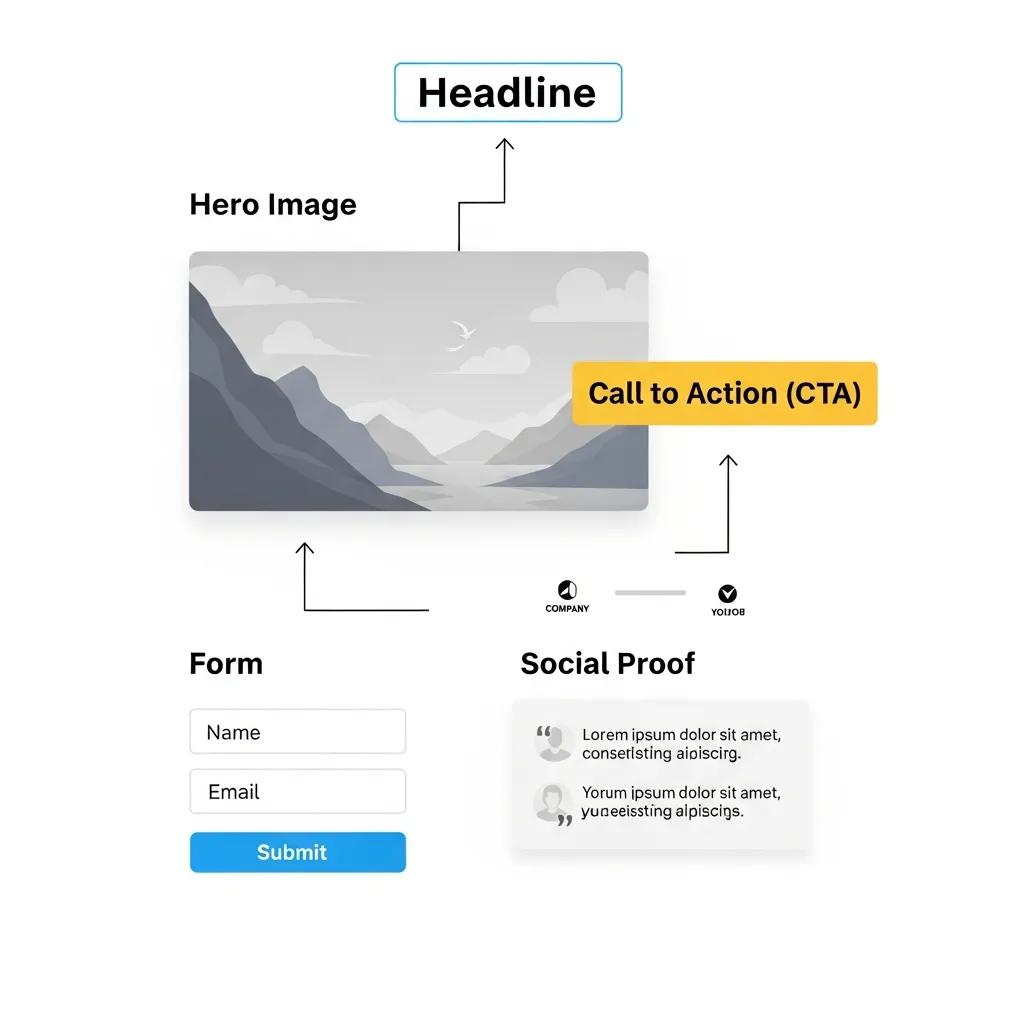
A high-converting landing page is focused: it echoes the ad promise, states a clear benefit, removes friction, and funnels visitors toward one conversion action. Each piece — headline, hero image, CTA, form, social proof — has a specific job in moving intent toward the desired outcome. Prioritizing these elements raises perceived relevance and trust, which typically increases conversion rate and can lower cost per acquisition (CPA). Below are the primary items to audit first and test for quick wins.
A landing page should include these core elements:
- Headline that mirrors the ad intent and states the benefit in a single, clear sentence.
- Hero image or project photo that shows the result and frames the offer in context.
- Primary CTA that’s action-specific, visually prominent, and easy to tap on mobile.
- Lead capture form with the fewest fields needed and progressive profiling where appropriate.
- Social proof such as project photos, localized testimonials, and trust badges.
These elements drive measurable lifts when tested: headlines move on-page CTR, hero images change engagement, and form length strongly correlates with completion rate. Next, we dive into headline mechanics and testing.
How Do Headlines Influence Landing Page Conversion Rates?
The headline is the page’s immediate promise — it determines whether a visitor reads on. A headline aligned with the ad reduces bounce and increases micro-conversions because it sets the right expectation. For home services, effective headlines blend locality, outcome, and a clear benefit — for example, “Kitchen Remodeling in [City] — Free Design Consult” — so visitors know they’ve landed in the right place. Test headline angles (cost savings, timeline, craftsmanship) and track lifts in engagement and form starts; industry benchmarks show well-targeted headline changes can deliver single- to double-digit percentage gains in CTR-to-lead. When A/B testing headlines, control for traffic source and sample size, and keep variants consistent with the originating ad to avoid confusing visitors.
That headline strategy flows directly into your primary CTA, which needs to restate value and reduce friction toward the click-to-lead path.
What Makes an Effective Call-to-Action for PPC Landing Pages?

A high-performing CTA is specific, tied to the page’s value, and optimized for every device so users know the next step and feel comfortable taking it. Use action-oriented microcopy like “Get Your Free Estimate” or “Book Design Consultation — No Obligation” instead of vague labels. Ensure the button contrasts with surrounding colors and remains visible above the fold on mobile. For form CTAs, run micro-experiments on button text, size, and placement — compare short-copy vs. benefit-led copy and measure both clicks and downstream form completion to surface hidden drop-off. On mobile, make CTAs thumb-friendly, avoid interstitials before capture, and repeat the primary CTA after key proof elements.
Validate these CTA choices through prioritized tests; next we’ll outline the CRO techniques to structure those experiments.
| Element | Role | Example / Best Practice |
|---|---|---|
| Headline | Grab attention and establish relevance | Match the ad headline and state the main benefit (e.g., “Bath Remodel — 2-Week Turnaround”) |
| Hero Image | Visual proof of the outcome | Use real project photos with homeowner context and before/after framing |
| CTA | Drive action and reduce friction | Specific copy, high-contrast colors, thumb-friendly for mobile |
| Form | Capture qualified leads | Keep fields to a minimum, apply progressive profiling, pre-qualify where possible |
| Social Proof | Build trust and credibility | Local testimonials, project counts, and photo-based proof |
This comparison clarifies each element’s tactical role so you can design focused tests that map to measurable outcomes and prioritize the highest-impact changes first.
Which Conversion Rate Optimization Techniques Boost Landing Page Performance?
Effective CRO combines disciplined experiments, UX fixes, and targeted personalization to deliver lasting conversion gains. The engine is hypothesis-driven testing and iterative improvement based on real user behavior. Use an impact-versus-effort framework to prioritize: pick quick wins (headline, CTA, form length) before heavier lifts (full redesigns or new templates). Below is a short prioritization list and a practical testing lifecycle you can adopt for ad-driven pages.
- Impact/Effort Prioritization: Rank changes by estimated conversion impact versus implementation effort.
- A/B/n Testing: Run controlled experiments changing one variable at a time with adequate sample sizes.
- Personalization & Segmentation: Tailor variants by traffic source, keyword intent, or audience segment.
- UX and Technical Fixes: Improve page speed, mobile layout, and reduce form friction to support experiments.
Follow a hypothesis-driven approach to reduce noise and focus on campaign goals (lead rate, cost per lead). Use the testing lifecycle below to structure reliable experiments.
How Can A/B Testing Improve Landing Page Elements?
A/B testing isolates a single variable to reveal causal effects on conversions by comparing control and variant pages, which removes confounding factors. Build clear hypotheses such as “Reducing the form to three fields will increase completions” and calculate the sample size needed for statistical significance before declaring winners. Quick tests include headline variations, CTA copy and color, and form field reductions. Track micro-conversions (CTA clicks, form starts) and final conversions to catch transfer effects. Keep a test log and only scale changes proven to win — over time this builds a library of reliable template elements for reuse.
This testing discipline supports UX improvements, the next area to optimize for ad conversion.
What User Experience Principles Enhance Ad Conversion Rates?
Good UX lowers cognitive load and builds trust so visitors can quickly evaluate value and act. Apply a scanning-friendly layout (F-pattern), concise benefit bullets, and a single primary CTA so attention funnels to conversion. For local/home services, use project galleries, licensing badges, and nearby customer testimonials to calm anxiety on big-ticket purchases like remodeling. Prioritize accessibility and mobile-first forms: large touch targets, minimal typing, and caching form entries to reduce abandonment. These UX moves make experiments more reliable and improve baseline conversion rates.
UX is only part of the picture — ads and landing pages must be tightly integrated to maximize results. Next we look at that integration.
How Does Google Ads Integration Affect Landing Page Optimization?
Google Ads and landing page relevance form a feedback loop: when ad copy, keywords, and landing page content align, visitors experience continuity, engagement rises, and auction outcomes improve. Better message match often lowers bounce rate and CPC while increasing conversions. Use the checklist below to align campaigns and landing pages so you can prioritize fixes that reduce CPC and grow lead volume.
- Echo ad headline language in the page headline and opening paragraph.
- Use dedicated landing pages per ad group for tight keyword-to-page mapping.
- Keep offer details (price, promotion, timeline) consistent between ad and page to avoid surprises.
These alignment steps directly influence Google Ads quality score and CPC. A tidy workflow reduces friction for advertisers and improves conversion efficiency — more on message match below.
Why Is Ad-to-Landing Page Message Match Critical for Conversion?
Message match means carrying the ad’s promise onto the landing page. When messaging drifts, visitors experience cognitive dissonance and bounce. Audit message match by comparing ad headlines, offers, and CTA language with the landing page headline, hero area, and CTA. A simple three-step audit — (1) identify top-performing ads, (2) validate headline/offer parity on the landing page, (3) adjust copy or create a tailored page — uncovers easy wins that often lift engagement. For home renovation, matching project type and service area (e.g., “Bathroom Remodel — Free Estimate in [City]”) converts search intent into leads more effectively. Message match is low effort and high impact, and it sets the stage for cleaner A/B tests and lower CPC.
Improved message match also helps mobile experience, which matters given the mobile-heavy nature of ad traffic.
How Can Mobile Landing Page Optimization Improve Google Ads Quality Score?
Mobile optimization — speed, responsive layout, and simplified forms — improves landing page experience metrics that Google uses in quality assessments. Tactics include compressing images, deferring non-critical scripts, placing thumb-friendly CTAs, and reducing mobile form fields to limit typing. Because many ad clicks drop off within seconds on slow pages, improving mobile performance lowers bounce and increases conversions, which over time can raise quality score and reduce CPC. Track progress with Core Web Vitals and measure conversion uplift by device to validate gains.
With ads and mobile optimized, you need measurement systems to prioritize tests — covered next.
- Schedule a strategy session to map ad groups to optimized landing page templates and prioritize tests.
What Metrics and Tools Should You Use to Measure Landing Page Success?
Measure landing page success by mapping KPIs to tools so you can interpret signals and prioritize work. Core metrics: conversion rate, bounce/engagement, time on page, and form completion rate — these show whether visitors convert and where they drop off. Use Google Analytics (GA4), event tracking, heatmaps, and session recordings to capture micro-conversions and map results to business KPIs like cost per lead and qualified lead rate. The table below pairs common KPIs with recommended tooling and interpretation guidance.
| KPI | What it tells you | Recommended tool / measurement |
|---|---|---|
| Conversion Rate | Share of sessions that become leads | GA4 events + goal funnels |
| Bounce Rate / Engagement | Initial relevance and page fit | Page analytics + session recordings |
| Form Completion Rate | Friction inside the capture flow | Form analytics + event tracking |
| Time on Page / Scroll Depth | Content engagement and proof effectiveness | Heatmaps and scroll maps |
| Quality Score impact | Ad relevance and landing page experience | Google Ads + analytics correlation |
Use these signals to prioritize: low form completion with high clicks points to form friction; low time on page with high CPC suggests message mismatch or speed issues.
With KPIs defined, instrument them correctly so your experiments produce trustworthy results — covered in the next subsection.
How to Use Google Analytics and Google Optimize for Conversion Tracking?
Set up event-driven tracking in GA4 to capture CTA clicks, form starts, and form completions as distinct events so you can analyze funnels and micro-dropoffs. Use Google Optimize or a similar experimentation platform to run controlled A/B tests tied to those events. Adopt clear naming conventions for events and create funnels to visualize where users exit the path to conversion. Ensure experiments run long enough and hit required sample sizes, and triangulate quantitative wins with qualitative tools like session recordings to avoid false positives. Feed validated outcomes back into your template library to accelerate future builds and improve predictability.
This systematic view of Google Ads campaign quality and performance highlights how ad relevance, CTR, landing page experience, and conversions are connected — and gives you a practical framework to optimize them.
Google Ads Campaign Quality and Performance: A Systematic Review for Optimization
This review categorizes the main drivers of campaign quality — ad relevance, click-through rate (CTR), landing page experience, and conversion rate — and presents a practical framework that links these dimensions to performance outcomes. It outlines data-driven optimization strategies and identifies the primary metrics advertisers should use to evaluate results. The model serves as a hands-on guide for marketers running Google Ads campaigns and measuring their impact.
The relationship between campaign quality and performance in Google Ads: a systematic review, M Shemshaki, 2025
- Learn our 6-week playbook to set up measurement and run your first valid A/B test with clear KPIs.
| Tool | Feature | Application |
|---|---|---|
| GA4 | Event-based tracking | Capture CTA clicks, form starts, and conversions |
| Google Optimize | Client-side experiments | Run A/B tests on headlines, CTAs, and layouts |
| Heatmaps | Visual engagement patterns | Spot scroll and attention gaps |
| Session recordings | Qualitative behavior insights | Pinpoint form friction and user confusion |
This tool mapping shows how to pair quantitative and qualitative data to prioritize high-impact changes and avoid expensive, low-return redesigns.
How Can Home Renovation and Remodeling Businesses Optimize Landing Pages for Leads?
Remodeling businesses convert best when landing pages surface local proof, a clear scope, and an easy path to booking. Homeowners need trust and clarity before requesting estimates for high-consideration projects. Use project photos, localized testimonials, and clear scope/budget signals to reduce uncertainty and increase form completion or appointment bookings. The table below gives industry-specific recommendations for common landing page elements and how to tailor them to homeowner intent.
A focused remodeling landing page leads with visual proof, a tight value proposition, and a low-friction booking or estimate request flow to capture interest immediately.
| Element | Attribute | Industry-specific recommendation |
|---|---|---|
| Hero Image | Contextual proof | Show a recent local project photo with homeowner context and a before/after toggle |
| Headline | Outcome + locality | Include service, city, and benefit (e.g., “Whole-Home Remodel — On-Time, On-Budget in [City]”) |
| Form | Qualification | Ask 3–4 key fields: project type, timeline, estimated budget, contact info |
| Social Proof | Local trust | Highlight neighborhood projects, short review excerpts, and project timelines |
| CTA | Low friction | “Request Free Estimate” or “Schedule On-Site Visit” with calendar integration option |
These recommendations reduce homeowner anxiety and raise lead quality by surfacing relevant proof and clear next steps. Below we illustrate concrete page examples.
What Are Effective Landing Page Examples for Home Remodeling Leads?
Strong remodeling landing pages follow a hero → proof → CTA pattern that quickly communicates competence, timelines, and next steps. An annotated wireframe places a concise headline and 1–2 benefit bullets beside a compelling project photo, followed immediately by a short form and three local proof points (before/after, testimonial, verified gallery). Use microcopy that builds trust — “Free on-site estimate” — and provide clockable timelines like “Typical projects completed in 4–8 weeks” to set expectations. Templates that swap localized images and testimonial snippets per campaign let teams deploy tailored pages quickly for different ad groups.
These layouts translate into measurable uplifts in form starts and lead quality, and they fit the testing frameworks we covered earlier.
How Have Case Studies Demonstrated Conversion Success in Home Services?
Case studies show that small, focused changes — clearer headlines, removing two form fields, adding local project photos — often deliver the largest short-term uplifts. The mechanism is simpler: less friction plus higher relevance. Typical results: a 20–60% lift in form completions after headline and form optimization, or a 10–25% CPC reduction after improving message match and mobile speed. Structure case studies with baseline KPIs, the exact changes made, the testing window, and observed lift so teams can replicate wins. Use those documented results to build an internal playbook for new campaigns and templates.
This approach scales best when teams build in-house capability, which is what the final section covers.
How Does Emulous Media’s 6-Week Program Empower Small Businesses to Own Their Landing Page Optimization?
The Take Back Your Marketing 6-Week Program trains small business teams to run repeatable landing page optimization and ad conversion workflows internally. Rather than creating ongoing agency dependence, the program transfers skills, templates, and processes so teams iterate faster and retain institutional knowledge. Core outcomes include a tested landing page template, a GA4 measurement plan, and a prioritized backlog of A/B tests tailored to the business.
What Are the Key Modules of the Take Back Your Marketing Program?
The program moves teams from measurement setup to live testing and template handoff, with clear weekly deliverables so they leave with operational skills and assets that generate predictable leads. Typical modules: set goals and KPIs, map ads to landing pages, implement GA4 event tracking, craft A/B hypotheses, launch experiments, and build a template library. Deliverables are practical — instrumented analytics, one validated A/B test, a documented landing page template, and an internal playbook. This hands-on, teach-to-own model helps small teams avoid vendor lock-in and scale optimization internally.
Completing the modules prepares teams to own CRO workflows and continuously improve ad performance without relying on outside partners for every change.
How Does Building an In-House Marketing System Improve Predictable Lead Generation?
Owning landing page optimization in-house speeds iteration, preserves institutional knowledge, and increases predictability. Teams can test faster, update local offers immediately, and apply winning patterns across campaigns — all with lower overhead than outsourcing every change. Over time, an internal library of proven templates and documented test outcomes reduces vendor dependence and creates steadier lead volume. For small businesses in competitive local markets, that predictability moves results from sporadic wins to a repeatable growth engine.
If your team is ready to adopt this model, schedule a strategy session to map current campaigns to a 6-week implementation plan and get clarity on next steps and resources.
Frequently Asked Questions
What role does user experience (UX) play in landing page conversion rates?
UX is foundational: it shapes how visitors process your message and take action. A clean layout, clear hierarchy, and visible trust signals reduce cognitive load and make choices obvious. Improving UX lowers bounce, increases engagement, and raises conversions — especially for higher-consideration services where trust matters.
How can personalization improve landing page effectiveness?
Personalization increases relevance by matching content to visitor intent. Tailor headlines, offers, and CTAs by traffic source, keyword, or audience segment to make the page feel targeted. When visitors see content that reflects their situation, engagement and conversion rates climb.
What are some common mistakes to avoid in landing page optimization?
Common mistakes: neglecting mobile responsiveness, using vague CTAs, mismatching ad and page messaging, overloading pages with information, and having overly long forms. Focus on clarity, simplicity, and message match to avoid these pitfalls and improve results.
How often should landing pages be tested and updated?
Test and update regularly. Aim to run A/B tests at least quarterly, and more often if campaign volume supports it or user behavior shifts. Use performance metrics (conversion rate, bounce rate) to trigger updates, and refresh copy, images, and CTAs based on data and seasonal offers.
What tools can help with landing page optimization?
Useful tools include Google Analytics (GA4) for event tracking, Google Optimize or similar platforms for experiments, heatmap tools like Hotjar or Crazy Egg, and form analytics to identify friction. Combine quantitative and qualitative tools for a complete view.
How does the quality of ad copy impact landing page conversions?
Ad copy sets expectations. High-quality, on-target ad copy that matches the landing page improves continuity, reduces bounce, and boosts conversions. If ad copy and landing page differ, visitors can feel misled and abandon the page — so prioritize strong message match.