Your website may look polished, load a homepage video, and say all the right things. Yet the traffic report is flat, leads are inconsistent, and most new business still comes from referrals, repeat customers, or paid ads. That’s the situation a lot of business owners are in. The site exists, but it doesn’t perform.
The issue usually isn’t effort. It’s focus. Businesses spend on design, logos, and scattered content, then wonder why Google barely notices them.
Organic search is where that gap gets exposed. On average, companies see 62% of their total website traffic from organic sources, and that channel is projected to account for 53% of all web traffic by 2025 according to Babylove Growth’s breakdown of organic website traffic. If your organic visibility is weak, your website is missing the single most important traffic source for long-term growth.
That matters even more now because search visibility is no longer limited to traditional rankings. Businesses also need content and site structure that help them boost your online AI presence as AI-driven discovery becomes part of how customers evaluate providers.
A good-looking site is not the same thing as a findable site. If that disconnect sounds familiar, this practical breakdown of why your lovable site is invisible to Google and what to use instead will feel uncomfortably accurate.
Table of Contents
- Why Your Website is Invisible and What To Do About It
- Build a Rock-Solid Technical Foundation First
- Create Content That Google and Customers Love
- Earn Digital Authority with Strategic Link Building
- Dominate Your Local Market and E-commerce Niche
- Use Data and AI to Accelerate Your Growth
- Your 90-Day Organic Traffic Action Plan
Why Your Website is Invisible and What To Do About It
Most invisible websites have the same problem. They were built like brochures, not like search assets.
A brochure site tells people who you are after they arrive. An organic growth site helps the right people find you before they know your brand name. That difference changes everything for lead generation, sales consistency, and how dependent you are on paid channels.
What invisibility usually looks like
You may recognize one or more of these patterns:
- Low impressions on important pages: Your service pages exist, but they don’t show up for the searches that matter.
- Traffic concentrated on branded terms: People find you only when they already know your company name.
- Blog content with no ranking strategy: Articles are published, but none connect to a bigger topic cluster or sales path.
- No clear priority pages: Google sees several weak pages instead of one strong page for each core service.
That last point matters more than most business owners realize. Search engines reward clarity. If your site sends mixed signals, rankings stay weak even when the design is clean and the messaging sounds good.
A website becomes visible when every page has a job, every topic has a clear owner, and every technical element supports discovery.
What to do instead
Organic traffic growth starts when you stop asking, “How do I get more clicks?” and start asking, “What would make Google trust this site as the right answer?”
That usually leads to four practical decisions:
- Choose priority pages first. Your top services, top product categories, and highest-intent local pages should get the most attention.
- Remove overlap. If three pages target the same topic, they often weaken each other.
- Map content to buying stages. Some pages should capture early research. Others should target ready-to-buy searches.
- Build around real search demand. Not every good business message belongs on its own page.
Business owners often assume they need more content. Often they need less content, structured better. That’s a different mindset, and it’s one of the biggest reasons professional execution changes outcomes.
Build a Rock-Solid Technical Foundation First
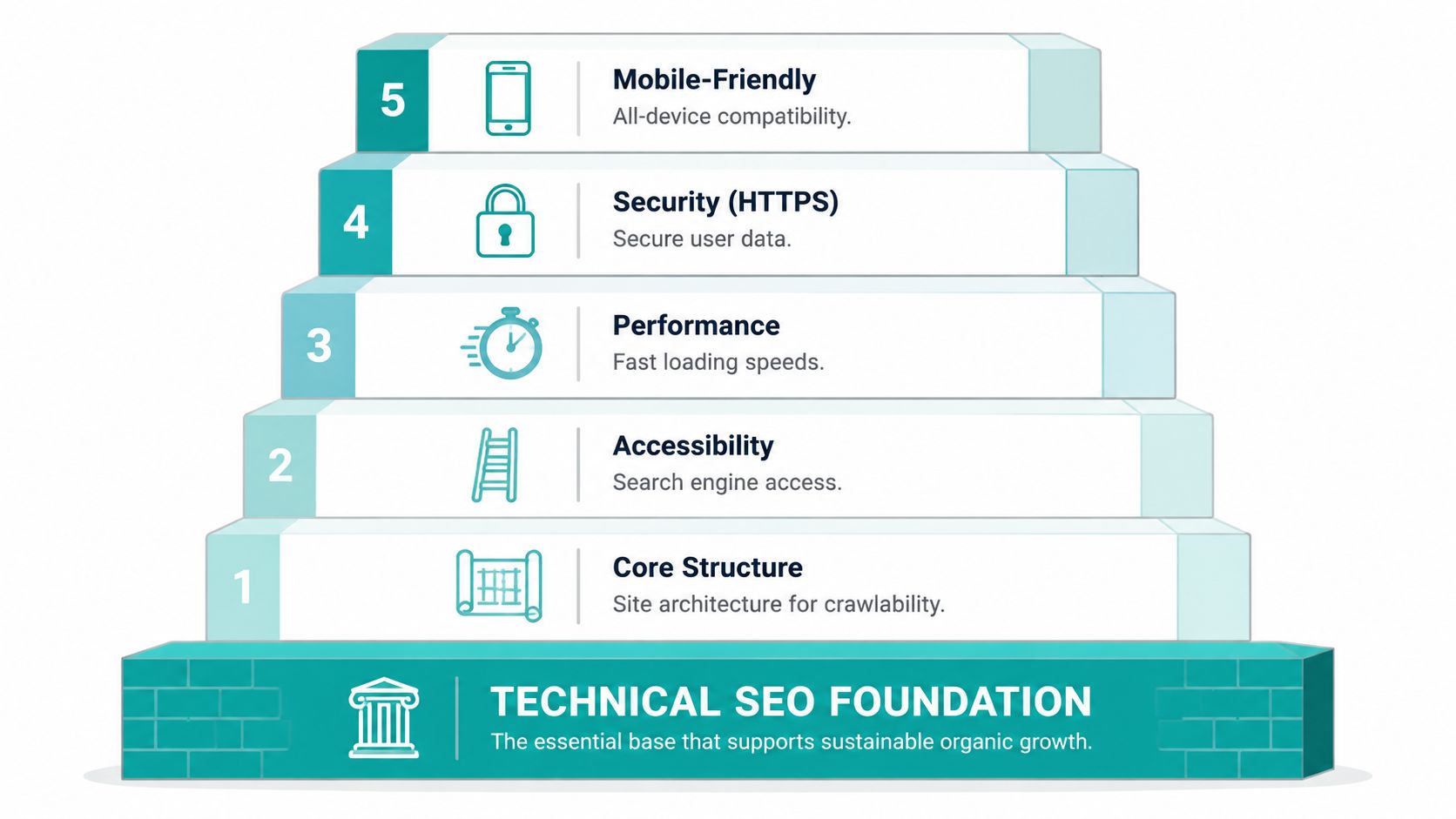
Technical SEO is boring until it isn’t. If search engines can’t crawl your pages cleanly, understand your structure, and trust your site experience, everything else gets harder. Great copy won’t rescue a weak foundation.
Think of this like construction. You don’t start with paint and furniture. You start with the frame, access, and structural integrity.
Fix the parts search engines rely on
A technical foundation usually comes down to a few essentials:
- Site architecture: Keep navigation logical. Important pages should not be buried behind cluttered menus or disconnected page paths.
- Crawl access: Make sure search engines can reach the pages you want indexed.
- Speed and responsiveness: Slow pages lose users fast, especially on mobile.
- HTTPS and trust signals: Security is baseline, not a bonus.
- Mobile usability: If your site is awkward on a phone, your rankings and conversions both suffer.
If you’re diagnosing a weak site, start with the pages that make money. Service pages, city pages, category pages, and product pages should be fast, usable, and internally connected. A focused process like website speed optimization then has a direct business impact because faster, cleaner pages give both users and search engines fewer reasons to leave.
Consolidate pages before you publish more
One of the fastest ways to improve organic performance is not publishing something new. It’s merging what already exists.
When websites consolidate or merge pages with overlapping keyword targets, they can see 20% to 40% ranking improvements for the main page within 4 to 8 weeks according to Karma Jack’s analysis of increasing organic site traffic. That happens because backlinks, internal link authority, and topical relevance stop being split across competing URLs.
Here’s the trade-off. Businesses hate deleting pages because it feels like losing assets. In reality, weak duplicate pages often dilute authority.
A practical audit looks like this:
| Problem | What it usually means | Better move |
|---|---|---|
| Several pages target the same service | Internal competition | Merge into one stronger page |
| Old blog posts barely get traction | Thin or outdated content | Refresh, redirect, or fold into a pillar page |
| Service pages repeat the same copy by city | Weak local differentiation | Rebuild with unique intent and local relevance |
Practical rule: If two pages are trying to rank for the same core idea, pick a winner and strengthen it.
What doesn’t work is blind pruning. If you remove URLs without redirects, or merge pages without preserving useful sections, you can create new problems. The right move is usually selective consolidation, cleaner internal linking, and a tighter page hierarchy.
Create Content That Google and Customers Love
Content drives rankings only when it earns them. Publishing generic articles because “SEO needs blogs” is how companies end up with dozens of pages and no meaningful traffic.
The goal is topical authority. That means your site becomes the obvious answer for a topic that matters to your customers.

Build topical authority instead of random blog posts
Google doesn’t reward randomness well. It rewards depth, structure, and relevance.
For a Florida estate planning law firm, that might mean one strong pillar page on estate planning, supported by focused pages on wills, trusts, probate, powers of attorney, and common planning mistakes. For a home service company, it could mean a main roofing service page supported by pages about inspections, repairs, insurance claims, storm damage, and maintenance.
This is where keyword strategy matters. The top 3 search results on Google receive more than 68% of all clicks, and only 23% of websites achieve a top-three placement according to First Page Sage’s organic traffic benchmarks. If you want to know how to increase website traffic organically, “pretty good” rankings aren’t enough. You need pages built to compete near the top.
One practical resource for that planning work is expert keyword research tips for SEO strategy, especially when you’re deciding which topics deserve a pillar page and which belong as supporting content.
Write for search intent, not for word count
A lot of content misses because it answers the wrong question.
If someone searches for a service, they usually want clarity, proof, process, and next steps. If someone searches for a comparison, they want distinctions and decision criteria. If someone searches for a how-to, they want steps, not brand slogans.
Good content tends to do a few things well:
- It matches the searcher’s goal: Informational pages educate. Transactional pages sell. Comparison pages help buyers choose.
- It uses clean page structure: One clear H1, helpful H2s, useful supporting sections, and internal links to related pages.
- It answers obvious follow-up questions: Not to increase word count, but to remove hesitation.
- It sounds like a practitioner wrote it: Clear opinions, trade-offs, and practical examples beat vague textbook SEO writing.
If your page could be copied onto a competitor’s site with almost no edits, it probably isn’t strong enough to rank well.
What doesn’t work is stuffing keywords into weak copy, publishing near-duplicate blogs, or writing only for awareness while ignoring buyer intent. Strong organic content helps rankings because it helps decisions.
Earn Digital Authority with Strategic Link Building
Backlinks still matter, but the way many businesses think about them is outdated. Link building is not about collecting as many links as possible. It’s about earning signals that your company is credible, relevant, and worth referencing.
That changes the conversation from spam to reputation.
Treat backlinks like reputation, not inventory
A single respected mention from a relevant site can matter more than a pile of low-quality directory links. That’s because search engines evaluate context, relevance, and authority, not just volume.
Businesses get into trouble when they treat backlinks like a commodity. They buy cheap packages, land on junk sites, and then wonder why rankings don’t improve. In some cases, they make the site harder to trust.
Good link building works more like digital PR:
- Publish something worth citing: A useful guide, a local resource, a strong service explainer, or original visual content.
- Build real relationships: Industry associations, local organizations, media contacts, vendors, and community sites all matter.
- Offer expertise, not outreach spam: Useful commentary and expert contribution earn better placements than templated email blasts.
What good link building looks like in practice
For a Central Florida home services company, authority might come from local chamber sites, neighborhood publications, supplier relationships, sponsorship pages, or regional business features. For an e-commerce brand, it could come from product reviewers, gift guides, niche publications, and expert roundups.
Here’s the trade-off. High-quality links are slower to earn. They require content worth sharing and outreach that sounds like a real human wrote it. But they support brand authority far better than volume-based tactics.
A practical filter for opportunities looks like this:
| Opportunity type | Usually worth pursuing | Usually not worth pursuing |
|---|---|---|
| Local business organizations | Yes, if relevant and legitimate | No, if the site is abandoned or spam-filled |
| Industry publications | Yes, if the audience overlaps with yours | No, if placement is unrelated to your market |
| Paid bulk link offers | Rarely | Usually not |
| Vendor and partner mentions | Often | Not if the page exists only to sell links |
The best link building usually follows strong positioning. Businesses that publish useful content, maintain a credible site, and participate in their market tend to attract better opportunities.
Dominate Your Local Market and E-commerce Niche
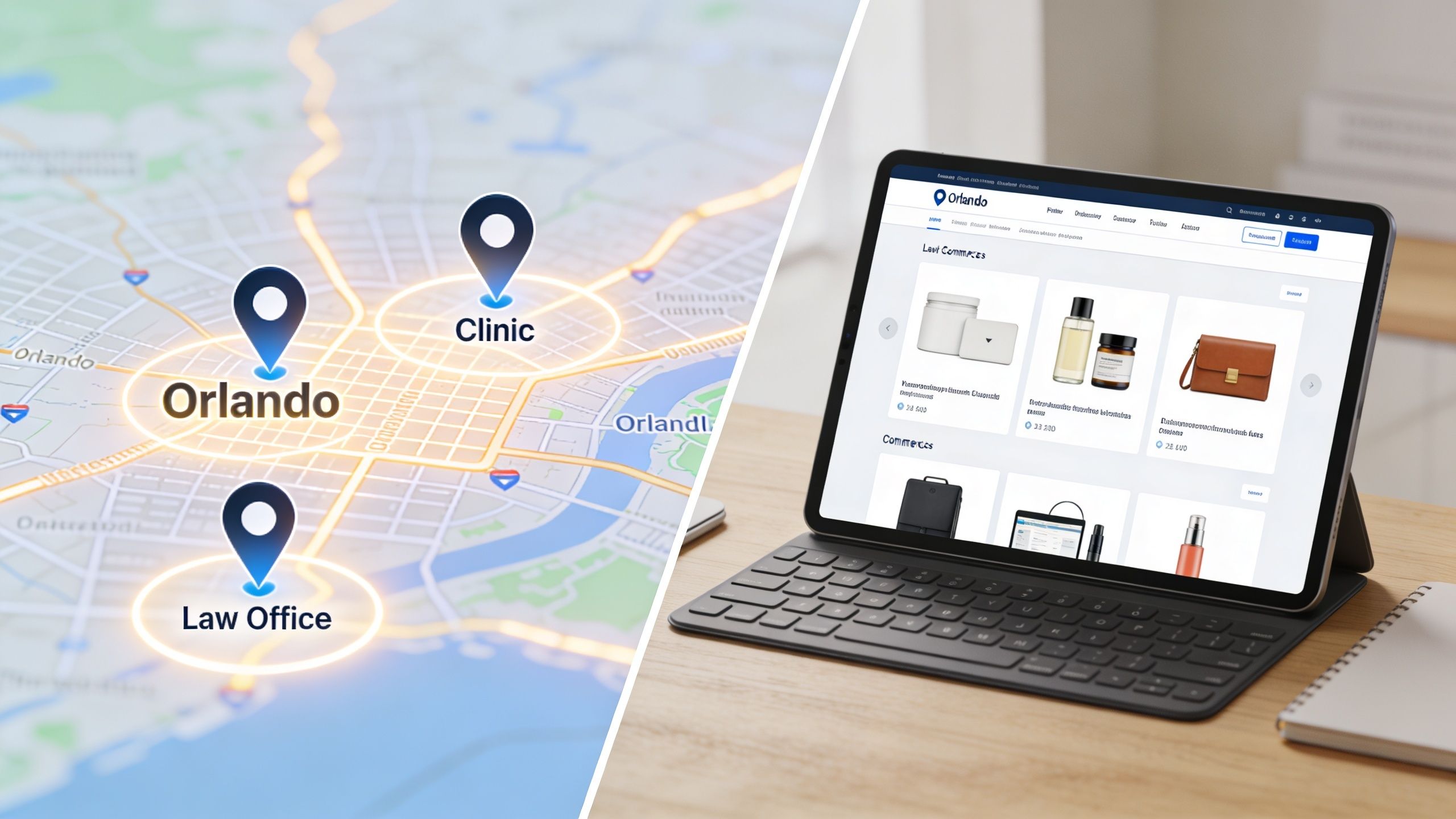
Organic traffic strategy should align with your business's sales approach. A local roofing company in Lake Mary does not need the same SEO structure as an e-commerce retailer shipping nationwide. The fundamentals overlap, but the execution is different.
For local service businesses
Local SEO is where a lot of service companies either dominate or disappear.
A strong local setup usually includes a complete Google Business Profile, location-consistent contact details, strong service pages, review generation, and local relevance built into the site itself. For a Central Florida roofer, that means pages that reflect actual services and actual service areas, not generic copy pasted across a dozen city pages.
A focused service area strategy becomes even more important if you’re using local SEO services in Lake Mary or building your own local footprint in a competitive market.
Useful local actions include:
- Strengthen your Google Business Profile: Keep categories, service descriptions, photos, and service areas accurate.
- Build city-relevant pages carefully: Write unique pages for real markets you serve, not doorway pages stuffed with city names.
- Collect and respond to reviews: Reviews influence trust and often shape click behavior before a user even visits the site.
For regional expansion into new cities
Expanding from Florida into a market like Charlotte introduces a different problem. Businesses often break local SEO during expansion by creating inconsistent location data or rolling out generic location pages too fast.
According to Mick Mar’s write-up on increasing organic traffic, inconsistent Name, Address, and Phone data can drop local pack rankings by 40% to 60% for businesses expanding into new regions. The same source notes that Google’s 2025 Proximity Relevance Update rewards unique, city-specific service pages with traffic boosts of 25% to 35%, while only 15% of SMBs implement that approach.
That creates a clear trade-off. Scaling quickly with templates is easier. Scaling correctly with unique city-specific pages, clean NAP consistency, and localized internal linking is what usually performs.
Expansion SEO fails when every new city page says the same thing with a different place name.
This short video gives a useful overview of the local visibility side of that work:
For e-commerce retailers
E-commerce SEO lives or dies at the category and product-page level. Many stores focus too much on blogs and not enough on the pages that drive purchases.
If you run an online store, prioritize:
- Category pages with intent-focused copy: Help shoppers understand product types, use cases, and differences.
- Product pages that answer objections: Materials, sizing, compatibility, shipping expectations, and use details all matter.
- Internal linking between related items and collections: This helps shoppers continue browsing and helps search engines understand site structure.
- Structured product information: Clean page data supports better interpretation in search.
For retailers, organic traffic quality matters more than vanity traffic. Ranking for broad terms that don’t convert is less valuable than winning searches tied to product intent.
Use Data and AI to Accelerate Your Growth
Most SEO advice tells businesses to create more. Smarter SEO starts by asking where your site is already close to winning.
That’s where data changes the pace of growth. Instead of chasing every keyword from scratch, look for pages that already show traction and improve those first.

Find the quickest SEO wins first
One of the most useful reports in Google Search Console is the query list where you already rank between positions 8 and 20. Those terms often represent pages that need refinement, not reinvention.
According to InfluencerDB’s guidance on increasing organic website traffic, improving keywords already ranking in positions 8 to 20 can generate 50% to 200% traffic increases within 30 to 60 days. That’s why this range tends to produce the highest-impact quick wins.
A solid workflow looks like this:
- Pull queries in positions 8 to 20 from Search Console.
- Match each query to its landing page so you know what page Google already associates with the topic.
- Improve the page, not just the title by tightening headings, relevance, internal links, and missing sections.
- Compare the page against current winners to see what your page lacks.
This is often where businesses get frustrated. They publish a new page for every keyword variation instead of improving the page that’s already close. That creates more clutter and more overlap.
Use AI where it speeds up thinking, not where it replaces it
AI is useful in SEO when it removes repetitive work and helps teams move faster with better judgment. It’s not useful when it floods a site with generic content.
Strong uses of AI include:
- Content gap analysis: Reviewing competitor headings and topic coverage at scale
- Draft support: Turning strategist notes into first-pass outlines
- Internal linking suggestions: Identifying pages that should support each other
- Performance summaries: Automating weekly reporting for rankings, clicks, and page movement
What still needs human judgment is strategy. Someone has to decide which pages matter most, what the buyer needs, what local nuance belongs on a city page, and where brand positioning should be sharper.
One option for teams building this workflow is generative content engines, which can support structured content production and AI-assisted optimization when used with editorial control. Emulous Media Inc offers this as part of a broader marketing and web performance workflow.
AI should compress research and production time. It should not replace expertise, local knowledge, or conversion strategy.
Your 90-Day Organic Traffic Action Plan
A useful organic strategy is not a giant list. It’s a sequence. The right order prevents wasted effort and helps you see movement faster.
Month one clean up the foundation
Start with what already exists.
- Audit technical basics: Review speed, mobile usability, crawl issues, indexation, and page structure.
- Consolidate overlap: Merge pages targeting the same topic and redirect old URLs properly.
- Identify priority pages: Choose the service, category, and local pages that matter most to revenue.
If you skip this stage, new content often lands on a weak structure and performs below its potential.
Month two publish with purpose
Once the foundation is cleaner, build authority around the pages that matter.
- Create one pillar and supporting cluster pages: Focus on a real business topic your customers search for.
- Rewrite weak service and category copy: Add specificity, proof, and clearer search intent alignment.
- Strengthen internal links: Connect supporting pages to the main conversion pages.
This is also a good time to study how search is evolving beyond standard blue links. For businesses planning ahead, this overview of optimizing for AI search engines is a useful companion to a traditional organic strategy.
Month three refine what is already moving
At this stage, data starts guiding effort more precisely.
- Pull keywords ranking in positions 8 to 20: Update those pages first.
- Review click-through opportunities: Improve titles and page relevance where impressions are present but clicks lag.
- Pursue authority signals: Earn links through partnerships, local relevance, and content promotion.
A lot of business owners can execute parts of this plan internally. The hard part is doing all of it consistently, in the right order, without letting technical debt and content sprawl creep back in. That’s where an experienced team usually saves time and avoids expensive detours.
If you want a custom plan to increase website traffic organically, Emulous Media Inc can help you audit what’s holding your site back, prioritize the quickest wins, and build a strategy that fits your market. To talk through your goals, book a free consultation, call 689-255-6327, or visit the contact page on the website.